 OnlineCalculator
Understanding Your Conception Probability
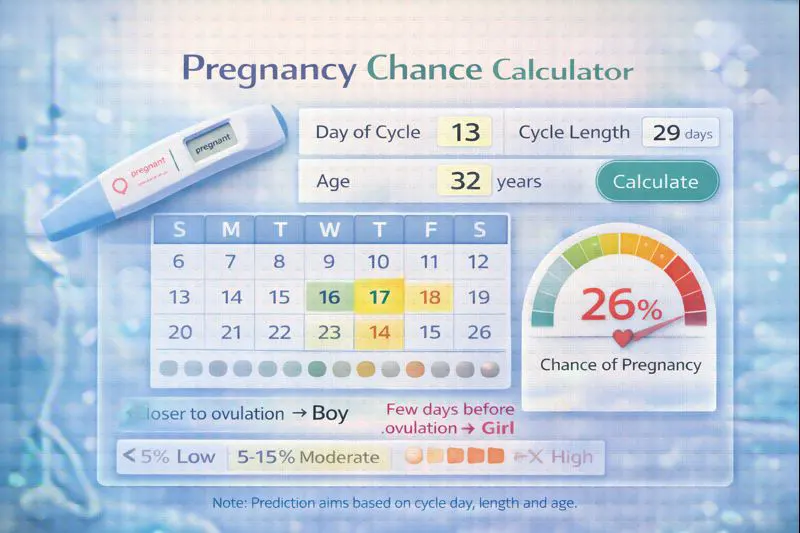
The Pregnancy Chance Calculator provides personalized estimates of your likelihood of conceiving based on scientifically-validated fertility data. Whether you're actively trying to conceive or simply want to understand your fertile window better, this tool offers valuable insights into your reproductive health.
This calculator is trusted by couples worldwide and used by our community at Online Calculator UAE as part of our comprehensive Health & Fitness calculator suite.
Key Benefits:
- Personalized Results: Calculations based on your unique cycle length, timing, and age
- Scientific Accuracy: Uses established fertility research and conception probability data
- Timing Optimization: Identifies your highest probability days for conception
- Age-Adjusted Estimates: Accounts for natural fertility decline with age
- Easy Planning: Helps couples plan intercourse timing for maximum success
html
How the Pregnancy Chance Calculator Works
This calculator uses a multi-factor analysis combining cycle timing, age-related fertility rates, and intercourse timing to estimate conception probability. The methodology is based on extensive fertility research published in leading reproductive medicine journals.
Calculation Methodology:
The calculator evaluates several critical factors:
1. Cycle Day Position: Your pregnancy chances vary dramatically throughout your cycle. The fertile window typically spans 6 days ending on ovulation day. The calculator identifies where you are in this window based on your cycle length and current cycle day.
2. Ovulation Timing: For a standard 28-day cycle, ovulation occurs around day 14. For longer or shorter cycles, we adjust using the formula: Ovulation Day = Cycle Length - 14. The 5 days before ovulation plus ovulation day itself represent your fertile window.
3. Age Factor: Female fertility naturally declines with age. The calculator applies age-adjusted multipliers:
- Under 25 years: 100% baseline fertility
- 25-29 years: 95% baseline fertility
- 30-34 years: 85% baseline fertility
- 35-39 years: 50% baseline fertility
- 40+ years: 30% baseline fertility
4. Daily Conception Rates: Research shows conception probability peaks at specific days relative to ovulation:
- Ovulation day (O): 30-33% chance per cycle
- One day before (O-1): 27-33% chance per cycle
- Two days before (O-2): 24-27% chance per cycle
- Three days before (O-3): 15-20% chance per cycle
- Four days before (O-4): 10-12% chance per cycle
- Five days before (O-5): 5-8% chance per cycle
Important Notes: These percentages represent probabilities for healthy couples with no known fertility issues. Individual results may vary based on factors like sperm quality, underlying health conditions, lifestyle factors, and timing of intercourse. This calculator provides estimates only and should not replace medical advice from fertility specialists.
Practical Pregnancy Chance Examples
These real-world scenarios demonstrate how different factors affect conception probability:
Example 1: Peak Fertility Timing
Scenario: Sarah is 28 years old with a regular 28-day cycle. She's on day 13 of her cycle and planning intercourse timing with her partner.
Calculation Process:
- Cycle length: 28 days
- Estimated ovulation: Day 14 (28 - 14 = 14)
- Current cycle day: 13 (one day before ovulation, O-1)
- Age: 28 years (95% fertility factor)
- Base probability for O-1: 30%
Final Result: 30% × 0.95 = 28.5% chance of conception if intercourse occurs on this day. This is one of the highest probability windows in her cycle. Similar to using an ovulation tracking tool, optimal timing is crucial for maximizing conception chances.
Example 2: Extended Cycle Timing
Scenario: Maya is 32 years old with a longer 35-day cycle. She wants to know her chances on day 18 of her cycle.
Calculation Process:
- Cycle length: 35 days
- Estimated ovulation: Day 21 (35 - 14 = 21)
- Current cycle day: 18 (three days before ovulation, O-3)
- Age: 32 years (85% fertility factor)
- Base probability for O-3: 17%
Final Result: 17% × 0.85 = 14.5% chance of conception. While not peak timing, this still falls within the fertile window. Couples using a fertile window tracker would identify this as a moderate-probability day worth considering.
Example 3: Age-Related Fertility Adjustment
Scenario: Lisa is 38 years old with a 30-day cycle, currently on day 16 (her ovulation day).
Calculation Process:
- Cycle length: 30 days
- Estimated ovulation: Day 16 (30 - 14 = 16)
- Current cycle day: 16 (ovulation day, O)
- Age: 38 years (50% fertility factor)
- Base probability for O: 31%
Final Result: 31% × 0.50 = 15.5% chance of conception. Despite perfect timing at ovulation, age-related factors reduce the probability. This highlights why women over 35 may benefit from consulting fertility specialists earlier. Tools like a conception date estimator can help track optimal timing across multiple cycles.
Understanding Your Results
The pregnancy chance percentage represents the probability of conception per cycle when intercourse occurs on that specific day. A 25% chance means that out of 100 couples having intercourse on that day, approximately 25 would conceive that cycle.
Cumulative Probability: Over multiple cycles, your chances accumulate. Couples with regular intercourse during the fertile window typically have about 85-90% chance of conception within one year if both partners are healthy and under 35.
Factors That Can Affect Accuracy
Several factors may influence your actual conception probability:
- Irregular Cycles: Women with PCOS or irregular periods may ovulate unpredictably
- Male Fertility: Sperm count, motility, and morphology significantly impact success rates
- Lifestyle Factors: Smoking, excessive alcohol, obesity, and stress can reduce fertility
- Medical Conditions: Endometriosis, thyroid disorders, or autoimmune conditions may decrease chances
- Previous Contraception: Some methods may temporarily affect return to fertility
Common Mistakes to Avoid
Miscalculating Cycle Length: Always count from the first day of your period (day 1) to the day before your next period starts. Using a cycle length tracker can help establish patterns.
Limiting Intercourse: Some couples only have intercourse on predicted ovulation day. For best results, aim for every 1-2 days during the entire fertile window (5 days before ovulation through ovulation day).
Ignoring Other Signs: Combine calculator predictions with physical signs like cervical mucus changes (clear, stretchy "egg white" consistency during fertile days) and basal body temperature tracking for improved accuracy.
Expert Tips for Maximizing Conception
- Track your cycles for at least 3 months to identify patterns before relying on predictions
- Maintain a healthy body mass index between 18.5-24.9 for optimal fertility
- Take prenatal vitamins with folic acid at least 3 months before trying to conceive
- Reduce caffeine intake to less than 200mg daily (about 2 cups of coffee)
- If over 35 or trying for 6+ months without success, consult a fertility specialist
Start Calculating Your Pregnancy Chances Today
Use our free pregnancy chance calculator to understand your fertility window and optimize your conception timing. Whether you're just starting your family planning journey or have been trying for a while, this tool provides valuable insights based on your unique situation.
Remember that while this calculator offers scientifically-based estimates, every couple's fertility journey is unique. If you have concerns about your fertility or have been trying without success, consult with a healthcare provider or fertility specialist for personalized guidance.
This calculator is provided for informational purposes only and does not constitute medical advice. For official health guidance, consult healthcare professionals or visit reputable medical resources.