 OnlineCalculator
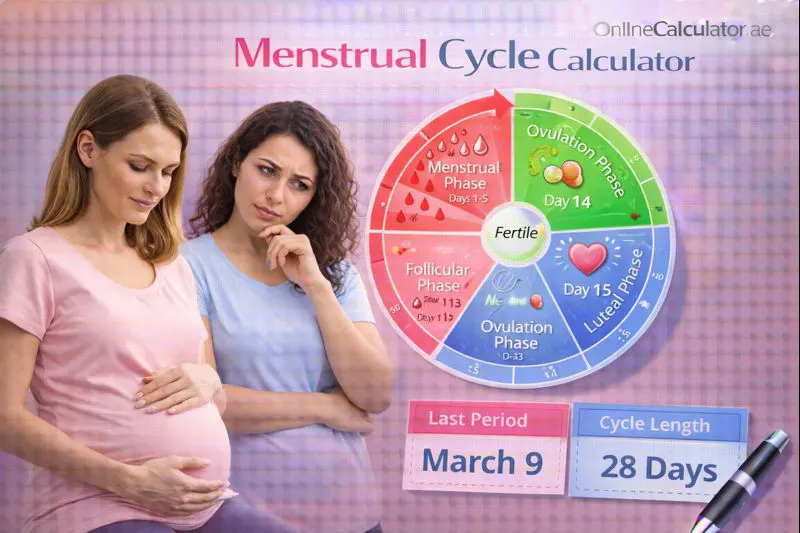
Understanding Your Menstrual Cycle with Our Calculator
Your menstrual cycle is a vital health indicator that deserves attention. Our menstrual cycle calculator uses your last period date and average cycle length to provide accurate predictions for your reproductive health journey.
Key Benefits:
- Accurate Period Predictions: Know exactly when to expect your next menstruation
- Fertile Window Tracking: Identify your most fertile days for conception planning
- Ovulation Day Calculation: Pinpoint when you're likely to ovulate each month
- Health Monitoring: Track irregularities and share data with your healthcare provider
Women in the UAE have unique healthcare needs, and understanding your cycle helps you make informed decisions about your reproductive health. This calculator is designed specifically for the Health & Fitness calculator category, providing reliable results you can trust.
html
How the Menstrual Cycle Calculator Works
Our calculator uses a scientifically-based methodology to predict your menstrual cycle phases. The calculation considers two primary inputs: your last menstrual period (LMP) start date and your average cycle length.
Calculation Methodology
The menstrual cycle calculator follows these proven formulas:
Next Period Date: LMP Start Date + Average Cycle Length
Ovulation Day: Next Period Date - 14 days
Fertile Window: Ovulation Day - 5 days to Ovulation Day + 1 day
Step-by-Step Breakdown
Step 1: Enter the first day of your last menstrual period. This is the day bleeding began, not when it ended.
Step 2: Input your average cycle length (typically 21-35 days, with 28 days being average). Count from the first day of one period to the first day of the next.
Step 3: The calculator automatically computes your next period date, ovulation day, and fertile window using the formulas above.
Step 4: Review your personalized cycle calendar showing predicted dates for the next several months.
Important Notes
The calculator assumes a regular cycle pattern. If your cycles vary significantly, track for 3-6 months to determine your average. Women with irregular periods, PCOS, or hormonal imbalances should consult healthcare providers at facilities like Burjeel Hospital Dubai or Mediclinic City Hospital for personalized guidance.
Example 1: Regular 28-Day Cycle
Scenario: Sara, a 29-year-old marketing professional working in Dubai Marina, has a consistent 28-day cycle and wants to predict her next period before her upcoming business trip.
Input Values:
- Last Period Start Date: January 5, 2026
- Average Cycle Length: 28 days
Calculation:
Next Period Date = January 5 + 28 days = February 2, 2026
Ovulation Day = February 2 - 14 days = January 19, 2026
Fertile Window = January 14 to January 20, 2026
Result: Sara can plan her travel knowing her period will likely start on February 2. She's also aware that her fertile window falls mid-January, useful for family planning decisions.
Example 2: Longer 32-Day Cycle
Scenario: Fatima, a 34-year-old teacher in Abu Dhabi, has a naturally longer cycle of 32 days and is using the calculator alongside her fertility tracking efforts.
Input Values:
- Last Period Start Date: December 20, 2025
- Average Cycle Length: 32 days
Calculation:
Next Period Date = December 20 + 32 days = January 21, 2026
Ovulation Day = January 21 - 14 days = January 7, 2026
Fertile Window = January 2 to January 8, 2026
Result: Fatima knows her fertile window is early in the month. She can share this information with her gynecologist at Cleveland Clinic Abu Dhabi for family planning consultations.
Example 3: Shorter 25-Day Cycle
Scenario: Layla, a 26-year-old nurse working at Mediclinic Parkview Hospital in Dubai, has a shorter 25-day cycle and wants to understand when to expect her next period while managing her shift schedule.
Input Values:
- Last Period Start Date: January 10, 2026
- Average Cycle Length: 25 days
Calculation:
Next Period Date = January 10 + 25 days = February 4, 2026
Ovulation Day = February 4 - 14 days = January 21, 2026
Fertile Window = January 16 to January 22, 2026
Result: Layla can prepare for her period arriving on February 4 and knows her fertile days occur in the third week of January. This helps her plan both professionally and personally.
Understanding Cycle Variations
While the average menstrual cycle is 28 days, normal cycles range from 21 to 35 days. Your cycle length is unique to you, and slight variations month-to-month are completely normal. Factors like stress, travel, exercise intensity, and dietary changes can affect timing.
When to Seek Medical Advice
Consult a healthcare provider in the UAE if you experience:
- Cycles shorter than 21 days or longer than 35 days consistently
- Missing periods for three months or more (not pregnant)
- Extremely heavy bleeding requiring pad/tampon changes every hour
- Severe pain that interferes with daily activities
- Bleeding between periods or after intercourse
The UAE has excellent gynecological facilities including Aster Hospital, Burjeel Medical City, and American Hospital Dubai where specialists can address concerns.
Common Mistakes to Avoid
Mistake 1: Counting cycle length from the last day of bleeding instead of the first day. Always count from day one of menstruation.
Mistake 2: Assuming all cycles are exactly the same length. Track for several months to find your true average.
Mistake 3: Relying solely on calculators for contraception. This tool is for tracking and planning, not birth control. Use proper contraceptive methods.
Expert Tips for Accurate Tracking
Keep a detailed log for at least three months noting cycle length, flow intensity, and symptoms. This data helps identify patterns and provides valuable information for your doctor. Combine this calculator with other pregnancy planning tools for comprehensive reproductive health monitoring.
Start Tracking Your Menstrual Cycle Today
Take control of your reproductive health with our free menstrual cycle calculator. Whether you're planning a family, monitoring your health, or simply staying organized, accurate cycle tracking empowers you with knowledge about your body. Use the calculator above to get instant predictions for your next period, fertile window, and ovulation day.
For personalized medical advice about menstrual health, consult qualified gynecologists at UAE healthcare facilities. The Ministry of Health and Prevention (MOHAP) regulates healthcare standards across the UAE, ensuring you receive quality care. Remember, this calculator is a helpful tool, but professional medical guidance is irreplaceable for specific health concerns.