 OnlineCalculator
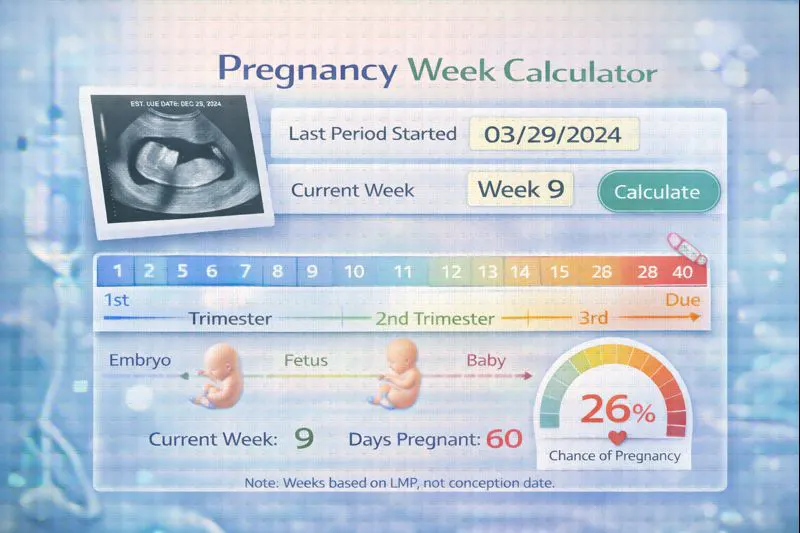
Our Pregnancy Week Calculator helps expecting mothers determine their exact gestational age and current pregnancy week. Whether you're planning your prenatal appointments or tracking your baby's development, this easy-to-use tool provides instant, accurate results based on your last menstrual period or conception date. Perfect for mothers worldwide who want to stay informed throughout their pregnancy journey.
Understanding Your Pregnancy Week
Knowing exactly which week of pregnancy you're in is essential for monitoring your baby's development and scheduling important prenatal care. Our Health & Fitness calculator tool instantly calculates your current gestational age using medically-approved methods.
Key Benefits:
- Instant Results: Get your exact pregnancy week in seconds
- Trimester Breakdown: Know which trimester you're in and what to expect
- Development Tracking: Understand your baby's growth milestones week by week
- Appointment Planning: Schedule prenatal visits at the right time
- Medically Accurate: Based on standard obstetric calculation methods used by healthcare providers
This calculator is trusted by expecting mothers globally, providing the same calculation method used by obstetricians and midwives. Simply enter your information to receive comprehensive pregnancy timeline details.
How the Pregnancy Week Calculator Works
Medical professionals calculate pregnancy duration from the first day of your last menstrual period (LMP), not from conception. This standard method provides the most accurate gestational age measurement and is used universally in prenatal care.
Calculation Methodology
The calculator uses the following formula:
Weeks Pregnant = (Current Date - First Day of LMP) ÷ 7
A full-term pregnancy typically lasts 40 weeks (280 days) from the first day of your last period. This equals approximately 9 months and 1 week, or about 38 weeks from conception.
Step-by-Step Calculation Process
- Enter Your LMP Date: Input the first day of your last menstrual period
- Calculate Days Elapsed: The system counts days from your LMP to today
- Convert to Weeks: Total days are divided by 7 to determine complete weeks
- Determine Trimester: Weeks 1-13 (First), Weeks 14-26 (Second), Weeks 27-40 (Third)
- Calculate Due Date: Automatically adds 280 days to your LMP for estimated delivery date
Important Notes:
- Pregnancy weeks are counted from LMP, not conception date
- Your expected delivery date is an estimate; only 5% of babies arrive exactly on their due date
- Early ultrasounds may adjust your due date based on fetal measurements
- Irregular menstrual cycles may require ultrasound dating for accuracy
Example 1: First Trimester Pregnancy
Scenario: Fatima from Dubai discovers she's pregnant and wants to know her exact week.
- Last Menstrual Period: November 1, 2025
- Today's Date: January 16, 2026
- Days Since LMP: 76 days
- Calculation: 76 days ÷ 7 = 10.9 weeks
- Result: 10 weeks and 6 days pregnant
- Trimester:
- Due Date: August 8, 2026
What This Means: Fatima is in her first trimester and approaching the end of week 10. She should schedule her first prenatal ultrasound soon, typically performed between 11-14 weeks. At this stage, her baby is about the size of a strawberry, and major organs are developing.
Example 2: Second Trimester Pregnancy
Scenario: Sarah, an expat in Abu Dhabi, wants to track her pregnancy progress.
- Last Menstrual Period: September 15, 2025
- Today's Date: January 16, 2026
- Days Since LMP: 123 days
- Calculation: 123 days ÷ 7 = 17.6 weeks
- Result: 17 weeks and 4 days pregnant
- Trimester: Second Trimester
- Due Date: June 22, 2026
What This Means: Sarah is comfortably in her second trimester, often called the "honeymoon period" of pregnancy. She may start feeling baby movements soon (quickening typically occurs between 16-22 weeks). Her anatomy scan ultrasound is likely scheduled around week 20 to check baby's development.
Example 3: Third Trimester - Final Weeks
Scenario: Amira is preparing for delivery and needs to track remaining weeks.
- Last Menstrual Period: June 20, 2025
- Today's Date: January 16, 2026
- Days Since LMP: 210 days
- Calculation: 210 days ÷ 7 = 30 weeks
- Result: Exactly 30 weeks pregnant
- Trimester: Third Trimester
- Due Date: March 28, 2026
- Weeks Remaining: 10 weeks until due date
What This Means: Amira has entered the final stretch of pregnancy. She should be attending prenatal appointments every two weeks now, and her baby is gaining significant weight. This is the time to finalize birth plans, prepare the nursery, and monitor for any signs of preterm labor. Understanding your gestational age becomes crucial during this period for delivery planning.
Medical Dating vs. Calculator Results
While our calculator provides accurate estimates based on your LMP, your healthcare provider may adjust your dates based on early ultrasound measurements. First-trimester ultrasounds (performed between 8-13 weeks) are considered the most accurate method for pregnancy dating, with precision within 3-5 days.
When Ultrasound Dating Takes Priority
Your doctor may rely on ultrasound dating rather than LMP calculations if:
- Your menstrual cycles are irregular or longer than 35 days
- You conceived while breastfeeding or recently stopped birth control
- You don't remember your exact LMP date
- There's a discrepancy of more than 5-7 days between LMP and ultrasound dating
- You have conditions like PCOS that affect ovulation timing
Common Mistakes to Avoid
- Don't count from conception date: Standard pregnancy dating uses LMP, not the day you conceived
- Don't use spotting or implantation bleeding: Only count from your last true menstrual period
- Don't assume 9 months equals 36 weeks: Pregnancy is actually 40 weeks (about 9 months + 1 week)
- Don't ignore medical adjustments: If your doctor changes your due date based on ultrasound, use the new date
Expert Tips for Accurate Tracking
Record Your LMP: Keep track of your menstrual cycle dates, especially if you're trying to conceive. This makes early pregnancy dating much more accurate.
Early Ultrasound Confirmation: Schedule a dating ultrasound between 8-13 weeks for the most precise gestational age determination, particularly if your cycles are irregular.
Use Multiple Tools: Combine this calculator with your estimated delivery date calculator and trimester calculator for comprehensive pregnancy tracking.
Regular Monitoring: Your pregnancy week directly impacts when specific tests and screenings should be performed, so accurate dating ensures optimal prenatal care timing.
Start Tracking Your Pregnancy Journey Today
Use our Pregnancy Week Calculator now to determine your exact gestational age and stay informed throughout your pregnancy. Whether you're in your first trimester experiencing morning sickness or in your third trimester preparing for delivery, knowing your exact week helps you understand your baby's development and prepare for upcoming milestones.
For comprehensive prenatal care guidance and to learn more about healthy pregnancy nutrition, explore our protein intake calculator and other Online Calculator UAE tools designed to support your health journey.
Remember: While this calculator provides medically-accurate estimates, always consult with your healthcare provider for personalized prenatal care. Regular checkups, proper nutrition including understanding your daily caloric needs, and monitoring your health are essential for a healthy pregnancy.