 OnlineCalculator
What Is a Conception Calculator?
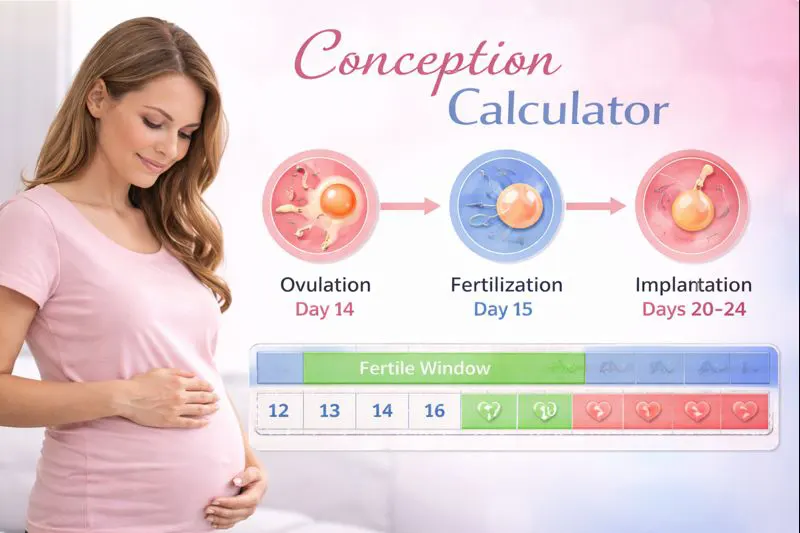
A conception calculator is a medical tool that estimates when fertilization occurred by working backward from either your expected due date or the first day of your last menstrual period (LMP). This calculation is particularly useful for expectant mothers who want to understand their pregnancy timeline better or need to identify the conception window for personal reasons.
Online Calculator UAE provides a comprehensive Health & Fitness calculator suite, and this conception tool stands out for its accuracy and ease of use.
Key Benefits:
- Accurate Timeline: Pinpoint the most likely conception date within a few days
- Multiple Methods: Calculate using due date, LMP, or ultrasound dating
- Instant Results: Get immediate answers without complicated formulas
- Privacy Assured: All calculations happen in your browser - no data stored
This calculator is trusted by expectant mothers across the UAE and internationally, providing medically-sound estimates based on standard obstetric practices used by healthcare providers worldwide.
html
How Does the Conception Calculator Work?
Understanding how conception dating works helps you interpret the results more accurately. The calculation is based on established medical principles used by obstetricians and gynecologists globally.
The Basic Formula
Human pregnancy typically lasts 280 days (40 weeks) from the first day of the last menstrual period. However, conception usually occurs around day 14 of a 28-day cycle, which is approximately 2 weeks after the LMP.
The calculator uses this method:
- From Due Date: Subtract 266 days (38 weeks) to find conception date
- From LMP: Add 14 days to the first day of your last period
- From Ultrasound: Subtract the gestational age from today's date, then add 14 days
Step-by-Step Breakdown
Step 1: Select your input method - whether you know your due date, LMP date, or ultrasound dating.
Step 2: Enter the relevant date in the calculator. For LMP, use the first day of your last menstrual period, not the last day.
Step 3: If using the LMP method, enter your average cycle length if it differs from the standard 28 days. Cycles can range from 21 to 35 days.
Step 4: Click calculate to receive your estimated conception date along with a probable conception window (typically 5-7 days).
Important Notes
The conception calculator provides an , not an exact date. Sperm can survive in the female reproductive tract for up to 5 days, and ovulation timing can vary. The results show a conception window rather than a single day to account for this biological variability. Similar to how our ovulation tracking tools work, precision improves with regular cycle tracking.
Practical Examples: Real-Life Scenarios
These examples demonstrate how the conception calculator works in different situations, helping you understand how to interpret your own results.
Example 1: Standard Due Date Calculation
Scenario: Sarah, a 32-year-old marketing manager in Dubai Marina, visits her OB-GYN who determines her due date is October 15, 2026 based on her first ultrasound.
Calculation Process:
- Due Date: October 15, 2026
- Subtract 266 days (38 weeks): January 22, 2026
- Conception Window: January 19-25, 2026
Result: Sarah most likely conceived around January 22, 2026, with a probable window from January 19th to 25th. This information helps her understand her pregnancy timeline and prepare accordingly.
Example 2: Using Last Menstrual Period
Scenario: Fatima in Abu Dhabi has a regular 28-day cycle. Her last menstrual period started on December 1, 2025, and she wants to know when conception occurred.
Calculation Process:
- LMP: December 1, 2025
- Add 14 days (typical ovulation): December 15, 2025
- Conception Window: December 12-18, 2025
Result: Based on standard ovulation timing, Fatima likely conceived around December 15, 2025. Her due date would be approximately September 7, 2026 (280 days from LMP). This aligns with calculations from our pregnancy timeline calculator.
Example 3: Irregular Cycle Adjustment
Scenario: Maria, working at a tech company in Sharjah, has a longer cycle averaging . Her LMP was November 10, 2025.
Calculation Process:
- LMP: November 10, 2025
- Cycle Length: 32 days (ovulation typically occurs around day 18)
- Add 18 days: November 28, 2025
- Conception Window: November 25 - December 1, 2025
Result: With a 32-day cycle, Maria's ovulation—and therefore conception—likely occurred around November 28, 2025, which is 4 days later than it would be in a standard 28-day cycle. Her adjusted due date would be approximately August 21, 2026. Understanding your cycle patterns improves calculation accuracy.
Understanding Conception Windows
Conception doesn't happen the moment intercourse occurs. Sperm can survive in the female reproductive system for , while an egg remains viable for 12-24 hours after ovulation. This creates a "fertile window" of approximately 6 days during each cycle.
The conception calculator accounts for this by providing a date range rather than a single day. The most likely conception date falls in the middle of this window, corresponding to the estimated ovulation date.
Factors Affecting Accuracy
Several factors can impact the accuracy of conception calculations:
- Cycle Irregularity: Women with irregular cycles may ovulate earlier or later than day 14
- Early Pregnancy Dating: First-trimester ultrasounds (before 13 weeks) are more accurate than later scans
- Multiple Gestations: Twin or multiple pregnancies may show different growth patterns
- Assisted Reproduction: IVF or IUI procedures have precise conception dates that differ from natural conception
When to Use Medical Dating
While this calculator provides reliable estimates, medical professionals in UAE hospitals and clinics use ultrasound measurements for the most accurate pregnancy dating, especially in the first trimester. If you're receiving prenatal care at facilities like Saudi German Hospital, Mediclinic, or Burjeel Hospital, your healthcare provider will confirm dates through clinical examination.
Common Mistakes to Avoid
Mistake 1: Using the last day of your period instead of the first day when calculating from LMP.
Mistake 2: Assuming all cycles are 28 days - track your actual cycle length for better accuracy.
Mistake 3: Confusing gestational age (from LMP) with fetal age (from conception). These differ by approximately 2 weeks.
Mistake 4: Relying solely on conception date calculations when irregular periods or medical conditions are present - always consult healthcare providers.
Expert Tips
For the most accurate results, track your menstrual cycles for at least 3 months before conception. This helps identify your average cycle length and ovulation patterns. Tools like our period tracking calculator can assist with this monitoring process.
Ready to Find Your Conception Date?
Use our free conception calculator above to estimate when conception occurred. Simply enter your due date or last menstrual period, and get instant results. Whether you're planning your pregnancy journey, preparing for prenatal appointments, or satisfying your curiosity, this tool provides medically-sound estimates you can trust.
For comprehensive prenatal care in the UAE, consult with licensed healthcare providers at facilities regulated by the Ministry of Health and Prevention (MOHAP)Dubai Health Authority (DHA). They can provide ultrasound dating and personalized pregnancy care.
All calculations are performed in your browser with complete privacy - we don't store or share any of your personal information.