 OnlineCalculator
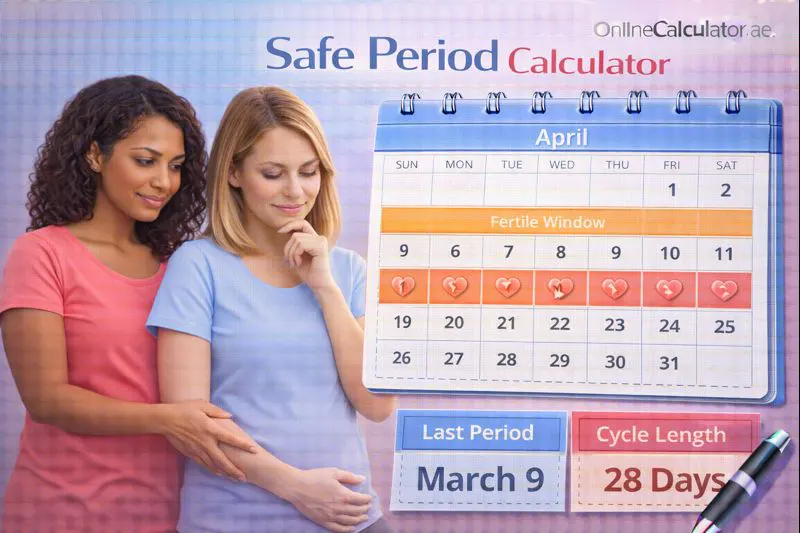
Understanding Your Safe Period
The safe period calculator is a fertility awareness tool designed to help women track their menstrual cycle and identify days when pregnancy is less likely to occur. Based on your cycle length and last menstrual period, this calculator estimates your fertile window and safe days.
This calculator is particularly useful for women across the UAE, from Dubai to Abu Dhabi, who want to:
- Practice natural family planning without hormonal contraceptives
- Understand their fertility patterns and menstrual cycle better
- Plan or avoid pregnancy using the rhythm method
- Track ovulation timing for conception purposes
- Monitor cycle regularity and identify potential health concerns
Our calculator uses the standard calendar method combined with ovulation prediction to give you comprehensive fertility insights. Simply enter your cycle details, and receive an instant breakdown of your safe and fertile days for the upcoming months.
html
This calculator provides estimates based on average cycle patterns. It should not be used as the sole method of contraception. Cycle variations, stress, illness, and other factors can affect ovulation timing. For reliable family planning, consult with a healthcare professional. The safe period method has a typical failure rate of 12-24% annually.How the Safe Period Calculator Works
The safe period calculator uses the calendar-based method, also known as the rhythm method, to estimate your fertile and non-fertile days. This method is based on the biological fact that ovulation typically occurs approximately 14 days before the start of your next period.
The Calculation Method
Our calculator follows a scientifically-backed approach to determine your safe and fertile periods:
Step 1: Identify Your Cycle Length
Your menstrual cycle length is counted from the first day of your period to the day before your next period starts. Most women have cycles ranging from 21 to 35 days, with 28 days being average.
Step 2: Calculate Ovulation Day
Ovulation typically occurs 14 days before your next period. For a 28-day cycle, this means ovulation happens around day 14. The formula is: Cycle Length - 14 = Estimated Ovulation Day
Step 3: Determine the Fertile Window
Sperm can survive in the female reproductive system for up to 5 days, and an egg remains viable for about 24 hours after ovulation. Therefore, your fertile window spans approximately : the 5 days before ovulation plus ovulation day itself.
Step 4: Identify Safe Days
Safe days are those outside your fertile window. These include the days immediately after your period starts and the days after your fertile window closes until your next period begins.
Important Notes
The safe period method is most accurate for women with regular menstrual cycles. If your cycles vary by more than 7-9 days, this method becomes less reliable. Additionally, factors like stress, illness, travel, and lifestyle changes can affect ovulation timing, making predictions less accurate.
Example 1: Regular 28-Day Cycle
Scenario: Fatima from Dubai Marina has a consistent 28-day menstrual cycle. Her last period started on January 1st, 2026.
Calculation:
- Cycle length: 28 days
- Last period start date: January 1, 2026
- Ovulation day: Day 14 (28 - 14 = 14)
- Estimated ovulation date: January 14, 2026
- Fertile window: January 9-14, 2026 (5 days before + ovulation day)
- Safe period (early): January 1-8, 2026
- Safe period (late): January 15-28, 2026
- Next period expected: January 29, 2026
Result: Fatima has 22 safe days and 6 fertile days in this cycle. For family planning purposes, she should avoid unprotected intercourse from January 9-14 if preventing pregnancy.
Example 2: Longer 32-Day Cycle
Scenario: Mariam from Abu Dhabi has a 32-day cycle. Her last period began on January 5th, 2026.
Calculation:
- Cycle length: 32 days
- Last period start date: January 5, 2026
- Ovulation day: Day 18 (32 - 14 = 18)
- Estimated ovulation date: January 22, 2026
- Fertile window: January 17-22, 2026
- Safe period (early): January 5-16, 2026
- Safe period (late): January 23 - February 5, 2026
- Next period expected: February 6, 2026
Result: With a longer cycle, Mariam's ovulation occurs later, giving her 12 safe days before and 14 safe days after her fertile window, totaling 26 safe days in her cycle.
Example 3: Shorter 25-Day Cycle
Scenario: Sara from Sharjah experiences shorter cycles of 25 days. Her period started on January 10th, 2026.
Calculation:
- Cycle length: 25 days
- Last period start date: January 10, 2026
- Ovulation day: Day 11 (25 - 14 = 11)
- Estimated ovulation date: January 20, 2026
- Fertile window: January 15-20, 2026
- Safe period (early): January 10-14, 2026
- Safe period (late): January 21 - February 3, 2026
- Next period expected: February 4, 2026
Result: Sara's shorter cycle means earlier ovulation, giving her only 5 safe days immediately after her period starts. She has 19 safe days total and needs to be more cautious during the middle of her cycle.
Reliability and Effectiveness
The safe period method has a typical use failure rate of approximately 12-24% annually. This means that out of 100 women using this method for one year, 12 to 24 may become pregnant. Perfect use (consistently accurate tracking and adherence) can improve effectiveness to about 95%, but this requires meticulous record-keeping and cycle regularity.
Who Should Use This Method
The safe period calculator works best for women who have:
- Regular menstrual cycles (varying by no more than 2-3 days each month)
- Cycles between 26-32 days in length
- No recent hormonal contraceptive use (wait 3-6 months after stopping)
- No underlying health conditions affecting menstruation
- The discipline to track cycles accurately for at least 6-12 months
Common Mistakes to Avoid
Relying on a single month's data: Track your cycles for at least 3-6 months to understand your pattern before relying on predictions.
Ignoring cycle irregularity: If your cycles vary significantly, the calendar method alone is not reliable. Consider combining it with other fertility awareness methods.
Forgetting about sperm survival: Sperm can live up to 5 days inside the female body, which is why the fertile window extends before ovulation.
Not accounting for external factors: Stress, illness, travel across time zones, and significant weight changes can all affect your cycle timing.
Expert Tips for Better Accuracy
Combine the calendar method with other fertility signs like basal body temperature tracking and cervical mucus observation. Many women in the UAE find that using our ovulation tracking tools alongside the safe period calculator provides better confidence in their predictions.
Track your cycles using a dedicated app or journal. Note any symptoms, stress levels, or lifestyle changes that might affect your cycle. The more data you have, the more accurate your predictions become.
Start Tracking Your Cycle Today
Understanding your menstrual cycle is empowering. Whether you're practicing natural family planning or trying to conceive, our safe period calculator provides the insights you need to make informed decisions about your reproductive health.
For the most accurate results, track your cycles for at least three months and consider keeping a detailed fertility journal. If you have concerns about cycle irregularity or fertility, consult with healthcare professionals at reputable medical facilities across the UAE.
Remember, while this calculator provides helpful estimates, it should not replace professional medical advice. For personalized guidance on family planning and reproductive health, schedule a consultation with your gynecologist.