 OnlineCalculator
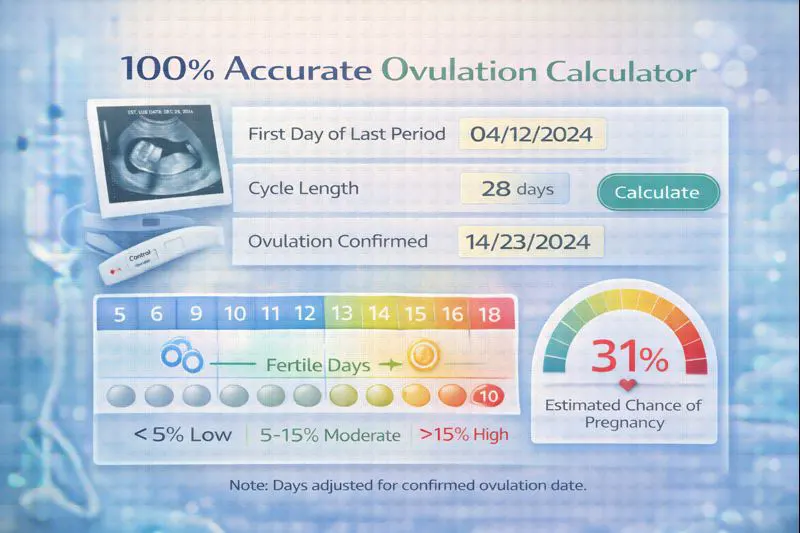
What Is an Ovulation Calculator?
An ovulation calculator is a fertility planning tool that predicts your ovulation date and fertile window based on your menstrual cycle. Understanding when you ovulate is crucial for conception, as the egg is only viable for 12-24 hours after release.
This calculator from Online Calculator UAE is designed specifically for women trying to conceive, helping them identify the best days for intercourse to maximize pregnancy chances.
Key Benefits:
- Accurate predictions based on your unique cycle length
- Identifies your 6-day fertile window when conception is most likely
- Completely free with instant results
- Easy to use - just enter your last period date and cycle length
- Helps plan or prevent pregnancy naturally
Thousands of women across the UAE use our Health & Fitness calculator tools to better understand their bodies and improve their chances of conception.
html
How Does the Ovulation Calculator Work?
Our ovulation calculator uses the standard menstrual cycle calculation method, which is based on the fact that ovulation typically occurs 14 days before your next period starts. Here's the science behind it:
The Calculation Method:
The menstrual cycle has two main phases:
- Follicular Phase: From day 1 of your period until ovulation (variable length)
- Luteal Phase: From ovulation until your next period (typically 14 days)
The calculator uses this formula: Ovulation Day = Cycle Length - 14 days
Step-by-Step Breakdown:
- Enter your last menstrual period (LMP) date - This is the first day of your last period
- Input your average cycle length - Count from day 1 of one period to day 1 of the next (typically 28 days)
- Calculate: The tool determines your ovulation date by subtracting 14 from your cycle length
- Identify fertile window: Your fertile days span 5 days before ovulation and 1 day after
Important Notes:
Sperm survival: Sperm can live in the female reproductive tract for up to 5 days, which is why your fertile window starts 5 days before ovulation. This makes timing intercourse before ovulation just as effective as on the day itself.
Cycle irregularity: If your cycles vary by more than 7-9 days, you may have irregular periods. In such cases, consider tracking your ovulation using additional methods like basal body temperature or ovulation predictor kits.
Accuracy limitations: While this calculator provides estimates based on average cycle data, individual variations exist. For personalized guidance, consult with healthcare professionals at facilities like Burjeel Hospital Dubai or Mediclinic City Hospital.
Practical Ovulation Calculator Examples
Let's look at three realistic scenarios to understand how the ovulation calculator works for different women:
Example 1: Sarah - Regular 28-Day Cycle
Scenario: Sarah, a 29-year-old marketing executive working in Dubai Marina, has been tracking her periods and knows she has a consistent 28-day cycle. Her last period started on January 1, 2026.
Calculation:
- Last Menstrual Period (LMP): January 1, 2026
- Cycle Length: 28 days
- Ovulation Day: 28 - 14 = Day 14
- Ovulation Date: January 1 + 14 days = January 15, 2026
- Fertile Window: January 10-16, 2026 (5 days before to 1 day after ovulation)
Result: Sarah should plan intercourse between January 10-16 for the best chance of conception. Her peak fertility days are January 13-15.
Example 2: Fatima - Longer 32-Day Cycle
Scenario: Fatima, a 32-year-old teacher in Abu Dhabi, has a slightly longer cycle of 32 days. She's been trying to conceive for 3 months. Her last period began on January 5, 2026.
Calculation:
- Last Menstrual Period (LMP): January 5, 2026
- Cycle Length: 32 days
- Ovulation Day: 32 - 14 = Day 18
- Ovulation Date: January 5 + 18 days = January 23, 2026
- Fertile Window: January 18-24, 2026
Result: Fatima ovulates later than someone with a 28-day cycle. She should focus on January 18-24 for conception attempts. This example shows why knowing your specific cycle length matters - using a generic "day 14" wouldn't be accurate for her.
Example 3: Aisha - Shorter 25-Day Cycle
Scenario: Aisha, a 27-year-old nurse at a hospital in Sharjah, has a shorter cycle of 25 days. She wants to use our fertility planning tool to time conception. Her last period started on January 8, 2026.
Calculation:
- Last Menstrual Period (LMP): January 8, 2026
- Cycle Length: 25 days
- Ovulation Day: 25 - 14 = Day 11
- Ovulation Date: January 8 + 11 days = January 19, 2026
- Fertile Window: January 14-20, 2026
Result: Aisha ovulates much earlier than average. Missing this narrow window could mean waiting another full cycle. Her peak fertility is January 17-19. After conception, she can use our expected delivery date calculator to estimate her baby's arrival.
Understanding Cycle Variations
Not all women have the standard 28-day cycle. According to reproductive health experts, cycle lengths can range from 21 to 35 days and still be considered normal. Track your cycles for at least 3 months to establish your average.
Factors That Affect Ovulation:
- Stress: High stress levels common in demanding jobs across Dubai and Abu Dhabi can delay or prevent ovulation
- Weight changes: Significant weight loss or gain affects hormone production
- Illness: Fever and infections can postpone ovulation
- Travel: Crossing time zones may temporarily disrupt your cycle
- Medications: Certain drugs can interfere with ovulation
- Age: Fertility naturally declines after 35, affecting cycle regularity
Common Mistakes to Avoid:
Counting from the wrong day: Always count from the first day of full menstrual flow, not spotting. Day 1 is when you need regular period protection.
Using inconsistent cycle lengths: If your cycles vary significantly (22 days one month, 35 the next), use your shortest cycle length to avoid missing your fertile window.
Relying solely on calculations: Combine this calculator with physical signs of ovulation like increased cervical mucus (clear and stretchy, similar to egg whites) and a slight rise in basal body temperature.
Expert Tips for Better Results:
Track for accuracy: Use a period tracking app or calendar for at least 3 months before trying to conceive. This establishes your baseline cycle length.
Best timing: Have intercourse every 2-3 days during your fertile window. Daily intercourse can sometimes reduce sperm count.
When to seek help: If you're under 35 and haven't conceived after 12 months of trying, or over 35 after 6 months, consult a fertility specialist. The UAE has excellent reproductive health facilities at hospitals like Conceive Fertility Center and Fakih IVF.
Healthy lifestyle: Maintain a balanced diet, regular exercise routine, and healthy weight. Use our body mass assessment tool to check if your weight is in the optimal range for conception.
Start Tracking Your Ovulation Today
Take control of your fertility journey with our free, accurate ovulation calculator. Whether you're just starting to plan for a baby or have been trying for months, understanding your cycle is the first step toward successful conception. Simply enter your information above to discover your most fertile days this month.
For comprehensive pregnancy planning, explore our range of related tools including the pregnancy week tracker and conception date calculator. Remember, every woman's fertility journey is unique—use these tools as guides and consult with healthcare professionals for personalized advice.