 OnlineCalculator
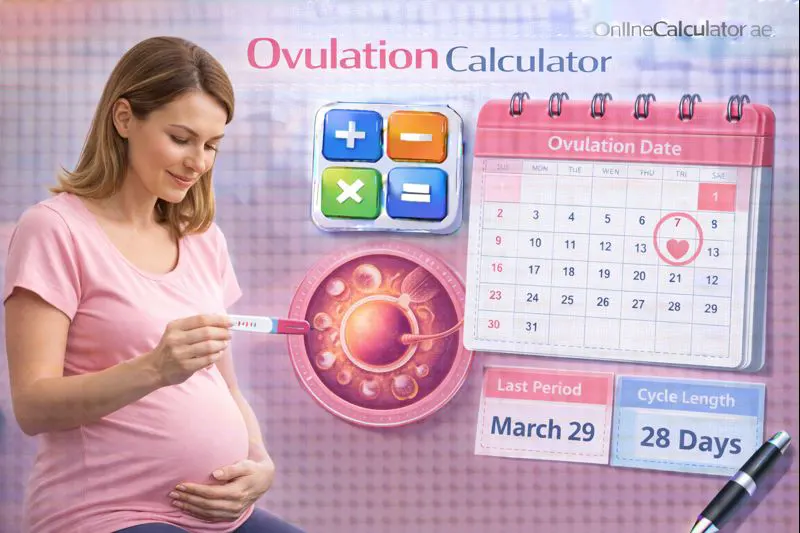
What Is an Ovulation Calculator?
An ovulation calculator is a specialized tool designed to help women predict their most fertile days based on their menstrual cycle. By entering basic information about your cycle, you can identify when you're most likely to conceive.
Health & Fitness calculator platform offers this essential tool specifically tailored for women in the UAE who are planning pregnancy or simply want to understand their reproductive health better.
Key Benefits:
- Accurate Predictions: Calculate your ovulation day and fertile window with precision
- Pregnancy Planning: Maximize your chances of conception by timing intercourse optimally
- Cycle Tracking: Better understand your body's natural rhythm and menstrual patterns
- Free & Private: No registration required, completely confidential calculations
Healthcare providers across Dubai Healthcare City and Abu Dhabi recommend tracking ovulation for couples actively trying to conceive. This calculator provides the same insights you'd discuss with fertility specialists at leading UAE hospitals.
How Does the Ovulation Calculator Work?
Our ovulation calculator uses a scientifically-proven method based on the average menstrual cycle and ovulation timing. Understanding this process helps you make the most of your fertile window.
The Calculation Method:
The calculator follows a simple yet effective formula:
Ovulation Day = First Day of Last Period + (Cycle Length - 14 days)
This calculation is based on the fact that ovulation typically occurs 14 days before your next period starts, regardless of your total cycle length. The fertile window extends approximately 5 days before ovulation and 1 day after.
Step-by-Step Breakdown:
- Enter Your Last Period Date: Input the first day of your most recent menstrual period
- Specify Cycle Length: Enter your average cycle length (typically 21-35 days, with 28 days being average)
- Calculate: The tool instantly determines your ovulation date and fertile window
- Review Results: See your predicted ovulation day, fertile window, and next period date
Important Notes:
- Results are predictions based on average ovulation patterns
- Individual variations exist - some women ovulate earlier or later
- Irregular cycles may require tracking over 3-6 months for accuracy
- The calculator assumes regular menstrual cycles
- Consult with gynecologists at UAE healthcare facilities for personalized advice
For women with irregular cycles, tracking additional signs like basal body temperature or using ovulation predictor kits alongside this calculator can provide more accurate results.
Practical Ovulation Calculation Examples
Understanding how the ovulation calculator works becomes clearer with real-life scenarios. Here are three common situations faced by women in the UAE:
Example 1: Regular 28-Day Cycle
Scenario: Mariam, a 29-year-old teacher in Dubai Marina, has a regular menstrual cycle and is planning her first pregnancy with her husband.
Input Values:
- Last Period Start Date: January 1, 2026
- Average Cycle Length: 28 days
Calculation:
Ovulation Day = January 1 + (28 - 14) = January 1 + 14 = January 15, 2026
Results:
- Ovulation Date: January 15, 2026
- Fertile Window: January 10-16, 2026 (6 days)
- Next Period Expected: January 29, 2026
- Best Conception Days: January 13, 14, and 15
Explanation: With a textbook 28-day cycle, Mariam ovulates exactly mid-cycle. Her best chances of conception are 2-3 days before ovulation when cervical mucus is most receptive to sperm.
Example 2: Longer 32-Day Cycle
Scenario: Fatima, a 32-year-old marketing manager in Abu Dhabi, has a naturally longer cycle. She's been tracking her menstrual patterns for six months.
Input Values:
- Last Period Start Date: January 5, 2026
- Average Cycle Length: 32 days
Calculation:
Ovulation Day = January 5 + (32 - 14) = January 5 + 18 = January 23, 2026
Results:
- Ovulation Date: January 23, 2026
- Fertile Window: January 18-24, 2026
- Next Period Expected: February 6, 2026
- Best Conception Days: January 21, 22, and 23
Explanation: Fatima's longer cycle means she ovulates later (Day 18 instead of Day 14). This is completely normal and shows why knowing your specific cycle length is crucial for accurate predictions.
Example 3: Shorter 25-Day Cycle
Scenario: Sarah, a 26-year-old nurse at a Sharjah hospital, has a shorter but regular cycle. She wants to understand her fertile window timing better.
Input Values:
- Last Period Start Date: January 10, 2026
- Average Cycle Length: 25 days
Calculation:
Ovulation Day = January 10 + (25 - 14) = January 10 + 11 = January 21, 2026
Results:
- Ovulation Date: January 21, 2026
- Fertile Window: January 16-22, 2026
- Next Period Expected: February 4, 2026
- Best Conception Days: January 19, 20, and 21
Explanation: Sarah ovulates earlier in her cycle (Day 11). Women with shorter cycles need to be aware that their fertile window comes sooner after menstruation ends, typically just 2-3 days after bleeding stops.
Understanding Your Cycle Variations
While our calculator provides accurate estimates, every woman's body is unique. Factors affecting ovulation timing include stress, travel, illness, and hormonal changes. Women in the UAE juggling demanding careers in Dubai's business districts or adjusting to the region's climate may experience occasional cycle variations.
Cycle Regularity Matters
The calculator works best for women with regular cycles (varying by no more than 2-3 days each month). If your cycle length varies significantly, track it for 3-6 months to calculate an average. Apps and period tracking tools can help establish patterns.
Common Mistakes to Avoid:
- Confusing Cycle Start Date: Always count from the first day of bleeding (not spotting)
- Guessing Cycle Length: Use actual tracked data, not assumptions
- Ignoring Irregular Patterns: Consult a healthcare provider if cycles vary by more than 7 days
- Relying Solely on Calculations: Combine with physical signs like cervical mucus changes
- Timing Issues: Sperm can survive 3-5 days, so timing before ovulation is often more effective
Expert Tips for UAE Residents:
- Stay Hydrated: The UAE's hot climate can affect your cycle; drink plenty of water
- Reduce Stress: High-pressure work environments can impact ovulation timing
- Maintain Healthy Weight: Use our BMI tracking tools to ensure optimal reproductive health
- Consult Specialists: Dubai and Abu Dhabi have excellent fertility clinics if you need professional guidance
- Track Consistently: Use the calculator monthly to identify your personal patterns
When to Seek Medical Advice:
Contact gynecologists at UAE healthcare facilities if you experience highly irregular cycles, absent periods, extremely painful periods, or haven't conceived after 12 months of trying (6 months if over 35). Leading hospitals across Dubai, Abu Dhabi, and Sharjah offer comprehensive fertility assessments.
Start Tracking Your Ovulation Today
Take control of your reproductive health with our free ovulation calculator. Whether you're actively trying to conceive or simply want to understand your body better, accurate ovulation tracking is the first step. Women across Dubai, Abu Dhabi, Sharjah, and throughout the UAE trust our Online Calculator UAE platform for reliable health insights.
Remember, while our calculator provides valuable predictions, every woman's journey is unique. If you have concerns about fertility or irregular cycles, don't hesitate to consult with healthcare professionals at Dubai's premier fertility centers or Abu Dhabi's specialized women's health clinics.
Start your pregnancy planning journey today with confidence and clarity.