 OnlineCalculator
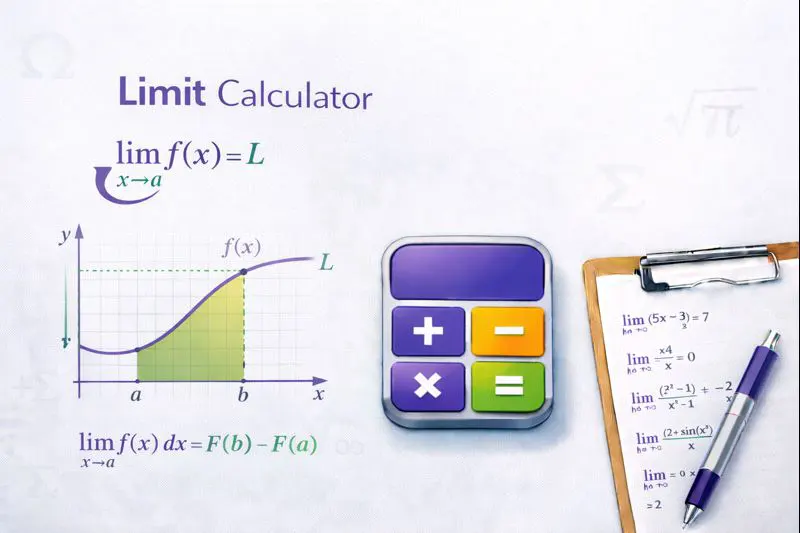
What Is a Limit Calculator and Why Do You Need One?
A is a specialized mathematical tool that evaluates the behavior of functions as they approach specific values. Understanding limits forms the foundation of calculus, differential equations, and advanced mathematical analysis. Our calculator at Online Calculator UAE simplifies this complex process instantly.
This tool processes various limit types including:
- One-sided limits – approaching from left (−) or right (+)
- Two-sided limits – standard limit evaluation
- Limits at infinity – analyzing asymptotic behavior
- Indeterminate forms – handling 0/0, ∞/∞, and similar expressions
Our limit solver uses advanced computational algorithms including L'Hôpital's Rule, algebraic manipulation, and Taylor series expansion to deliver mathematically precise answers. The tool supports standard mathematical notation and provides detailed breakdowns of each calculation step.
Students at UAE universities, including those studying engineering at Khalifa University or mathematics at NYU Abu Dhabi, regularly use limit calculators to verify homework solutions and understand problem-solving approaches. Professionals in finance, physics, and engineering rely on accurate limit calculations for modeling real-world phenomena.
ADVANCED LIMIT CALCULATOR WIDGET Compatible with WordPress Elementor HTML Widget Copy and paste this entire code into an Elementor HTML widget
4 Steps will be inserted here History items will be inserted here ^epi
How the Limit Calculator Works
Understanding Limit Notation
The mathematical limit notation x→a f(x) = L means that as the variable x approaches the value a, the function f(x) approaches the value L. Our calculator interprets this notation and applies appropriate mathematical techniques to find L.
Calculation Methods Used
The calculator employs several strategies depending on the function type:
Direct Substitution: For continuous functions, the calculator first attempts direct substitution. If f(a) produces a defined value, that becomes the limit. For example, calculating limx→2 (x² + 3) simply substitutes x = 2 to get 7.
Factoring and Simplification: When direct substitution yields an indeterminate form like 0/0, the calculator factors the expression. Consider limx→3 (x² − 9)/(x − 3). Factoring gives (x + 3)(x − 3)/(x − 3), which simplifies to (x + 3), yielding a limit of 6.
L'Hôpital's Rule: For persistent indeterminate forms (0/0 or ∞/∞), the calculator applies L'Hôpital's Rule, taking derivatives of numerator and denominator separately until a determinate form emerges.
Special Limit Techniques: The tool recognizes special limits such as lim (sin x)/x = 1 and limx→∞ (1 + 1/n)n = e, applying known results when applicable.
Step-by-Step Process
- Enter your function using standard mathematical notation
- Specify the variable (usually x) and the approach value
- Select the direction: left-sided (−), right-sided (+), or both-sided
- Click calculate to receive your result with full working
Important Note: While the calculator handles most standard functions, extremely complex expressions or piecewise functions may require manual verification. Always cross-reference critical calculations with additional sources when accuracy is essential.
Practical Limit Calculation Examples
Example 1: Basic Polynomial Limit
Scenario: Ahmed, a first-year engineering student at American University of Sharjah, needs to evaluate the limit of a polynomial function for his calculus homework.
Problem:x→4 (2x² − 5x + 3)
Input Values:
- Function: 2x² − 5x + 3
- Variable: x
- Approaches: 4
Calculation:
Since this is a polynomial (continuous everywhere), use direct substitution:
= 2(4)² − 5(4) + 3
= 2(16) − 20 + 3
= 32 − 20 + 3
= 15
Result: The limit equals 15. Ahmed can verify this matches his manual calculation and understand the direct substitution method.
Example 2: Indeterminate Form (0/0)
Scenario: Sara, studying applied mathematics at UAE University, encounters a rational function that yields 0/0 when directly evaluated.
Problem:x→2 (x² − 4)/(x − 2)
Input Values:
- Function: (x² − 4)/(x − 2)
- Variable: x
- Approaches: 2
Calculation:
Direct substitution gives (4 − 4)/(2 − 2) = 0/0 (indeterminate)
Factor the numerator using algebraic techniques:
= (x + 2)(x − 2)/(x − 2)
Cancel common factors:
= x + 2
Now substitute x = 2:
= 2 + 2 = 4
Result: The limit equals 4. The 0/0 form was resolved through factoring, a technique frequently tested in calculus examinations.
Example 3: Limit at Infinity
Scenario: Omar, a financial analyst in DIFC, needs to understand the long-term behavior of a growth model represented by a rational function.
Problem:x→∞ (3x² + 2x)/(5x² − 7)
Input Values:
- Function: (3x² + 2x)/(5x² − 7)
- Variable: x
- Approaches: ∞ (infinity)
Calculation:
For rational functions as x approaches infinity, compare the highest degree terms:
Numerator highest degree: 3x² (coefficient 3)
Denominator highest degree: 5x² (coefficient 5)
Since degrees are equal, the limit equals the ratio of leading coefficients:
= 3/5 = 0.6
Result: The limit equals 3/5 or 0.6. This indicates the function approaches a horizontal asymptote at y = 0.6, meaning the growth model stabilizes at 60% of its maximum theoretical rate over time.
Essential Information for Accurate Limit Calculations
Understanding Indeterminate Forms
Seven indeterminate forms require special handling: 0/0, ∞/∞, 0 × ∞, ∞ − ∞, , 1∞, and ∞. When encountering these, the calculator automatically applies L'Hôpital's Rule or algebraic manipulation techniques.
Common Mistakes to Avoid
- Incorrect notation: Use proper syntax – write x^2 for x², not x2
- Forgetting parentheses: (x+1)/x is different from x+1/x
- Ignoring domain restrictions: Check where your function is defined
- Confusing one-sided limits: Left and right limits can differ at discontinuities
When Limits Don't Exist
A limit fails to exist when:
- Left-sided and right-sided limits differ (jump discontinuity)
- The function oscillates infinitely near the approach point
- The function approaches positive or negative infinity differently from each side
Professional Tips
Before using the calculator, simplify your expression manually when possible. Combine fractions, factor where obvious, and identify the function type. This preparation helps you understand the solution and catch potential input errors.
For academic work, always show your reasoning alongside the calculator result. Instructors at UAE universities expect demonstrated understanding, not just numerical answers.
Frequently Asked Questions About Limit Calculations
How accurate is this limit calculator?
Our calculator uses symbolic computation algorithms that provide mathematically exact results for standard functions. For transcendental functions (sin, cos, ln, e), results are accurate to at least 10 decimal places. The step-by-step solutions follow rigorous mathematical procedures.
Can this calculator solve limits with trigonometric functions?
Yes. The calculator handles all standard trigonometric functions (sin, cos, tan, cot, sec, csc) and their inverses. It recognizes special trigonometric limits like lim (sin x)/x = 1 and applies appropriate identities when needed.
What do I do if the calculator shows "limit does not exist"?
This result means the function doesn't approach a single value. Try calculating left-sided and right-sided limits separately to understand the behavior. If they differ, the two-sided limit genuinely doesn't exist at that point.
How do I enter complex expressions correctly?
Use standard mathematical notation: x^2 for powers, sqrt(x) for square roots, exp(x) for ex, log(x) for natural logarithm. Enclose function arguments in parentheses. For example: (sin(x^2))/(x^2).
Can I calculate limits for piecewise functions?
The calculator works best with single-expression functions. For piecewise functions, evaluate each piece separately at the point of interest, then compare left and right limits manually to determine if the overall limit exists.
Is this tool suitable for university-level calculus?
Absolutely. The calculator handles all standard calculus curriculum topics including epsilon-delta definitions, squeeze theorem applications, and multivariable limit concepts. Students at institutions across the UAE use this for homework verification and exam preparation.
How does the calculator handle limits involving infinity?
Enter "inf" or "∞" as the approach value for limits at infinity. The calculator analyzes dominant terms, growth rates, and asymptotic behavior to determine whether the limit converges to a finite value, diverges to infinity, or oscillates.
Can I see the mathematical steps, not just the answer?
Yes. Our calculator provides detailed step-by-step solutions showing the mathematical techniques applied. This educational feature helps students understand the methodology and learn proper problem-solving approaches for calculus problems.
Start Calculating Limits Now
Whether you're preparing for examinations, completing assignments, or solving real-world mathematical problems, our limit calculator delivers the accuracy and explanations you need. Enter your function above and receive instant results with comprehensive step-by-step solutions.
For additional mathematical resources, explore our mathematics and scientific calculators collection. Students and professionals worldwide trust these tools for reliable calculations.
Need to solve related problems? Our integration solver and differential equation calculator complement limit calculations for comprehensive calculus work.
Related Mathematical Calculators
- Derivative Calculator – Find derivatives and rates of change
- Integral Calculator – Solve definite and indefinite integrals
- Polynomial Solver – Factor and analyze polynomial expressions
- Function Graphing Tool – Visualize mathematical functions
- Equation Solver – Solve algebraic equations
- Matrix Operations Calculator – Perform matrix calculations