 OnlineCalculator
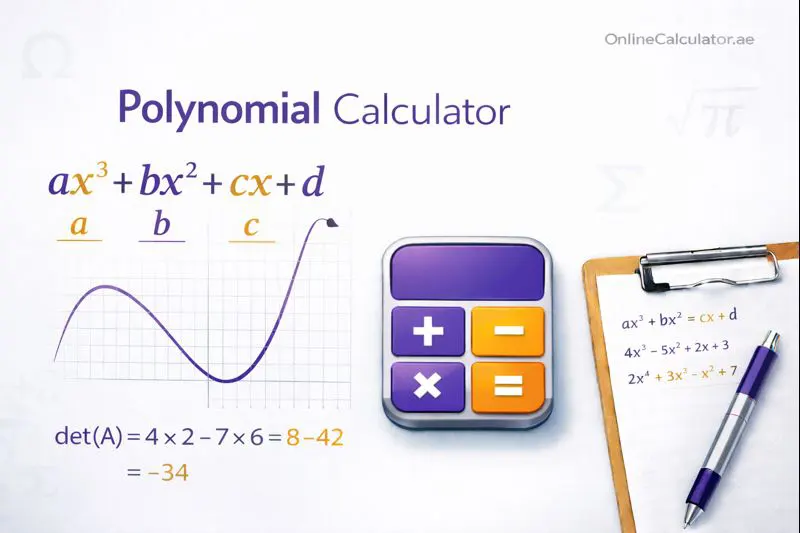
What Is the Polynomial Calculator?
A polynomial is an algebraic expression containing variables, coefficients, and exponents combined through addition, subtraction, and multiplication. Our simplifies working with these expressions by performing all standard operations automatically.
This tool is perfect for:
- Students preparing for exams at universities across Dubai, Abu Dhabi, and Sharjah
- Engineers calculating curves, trajectories, and modeling data
- Teachers creating problem sets and verifying solutions
- Researchers working with mathematical models
Key Benefits:
- Instant calculations for polynomial addition, subtraction, multiplication, and division
- Complete factorization with all factors displayed
- Step-by-step breakdown of each operation
- Support for polynomials up to degree 10
- Works on any device – desktop, tablet, or mobile
Built by Online Calculator UAE, this tool uses proven mathematical algorithms to ensure accuracy for every calculation you perform.
ADVANCED POLYNOMIAL CALCULATOR - WordPress Elementor HTML Widget Copy this entire code into an Elementor HTML widget
How the Polynomial Calculator Works
The calculator processes polynomial expressions using standard algebraic rules. Here's the methodology behind each operation:
Addition and Subtraction
When adding or subtracting polynomials, the calculator identifies like terms – terms with identical variables and exponents – then combines their coefficients. For example, 3x² and 5x² are like terms because both contain x raised to the power of 2.
Formula: (ax^n + bx^n) = (a + b)x^n
Polynomial multiplication applies the distributive property. Each term in the first polynomial multiplies every term in the second polynomial. The calculator then combines like terms in the result.
Formula: (ax^m)(bx^n) = (ab)x^(m+n)
Division
For polynomial division, the calculator uses long division or synthetic division. It divides the leading term of the dividend by the leading term of the divisor, then subtracts and repeats until reaching the remainder.
Factoring
The factoring algorithm identifies common factors, applies special factoring patterns (difference of squares, perfect square trinomials), and uses the rational root theorem to find linear factors of higher-degree polynomials.
Step-by-Step Process:
- Enter your polynomial expression in the input field
- Select the operation you want to perform
- Enter a second polynomial if performing binary operations
- Click "Calculate" to generate your result
- Review the step-by-step solution provided
Important Note: Use the caret symbol (^) for exponents. For example, write "x squared" as x^2. The calculator accepts coefficients as integers or decimals.
Example 1: Adding Polynomials for Engineering Calculations
Scenario: Ahmed, a civil engineering student at Khalifa University in Abu Dhabi, needs to combine two polynomial expressions representing load distributions on a beam structure.
4x³ + 2x² - 5x + 8
2x³ - 3x² + 7x - 2
Step-by-Step Solution:
- Identify like terms:
- x³ terms: 4x³ and 2x³
- x² terms: 2x² and -3x²
- x terms: -5x and 7x
- Constants: 8 and -2
- Add coefficients of like terms:
- x³: 4 + 2 = 6x³
- x²: 2 + (-3) = -1x²
- x: -5 + 7 = 2x
- Constant: 8 + (-2) = 6
Final Result: 6x³ - x² + 2x + 6
Ahmed can now use this combined polynomial to model the total load distribution across the beam. For related percentage-based calculations in his analysis, he might use a percent computation tool.
Example 2: Multiplying Polynomials for Area Calculations
Scenario: Fatima, an architect working on a villa project in Dubai Marina, needs to calculate the area of a rectangular space where both dimensions are expressed as polynomials.
Length: (3x + 4) meters
Width: (2x - 1) meters
Step-by-Step Solution using FOIL method:
- First terms: 3x × 2x = 6x²
- Outer terms: 3x × (-1) = -3x
- Inner terms: 4 × 2x = 8x
- Last terms: 4 × (-1) = -4
- Combine like terms: -3x + 8x = 5x
Final Result: Area = 6x² + 5x - 4 square meters
If x = 5 meters, the area would be 6(25) + 5(5) - 4 = 150 + 25 - 4 = 171 square meters. For solving equations where x is unknown, Fatima could use an algebraic expression solver.
Example 3: Factoring a Quadratic Polynomial
Scenario: Omar, a physics teacher at a school in Yas Island, Abu Dhabi, wants to factor a polynomial representing projectile motion to find when an object hits the ground.
x² - 5x - 14
Step-by-Step Solution:
- Identify that this is a quadratic in the form ax² + bx + c where a=1, b=-5, c=-14
- Find two numbers that multiply to give ac = -14 and add to give b = -5
- The numbers are -7 and +2 (since -7 × 2 = -14 and -7 + 2 = -5)
- Rewrite the polynomial: x² - 7x + 2x - 14
- Factor by grouping: x(x - 7) + 2(x - 7)
- Extract common factor: (x - 7)(x + 2)
Final Result: (x - 7)(x + 2)
Verification: Setting each factor to zero gives x = 7 and x = -2. These represent the times when the projectile is at ground level. For similar problems, a second-degree equation solver provides quick roots.
Standard Form Matters
Always write polynomials in descending order of degree (highest exponent first). This format ensures consistency when comparing results and makes division operations more straightforward. The calculator automatically converts your input to standard form.
Understanding Degree and Terms
The of a polynomial is its highest exponent. A polynomial with degree 2 is quadratic, degree 3 is cubic, and degree 4 is quartic. Knowing the degree helps predict the shape of graphs and the number of possible roots.
Common Mistakes to Avoid
- Sign errors: When subtracting polynomials, remember to distribute the negative sign to all terms in the second polynomial
- Exponent confusion: When multiplying, ADD exponents (x² × x³ = x⁵). When dividing, SUBTRACT exponents
- Missing terms: Include placeholder terms with zero coefficients when needed (e.g., x³ + 0x² + 2x + 1)
- Incomplete factoring: Always check if factors can be factored further
Expert Tips
When working with complex polynomials, break the problem into smaller steps. For multiplication of polynomials with many terms, create a multiplication table to organize your work. For factoring, always start by extracting the greatest common factor (GCF) – tools for finding the highest common factor can help with this step.
For polynomial division that doesn't divide evenly, the remainder is expressed as a fraction over the divisor. Understanding remainders is crucial for applications in calculus operations like partial fraction decomposition.
Start Solving Polynomials Now
Ready to simplify your polynomial calculations? Enter your expression above and get instant, accurate results with complete step-by-step explanations. Whether you're studying algebra, preparing for engineering exams, or working on professional mathematical models, this calculator delivers the precision you need.
For more mathematical tools and calculators, explore the full Scientific & Math collection. Have questions or suggestions? We're committed to providing reliable, free tools for students and professionals throughout the UAE and worldwide.
This calculator is provided free of charge as an educational resource. Results should be verified for critical applications.