 OnlineCalculator
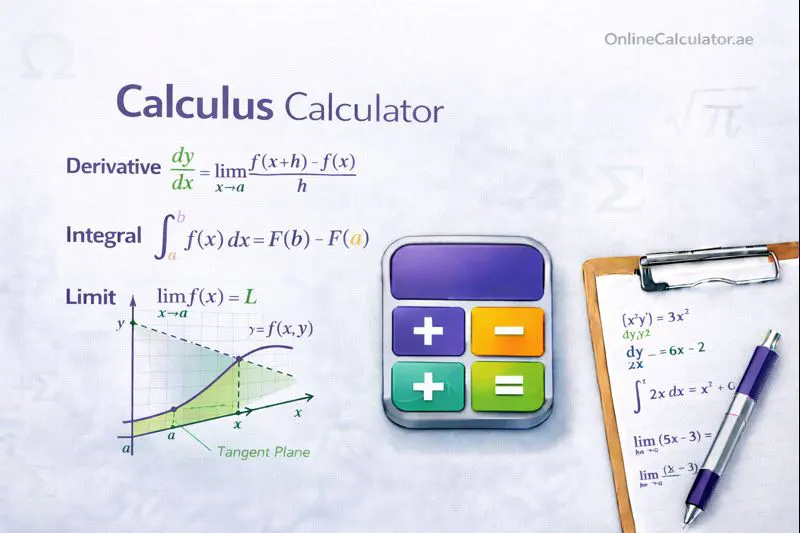
What Is a Calculus Calculator?
A calculus calculator is a powerful computational tool that solves mathematical problems involving rates of change and accumulation. From finding the slope of a curve to calculating the area under a graph, this calculator handles the core concepts that form the backbone of modern science, engineering, and economics.
Online Calculator UAE platform brings you an advanced calculus solver designed for accuracy and ease of use. Here's what makes it essential:
- Instant Solutions: Get answers to derivative and integral problems within seconds
- Step-by-Step Breakdown: Understand the methodology behind each calculation
- Multiple Functions: Solve derivatives, indefinite integrals, definite integrals, limits, and partial derivatives
- Free Access: No registration or subscription required—completely free to use
Trusted by thousands of students and professionals across the UAE and internationally, this calculator follows standard mathematical notation and conventions used in academic institutions worldwide.
ADVANCED CALCULUS CALCULATOR WIDGET Compatible with WordPress Elementor HTML Widget Features: Derivatives, Integrals, Limits, Step-by-Step Solutions Operation Selection Tabs Function Input Symbol Keyboard Definite Integral Bounds Limit Parameters Example Buttons Calculate Button Error Message Results Section
How the Calculus Calculator Works
Understanding the mathematical foundation behind this tool helps you verify results and build confidence in your calculations. The calculator employs symbolic computation algorithms to process your input and deliver accurate results.
Derivative Calculation Method
The derivative measures the instantaneous rate of change of a function. For a function f(x), the derivative f'(x) is computed using differentiation rules:
Power Rule: d/dx [x^n] = n × x^(n-1)
Product Rule: d/dx [f(x) × g(x)] = f'(x)g(x) + f(x)g'(x)
Chain Rule: d/dx [f(g(x))] = f'(g(x)) × g'(x)
Integration Calculation Method
Integration finds the antiderivative or the area under a curve. The calculator applies integration techniques including:
Power Rule: ∫x^n dx = x^(n+1)/(n+1) + C
Substitution: For composite functions requiring variable substitution
Integration by Parts: ∫u dv = uv - ∫v du
Step-by-Step Process
- Enter Your Function: Type the mathematical expression using standard notation (e.g., x^2, sin(x), e^x)
- Select Operation: Choose derivative, integral, or limit from the dropdown
- Specify Parameters: For definite integrals, enter upper and lower bounds; for limits, enter the approaching value
- Calculate: Click the calculate button to process your function
- Review Results: View the answer along with the step-by-step solution
Important Note: Use proper mathematical notation. Write multiplication explicitly (2*x not 2x), and use parentheses to clarify order of operations. For trigonometric functions, the calculator assumes radians unless specified.
Practical Calculus Examples
Real-world applications demonstrate how this calculator handles various problem types. These examples use scenarios relevant to students and professionals.
Example 1: Finding the Derivative of a Polynomial
Context: Fatima, an engineering student at Khalifa University in Abu Dhabi, needs to find the velocity function from a position equation during her physics assignment.
Problem: Find the derivative of f(x) = 3x⁴ - 5x² + 2x - 7
Input Values:
- Function: 3x^4 - 5x^2 + 2x - 7
- Operation: Derivative
- Variable: x
Step-by-Step Calculation:
- Apply power rule to 3x⁴: 4 × 3x³ = 12x³
- Apply power rule to -5x²: 2 × (-5)x¹ = -10x
- Apply power rule to 2x: 1 × 2x⁰ = 2
- Constant -7 differentiates to:
Final Result: f'(x) = 12x³ - 10x + 2
Example 2: Computing a Definite Integral
Context: Omar, a data analyst at a Dubai Marina financial firm, calculates the total accumulated value of a continuous investment function over a specific period.
Problem: Evaluate ∫₀² (x² + 3x) dx
Input Values:
- Function: x^2 + 3x
- Operation: Definite Integral
- Lower Bound: 0
- Upper Bound: 2
Step-by-Step Calculation:
- Find antiderivative: F(x) = x³/3 + 3x²/2
- Evaluate at upper bound (x=2): (8/3) + (12/2) = 8/3 + 6 = 26/3
- Evaluate at lower bound (x=0): 0 + 0 =
- Subtract: 26/3 - 0 = 26/3
Final Result: ∫₀² (x² + 3x) dx = 26/3 ≈ 8.667
Example 3: Calculating a Limit
Context: Ahmed, preparing for his calculus exam at American University of Sharjah, needs to evaluate a limit that appears indeterminate at first glance.
Problem: Find lim(x→0) [sin(x)/x]
Input Values:
- Function: sin(x)/x
- Operation: Limit
- Variable approaches: 0
Step-by-Step Calculation:
- Direct substitution gives: sin(0)/0 = 0/0 (indeterminate form)
- Apply L'Hôpital's Rule: differentiate numerator and denominator
- d/dx[sin(x)] = cos(x)
- d/dx[x] = 1
- New limit: lim(x→0) [cos(x)/1] = cos(0) = 1
Final Result: lim(x→0) [sin(x)/x] = 1
This is a fundamental limit frequently encountered in calculus courses.
Input Formatting Guidelines
Proper notation ensures accurate results. Follow these conventions when entering functions:
- Exponents: Use ^ symbol (x^3 for x cubed)
- Multiplication: Use * symbol (2*x, not 2x)
- Division: Use / symbol with parentheses when needed ((x+1)/(x-1))
- Square Root: Type sqrt(x)
- Natural Log: Type ln(x)
- Euler's Number: Type e^x for exponential functions
- Pi: Type pi (e.g., sin(pi*x))
Common Mistakes to Avoid
- Missing Parentheses: sin(2x) is different from sin(2)*x
- Implicit Multiplication: Always write 3*x instead of 3x
- Degree vs. Radian: Trigonometric functions default to radians
- Forgetting Constants: Indefinite integrals include "+ C"
When to Use Each Operation
Choosing the right calculus operation depends on your problem:
- Derivative: Finding rates of change, velocity, slope of tangent line, optimization
- Indefinite Integral: Finding antiderivatives, general solutions
- Definite Integral: Calculating area under curves, total accumulation, average values
- Limit: Evaluating function behavior at specific points, handling indeterminate forms
For problems involving algebraic manipulation, simplify your expression before using the calculus calculator for best results.
Start Solving Calculus Problems Now
Whether you're working through calculus homework, preparing for exams, or applying mathematical concepts professionally, our calculus calculator delivers the answers you need. Enter your function above and experience instant, accurate solutions with clear explanations.
For comprehensive mathematical tools, explore our complete collection at Scientific & Math Calculators. Students and educators across the UAE rely on these resources daily.
Disclaimer: This calculator is intended for educational and verification purposes. Always show your work in academic settings and consult your instructor regarding calculator policies.