 OnlineCalculator
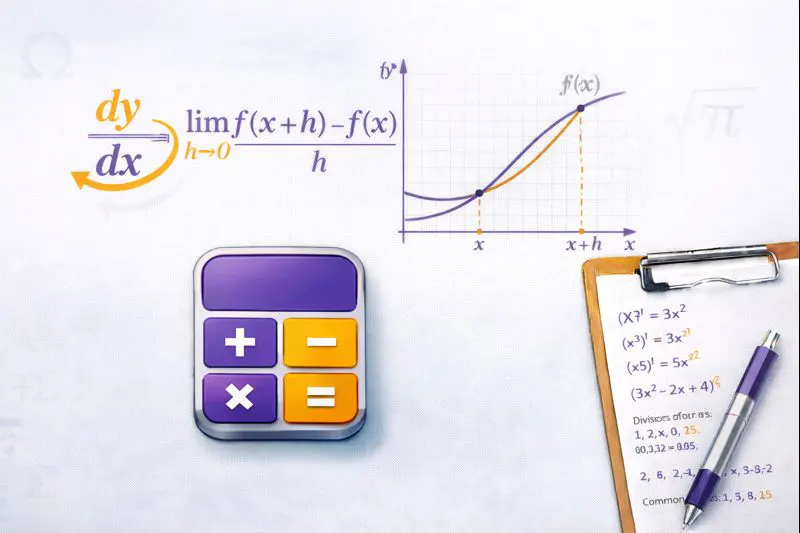
What Is a Derivative Calculator?
A derivative calculator is a specialized mathematical tool that computes the derivative of any given function automatically. Derivatives measure the rate of change of a function—an essential concept in calculus, physics, economics, and engineering. Our free Online Calculator UAE platform provides this powerful tool to help users solve differentiation problems quickly and accurately.
Key benefits of using our derivative calculator:
- Instant results: Get derivatives computed in milliseconds
- Step-by-step breakdown: Understand exactly how the solution is derived
- Multiple notation support: Works with Leibniz, Lagrange, and Newton notation
- Higher-order derivatives: Calculate second, third, or nth derivatives easily
Built using advanced symbolic computation algorithms, this calculator handles everything from basic polynomials to complex trigonometric, exponential, and logarithmic functions. The tool follows standard mathematical differentiation rules to ensure accurate, reliable results every time.
================================================ ADVANCED DERIVATIVE CALCULATOR WIDGET For WordPress Elementor HTML Widget ================================================ Copy and paste this entire code into an Elementor HTML widget ================================================
↓
How the Derivative Calculator Works
Our derivative calculator uses symbolic differentiation—the same method taught in calculus courses worldwide. Rather than approximating values numerically, it applies fundamental differentiation rules to produce exact analytical solutions.
Core Differentiation Rules Applied
The calculator recognizes and applies these essential rules automatically:
- Power Rule: d/dx(x^n) = n·x^(n-1)
- Product Rule: d/dx(f·g) = f'·g + f·g'
- Quotient Rule: d/dx(f/g) = (f'·g - f·g') / g²
- Chain Rule: d/dx(f(g(x))) = f'(g(x))·g'(x)
- Trigonometric derivatives: d/dx(sin x) = cos x, d/dx(cos x) = -sin x, etc.
- Exponential Rule: d/dx(e^x) = e^x, d/dx(a^x) = a^x·ln(a)
- Logarithmic Rule:
Step-by-Step Process
Step 1: Enter your function using standard mathematical notation. For example, type x^3 + 5x^2 - 2x + 7 or sin(x)*e^x.
Step 2: Select the variable of differentiation (usually x) and choose the derivative order (first, second, third, etc.).
Step 3: Click "Calculate" to receive the derivative along with a detailed breakdown showing each rule applied.
Important note: Use proper syntax for functions—parentheses matter. Write not sinx, and use * for multiplication when needed (e.g., 2*x or 2x).
Example 1: Polynomial Function
Scenario: Fatima, a mathematics student at UAE University, needs to find the derivative of a position function to determine velocity.
Function: f(x) = 3x⁴ - 2x³ + 5x² - 7x + 4
Step-by-step solution:
- Apply power rule to 3x⁴: 4 × 3x³ = 12x³
- Apply power rule to -2x³: 3 × (-2)x² = -6x²
- Apply power rule to 5x²: 2 × 5x = 10x
- Apply power rule to -7x: 1 × (-7) = -7
- Derivative of constant 4 =
Final Result: f'(x) = 12x³ - 6x² + 10x - 7
This derivative represents the instantaneous rate of change of the original function at any point x. If you need help with polynomial expressions, our dedicated tool can assist further.
Example 2: Trigonometric Function with Chain Rule
Scenario: Ahmed, an engineering student in Dubai, is analyzing oscillatory motion and needs to differentiate a composite trigonometric function.
Function: f(x) = sin(3x²)
Step-by-step solution using chain rule:
- Identify outer function: sin(u) where u = 3x²
- Derivative of outer function: d/du(sin(u)) = cos(u) = cos(3x²)
- Derivative of inner function: d/dx(3x²) = 6x
- Apply chain rule: multiply results together
Final Result: f'(x) = 6x·cos(3x²)
The chain rule is essential whenever you have functions nested inside other functions. For related calculus operations, explore our comprehensive toolkit.
Example 3: Product of Exponential and Polynomial (Product Rule)
Scenario: Sara, a data scientist in Abu Dhabi, needs to find the derivative for a growth model involving both exponential and polynomial terms.
Function: f(x) = x²·e^x
Step-by-step solution using product rule:
- Identify: f = x², g = e^x
- Find f' = 2x
- Find g' = e^x
- Apply product rule: f'·g + f·g' = (2x)(e^x) + (x²)(e^x)
- Factor out common term e^x
Final Result: f'(x) = e^x(x² + 2x) or equivalently xe^x(x + 2)
This type of derivative appears frequently in mathematical modeling. You might also find our antiderivative calculator useful for the reverse operation.
When Derivatives Don't Exist
Not every function has a derivative at every point. Derivatives may not exist at:
- Sharp corners: Functions like |x| have no derivative at x = 0
- Vertical tangents: Functions with infinite slopes at certain points
- Discontinuities: Where the function jumps or has holes
Common Mistakes to Avoid
Forgetting the chain rule: When differentiating composite functions like sin(2x), the derivative is 2cos(2x), not just cos(2x).
Misapplying the power rule to exponentials: The derivative of e^x is e^x, not x·e^(x-1). The power rule only applies when x is in the base, not the exponent.
Confusing the product and chain rules: Use the product rule for f(x)·g(x), but the chain rule for f(g(x)).
Expert Tips
Always simplify your function before differentiating when possible. For instance, rewrite 1/x² as x^(-2) to apply the power rule directly. When working with algebraic equations, simplification often makes differentiation much easier.
For implicit differentiation, treat y as a function of x and apply the chain rule. Our calculator handles explicit functions; for implicit differentiation, isolate y first when possible.
Start Solving Derivatives Now
Ready to tackle your calculus problems? Enter your function in the calculator above and get instant, step-by-step solutions. Whether you're checking homework, preparing for exams, or working through complex mathematical models, our derivative calculator provides the accuracy and detail you need.
For comprehensive mathematical resources and calculation tools, explore the full Mathematics & Scientific tools collection. Bookmark this page and use it whenever you need quick, reliable differentiation help.
Note: While our calculator provides accurate mathematical solutions, students are encouraged to understand the underlying concepts and verify important calculations.