 OnlineCalculator
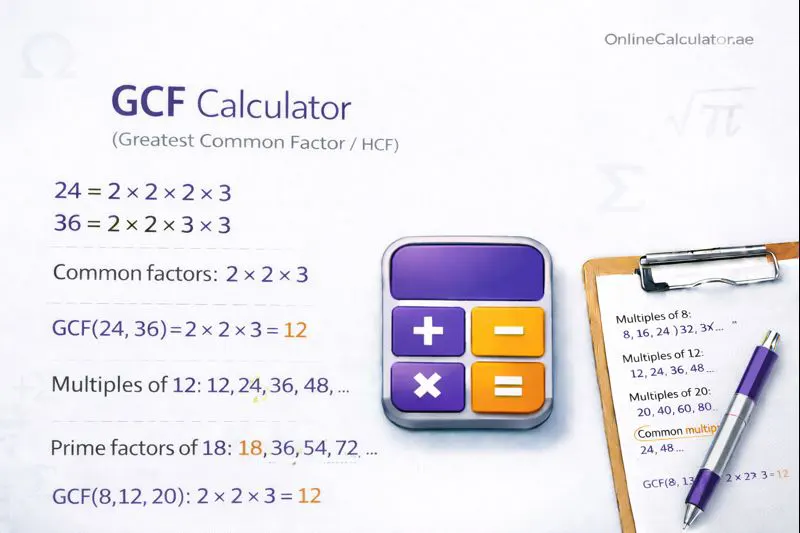
What Is a GCF/HCF Calculator?
A GCF (Greatest Common Factor) calculator—also called an HCF (Highest Common Factor) or GCD (Greatest Common Divisor) calculator—finds the largest positive integer that divides two or more numbers without leaving a remainder. This Online Calculator UAE tool handles calculations that would otherwise require manual computation.
Key benefits of using this calculator:
- Multiple calculation methods: Choose between prime factorization, Euclidean algorithm, or factor listing
- Step-by-step solutions: Understand exactly how the GCF is calculated
- Handles multiple numbers: Find GCF of 2, 3, 4, or more numbers simultaneously
- Instant results: Get accurate answers in milliseconds
Whether you're simplifying fractions, solving algebraic equations, or working on engineering calculations, this tool eliminates manual errors and saves valuable time. The calculator uses mathematically verified algorithms to ensure 100% accuracy for all valid inputs.
=========================================== ADVANCED GCF/HCF CALCULATOR WIDGET For WordPress Elementor HTML Widget ===========================================
12
How the GCF Calculator Works
The GCF (Greatest Common Factor) represents the largest number that evenly divides all given numbers. Our calculator employs three proven mathematical methods to find this value.
Method 1: Prime Factorization
This method breaks each number into its prime factors, then identifies the common prime factors shared by all numbers. The GCF equals the product of these common primes raised to their lowest powers.
Formula: GCF = Product of (common prime factors raised to minimum power)
For example, finding GCF of 48 and 60:
- 48 = 24 × 31
- 60 = 22 × 31 × 51
- Common factors: 2 and 3
- GCF = 22 × 31 = 4 × 3 = 12
Method 2: Euclidean Algorithm
The Euclidean algorithm uses repeated division to find the GCF efficiently. This method divides the larger number by the smaller, then divides the smaller by the remainder, continuing until the remainder equals zero.
Formula: GCF(a, b) = GCF(b, a mod b) until remainder = 0
Method 3: Factor Listing
This straightforward approach lists all factors of each number, then identifies the largest factor common to all lists. While simple to understand, it becomes impractical for large numbers—which is why our calculator also offers the faster Euclidean method.
Important notes:
- The GCF of any number with itself equals that number
- The GCF of any number with 1 always equals 1
- Negative numbers are converted to positive values for calculation
- For calculating related values, you might also use an LCM finder tool
Practical Examples
Example 1: Simplifying a Fraction
Scenario: A teacher in Dubai needs to simplify the fraction 84/126 for a Grade 7 mathematics worksheet.
Input values: 84 and 126
Step-by-step calculation using prime factorization:
- 84 = 22 × 3 × 7 = 2 × 2 × 3 × 7
- 126 = 2 × 32 × 7 = 2 × 3 × 3 × 7
- Common prime factors: 21, 31, 71
- GCF = 2 × 3 × 7 = 42
Result: The GCF is 42. Therefore, 84/126 simplifies to (84÷42)/(126÷42) = 2/3
Example 2: Distributing Items Equally
Scenario: An event organizer has 180 red balloons and 240 blue balloons. They want to create identical decoration bundles using all balloons with no leftovers.
Input values: 180 and 240
Step-by-step calculation using Euclidean algorithm:
- 240 ÷ 180 = 1 remainder 60
- 180 ÷ 60 = 3 remainder 0
- When remainder = 0, the divisor (60) is the GCF
Result: GCF = 60. The organizer can create 60 identical bundles, each containing 3 red balloons (180÷60) and 4 blue balloons (240÷60).
Example 3: Finding GCF of Three Numbers
Scenario: A math and science student needs to find the GCF of 72, 96, and 120 for a number theory assignment.
Input values: 72, 96, and 120
Step-by-step calculation:
- 72 = 23 × 32
- 96 = 25 × 31
- 120 = 23 × 31 × 51
- Common primes with minimum powers: 23 × 31
- GCF = 8 × 3 = 24
Result: The GCF of 72, 96, and 120 is 24. This means 24 is the largest number that divides all three values evenly.
Important Information About GCF Calculations
Special Rules and Considerations
When working with GCF calculations, keep these mathematical properties in mind:
- GCF × LCM = Product: For two numbers a and b, GCF(a,b) × LCM(a,b) = a × b. This relationship helps verify calculations using a least common multiple calculator.
- Coprime numbers: Two numbers with GCF = 1 are called coprime or relatively prime. Examples include 8 and 15, or 7 and 11.
- Consecutive integers: Any two consecutive integers (like 14 and 15) always have a GCF of 1.
Common Mistakes to Avoid
- Confusing GCF with LCM: GCF finds the largest common divisor; LCM finds the smallest common multiple. They serve opposite purposes.
- Forgetting to check all factors: When using the listing method, ensure you've identified all factors before comparing.
- Stopping Euclidean algorithm early: Continue dividing until the remainder is exactly zero.
- Missing prime factors: When using prime factorization, double-check that you've completely factored each number.
Expert Tips
For faster manual calculations, start by checking if the smaller number divides the larger number evenly—if it does, the smaller number is the GCF. When dealing with numbers that share obvious common factors (like 100 and 150 both being divisible by 50), use that knowledge to speed up your work. For finding prime factors, always begin dividing by 2, then 3, then 5, and continue with larger primes.
Frequently Asked Questions
What is the difference between GCF, HCF, and GCD?
GCF (Greatest Common Factor), HCF (Highest Common Factor), and GCD (Greatest Common Divisor) are three names for the same mathematical concept. GCF is commonly used in the United States, while HCF is preferred in British English and many international curricula. GCD appears frequently in computer science and number theory.
How accurate is this GCF calculator?
This calculator provides 100% mathematically accurate results for all valid positive integer inputs. It uses verified algorithms (Euclidean algorithm and prime factorization) that have been proven correct for centuries. The calculator handles numbers up to 15 digits.
Can I find the GCF of more than two numbers?
Yes. This calculator accepts multiple numbers separated by commas. To find GCF of three or more numbers, the calculator first finds GCF of the first two numbers, then finds GCF of that result with the third number, and continues this process for all inputs.
What if the GCF equals 1?
A GCF of 1 means the numbers are coprime (relatively prime)—they share no common factors other than 1. This occurs with numbers like 7 and 11, or 8 and 15. Fractions with coprime numerators and denominators are already in their simplest form.
How is GCF used in fraction simplification?
To simplify a fraction, divide both the numerator and denominator by their GCF. For example, to simplify 24/36: GCF(24,36) = 12, so 24/36 = (24÷12)/(36÷12) = 2/3. Our fraction simplifier tool automates this process.
Which calculation method is fastest?
The Euclidean algorithm is the most efficient method, especially for large numbers. It requires at most log(min(a,b)) steps, making it significantly faster than listing all factors. This is why computers and calculators use this algorithm internally.
Can GCF be larger than one of the input numbers?
No. The GCF cannot exceed the smallest input number. Since the GCF must divide all numbers evenly, it's mathematically bounded by the smallest value. If you get a result larger than your smallest input, an error has occurred.
How does GCF relate to LCM?
For any two positive integers a and b: GCF(a,b) × LCM(a,b) = a × b. This formula lets you calculate one value if you know the other. Many math problems require both values, making them complementary concepts.
Start Calculating Now
Enter your numbers above to find the GCF instantly. Whether you're simplifying fractions, solving algebraic expressions, or working on mathematical proofs, this calculator delivers accurate results with detailed explanations.
For additional mathematical resources, explore Khan Academy's comprehensive lessons on factors and multiples.
This calculator is provided free by Online Calculator UAE—your trusted source for accurate, easy-to-use calculation tools.
Related Calculators
- LCM Calculator – Find the Least Common Multiple of numbers
- Prime Factorization Calculator – Break numbers into prime factors
- Fraction Calculator – Add, subtract, multiply, and simplify fractions
- Factorial Calculator – Calculate n! for combinatorics
- Ratio Calculator – Simplify and compare ratios
- Percentage Calculator – Solve percentage problems quickly