 OnlineCalculator
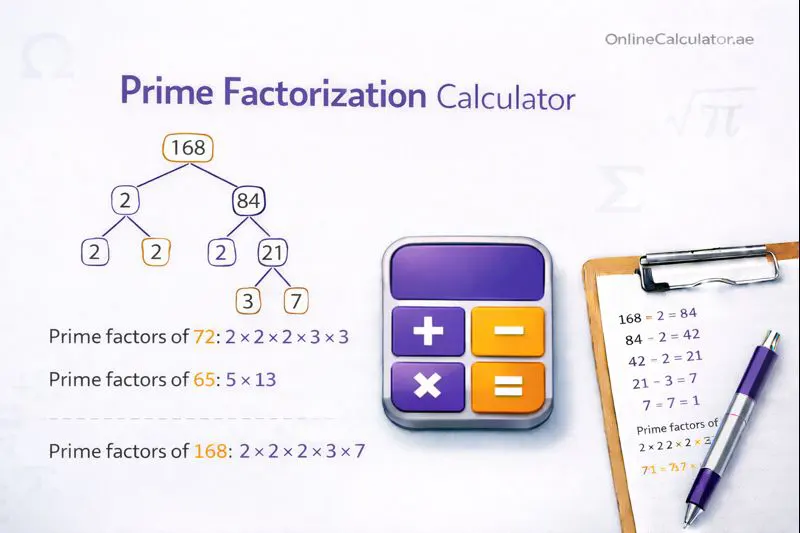
What Is Prime Factorization?
Prime factorization is the process of expressing a composite number as a product of its prime factors. Every positive integer greater than 1 can be represented uniquely as a product of prime numbers—this is known as the Fundamental Theorem of Arithmetic. Our calculator at Online Calculator UAE makes this process effortless.
Key benefits of using this calculator:
- Instant results – Get prime factors for any number up to 10 billion
- Visual factor tree – See the complete breakdown displayed graphically
- – Learn exactly how each factor is found
- Multiple output formats – View results as a product, with exponents, or as a list
The calculator uses the trial division method optimized for speed. Results are mathematically verified, ensuring you can trust every output for homework, exams, or professional applications.
PRIME FACTORIZATION CALCULATOR - ADVANCED VERSION For WordPress Elementor HTML Widget Features: Factor Tree Visualization, Step-by-Step Division, Multiple Output Formats, Copy Results, History Results Tab Factor Tree Tab Steps Tab All Factors Tab
How Prime Factorization Works
The calculator employs the trial division method, which systematically tests potential prime divisors starting from the smallest prime number (2) and working upward. Here's the methodology:
The Division Process
Starting with your input number, the algorithm divides by 2 repeatedly until the result is no longer divisible by 2. It then moves to 3, then 5, and continues testing prime numbers up to the square root of the remaining quotient. Each successful division records a prime factor.
The Formula
For any composite number n, the factorization follows this pattern:
n = p₁^a₁ × p₂^a₂ × p₃^a₃ × ... × pₖ^aₖ
Where p₁, p₂, p₃... are distinct prime numbers and a₁, a₂, a₃... are their respective exponents (how many times each prime appears).
Step-by-Step Breakdown
For example, factoring :
- 360 ÷ 2 = 180 (first factor: 2)
- 180 ÷ 2 = 90 (second factor: 2)
- 90 ÷ 2 = 45 (third factor: 2)
- 45 ÷ 3 = 15 (fourth factor: 3)
- 15 ÷ 3 = 5 (fifth factor: 3)
- 5 ÷ 5 = 1 (sixth factor: 5)
Result: 360 = 2³ × 3² × 5
Important note: The number 1 is neither prime nor composite—it has no prime factorization. Prime numbers themselves (like 7, 11, 13) are their own prime factorization.
Example 1: Finding the LCM for Project Scheduling
Scenario: Ahmed, a project manager in Dubai Marina, needs to schedule three recurring tasks. Task A repeats every 12 days, Task B every 18 days, and Task C every 30 days. He needs the prime factorizations to find when all tasks align.
Calculations:
- 12 = 2 × 2 × 3 = 2² × 3
- 18 = 2 × 3 × 3 = 2 × 3²
- 30 = 2 × 3 × 5 = 2 × 3 × 5
Result: Using these factorizations with our least common multiple tool, Ahmed finds the LCM is 2² × 3² × 5 = 180 days. All three tasks will coincide every 180 days.
Example 2: Simplifying Fractions in Financial Analysis
Scenario: Fatima, an accountant at a DIFC firm, needs to simplify the ratio 84/126 for a quarterly report.
Calculations:
- 84 = 2 × 2 × 3 × 7 = 2² × 3 × 7
- 126 = 2 × 3 × 3 × 7 = 2 × 3² × 7
Finding the GCF: Common factors are 2¹ × 3¹ × 7¹ = 42
Result: 84/126 = (84÷42)/(126÷42) = 2/3. Fatima can also use our greatest common factor calculator to verify this result.
Example 3: Large Number Factorization
Scenario: Omar, an engineering student at Khalifa University, needs to factorize 2,310 for a cryptography assignment.
Calculation:
- 2310 ÷ 2 = 1155
- 1155 ÷ 3 = 385
- 385 ÷ 5 = 77
- 77 ÷ 7 = 11
- 11 ÷ 11 = 1
Result: 2310 = 2 × 3 × 5 × 7 × 11
This number is special—it's the product of the first five prime numbers, also known as a primorial (written as 5#).
Key Mathematical Rules
Every composite number has exactly one unique prime factorization (ignoring the order of factors). This uniqueness property is foundational to number theory and has practical applications in cryptography, computer science, and data security.
Special Cases to Remember
- The number 1 – Has no prime factors and is not included in any factorization
- Prime numbers – Cannot be factored further (e.g., 17 = 17)
- Powers of primes – Numbers like 64 = 2⁶ have only one unique prime factor
- Even numbers – Always have 2 as their smallest prime factor
Common Mistakes to Avoid
Stopping too early: Always continue dividing until you reach 1. A common error is stopping when the quotient becomes prime—you need to include that final prime in your answer.
Missing repeated factors: Don't forget that prime factors can repeat. For 72, the factor 2 appears three times (72 = 2³ × 3²).
Testing non-prime divisors: Only test prime numbers. Testing 4, 6, 9, etc., wastes time since their factors would have been found already.
Pro Tips
For mental math, memorize divisibility rules: numbers ending in 0 or 5 are divisible by 5; if digit sum is divisible by 3, the number is divisible by 3. These shortcuts speed up manual factorization significantly.
Start Factoring Now
Enter any positive integer above to discover its prime factors instantly. The calculator displays your results in multiple formats—as a product, with exponents, and as a visual factor tree. Bookmark this page for quick access whenever you need to break down numbers into their fundamental prime components.
For comprehensive mathematical problem-solving, explore our complete collection of tools at Online Calculator UAE. Each calculator is designed for accuracy, speed, and educational value.