 OnlineCalculator
What Is an LCM Calculator?
An LCM (Least Common Multiple) calculator determines the smallest positive integer that is divisible by each number in your set. Whether you're adding fractions with unlike denominators, scheduling repeating events, or solving number theory problems, finding the LCM is essential.
This free tool from Online Calculator UAE handles:
- Two or more numbers – Enter as many values as needed
- Multiple calculation methods – Prime factorization, listing multiples, and division method
- Step-by-step explanations – Understand exactly how the answer was reached
- Large number support – Works with values up to millions
The calculator uses validated algorithms to ensure accuracy. Results display instantly, making it reliable for academic submissions, engineering calculations, and professional applications.
ADVANCED LCM CALCULATOR WIDGET Compatible with WordPress Elementor HTML Widget Copy and paste this entire code block into Elementor's HTML widget
How the LCM Calculator Works
The Least Common Multiple is found using mathematical methods that have been taught for centuries. This calculator employs three primary approaches to ensure you understand the process.
Prime Factorization Method
This method breaks each number into its prime factors, then multiplies the highest power of each prime found across all numbers.
Formula: LCM(a, b) = Product of highest powers of all prime factors
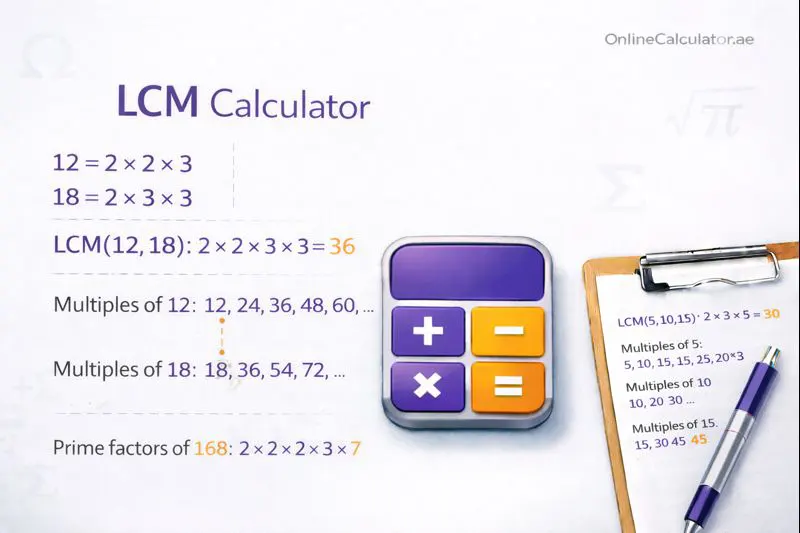
For example, finding LCM(12, 18):
- 12 = 2² × 3¹
- 18 = 2¹ × 3²
- LCM = 2² × 3² = 4 × 9 = 36
Using GCF (Greatest Common Factor)
A faster computational method uses the relationship between LCM and GCF (HCF):
Formula: LCM(a, b) = |a × b| ÷ GCF(a, b)
This approach is particularly efficient for larger numbers because finding the GCF using the Euclidean algorithm is computationally fast.
Listing Multiples Method
The simplest conceptual method lists multiples of each number until a common value appears:
- Multiples of 4: 4, 8, 12, 16, 20, 24...
- Multiples of 6: 6, 12, 18, 24...
- First common multiple: 12
Note: For numbers greater than 100, the prime factorization or GCF method is far more efficient. The listing method works best for smaller values or educational demonstrations.
Example 1: Adding Fractions with Different Denominators
Scenario: A student in Dubai needs to add 5/8 + 3/12 for a mathematics assignment.
Input values: 8 and 12
Step-by-step calculation:
- Prime factorization of 8 = 2³
- Prime factorization of 12 = 2² × 3
- Highest power of 2 = 2³ = 8
- Highest power of 3 = 3¹ = 3
- LCM = 8 × 3 = 24
Result: The common denominator is 24. The student converts: 5/8 = 15/24 and 3/12 = 6/24, giving 15/24 + 6/24 = 21/24 = 7/8.
Example 2: Scheduling Maintenance Cycles
Scenario: A facilities manager at a Yas Island hotel schedules elevator maintenance every 15 days and HVAC servicing every 20 days. When will both occur on the same day?
Input values: 15 and 20
Step-by-step calculation:
- 15 = 3 × 5
- 20 = 2² × 5
- LCM = 2² × 3 × 5 = 4 × 3 × 5 = 60
Result: Both maintenance tasks align every 60 days. The manager can plan combined inspections accordingly.
Example 3: Finding LCM of Three Numbers
Scenario: An engineering student calculates signal synchronization requiring LCM of 6, 8, and 15 milliseconds.
Input values: 6, 8, and 15
Step-by-step calculation:
- 6 = 2 × 3
- 8 = 2³
- 15 = 3 × 5
- Highest power of 2 = 2³ = 8
- Highest power of 3 = 3¹ = 3
- Highest power of 5 = 5¹ = 5
- LCM = 8 × 3 × 5 = 120
Result: The signals synchronize every 120 milliseconds. This helps determine buffer requirements and timing circuits.
Mathematical Properties to Remember
The LCM has specific properties that affect calculations:
- LCM(a, a) = a – The LCM of a number with itself equals that number
- LCM(a, 1) = a – Any number's LCM with 1 is the number itself
- LCM is commutative – LCM(a, b) = LCM(b, a)
- LCM is associative – LCM(a, LCM(b, c)) = LCM(LCM(a, b), c)
Common Mistakes to Avoid
Confusing LCM with GCF: The LCM is always greater than or equal to the largest input number. The GCF is always less than or equal to the smallest input. If your answer seems wrong, verify you've calculated the correct one.
Forgetting zero is undefined: LCM involving zero has no mathematical meaning since zero has no positive multiples. The calculator will prompt you to enter positive integers only.
Not reducing fractions first: When finding common denominators for fractions, work with the denominators in their given form. Simplifying comes after addition or subtraction.
Expert Tips
For quick mental calculations with small numbers, multiply the two values and divide by their obvious common factor. For 4 and 6: (4 × 6) ÷ 2 = 12. This shortcut works when you can spot the GCF quickly.
When working with multiple numbers, calculate LCM in pairs. Find LCM(a, b) first, then find LCM of that result with c. This step-by-step approach reduces errors.
Start Calculating Your LCM
Enter your numbers above to find the least common multiple instantly. Whether you're solving homework problems, planning maintenance schedules, or working on engineering calculations, this calculator provides accurate results with clear explanations.
Bookmark this page for quick access whenever you need LCM calculations. For comprehensive mathematical assistance, explore the full range of tools available at Online Calculator UAE.