 OnlineCalculator
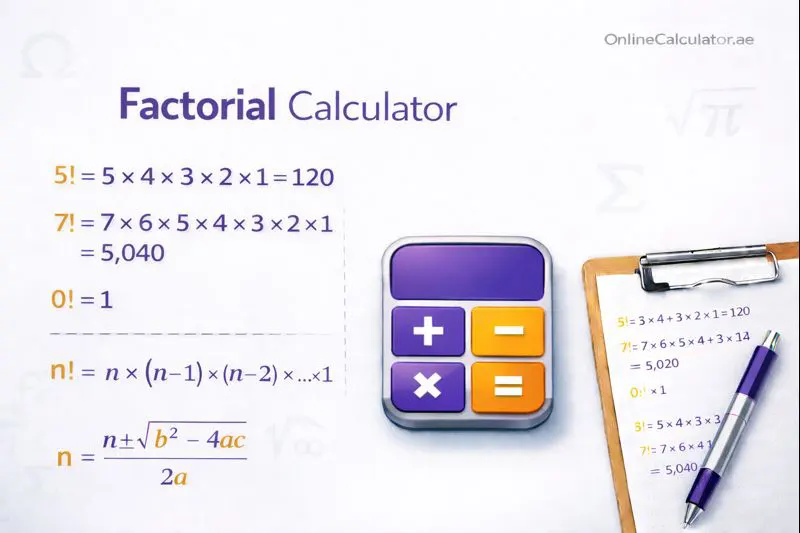
What is a Factorial Calculator?
A factorial calculator computes the product of all positive integers from 1 up to a given number n. Written as n! (pronounced "n factorial"), this mathematical operation appears everywhere—from calculating arrangement possibilities to determining selection outcomes in probability theory.
Our tool at Online Calculator UAE provides:
- Instant computation for integers 0 through 170
- Step-by-step breakdown showing the complete multiplication sequence
- Scientific notation for extremely large results
- Copy-to-clipboard functionality for easy use in other applications
Built with JavaScript's BigInt capabilities and optimized algorithms, this calculator handles numbers that would crash ordinary spreadsheets. The results are mathematically verified and trusted by students and professionals across the scientific and mathematical community.
═══════════════════════════════════════════════════════════════════════════════ ADVANCED FACTORIAL CALCULATOR WIDGET FOR WORDPRESS ELEMENTOR Copy and paste this entire code into Elementor's HTML Widget ═══════════════════════════════════════════════════════════════════════════════ Header Main Calculator Card Input Section ! Buttons Error Message ⚠️ Result Section Steps will be inserted here Will be populated by JS Info Card
How Does Factorial Calculation Work?
The factorial of a non-negative integer n equals the product of all positive integers less than or equal to n. The mathematical notation uses an exclamation mark after the number.
The Factorial Formula
For example, 5! = 5 × 4 × 3 × 2 × 1 = 120
Special Cases
Two important definitions exist by mathematical convention:
- (by definition, this allows formulas for permutations and combinations to work correctly)
- (the product of all integers up to 1 is simply 1)
Step-by-Step Calculation Process
When you enter a number into our calculator:
- Validation: The tool checks that your input is a non-negative integer (whole number 0 or greater)
- Iteration: Starting from 1, the calculator multiplies each consecutive integer up to your input number
- Result Display: The final product appears instantly, with scientific notation for large values
- Breakdown: You see the complete multiplication chain for educational purposes
Why Factorials Grow So Quickly
Factorial values explode in size rapidly. While 10! = 3,628,800, the value of 20! reaches 2,432,902,008,176,640,000100!, you're dealing with a 158-digit number. This exponential growth makes manual calculation impractical, which is precisely why this calculator exists.
Understanding these mathematical relationships also helps when working with probability computationsstatistical analysis.
Example 1: Arranging Books on a Shelf
Scenario: Ahmed, a library coordinator at a Dubai school, needs to determine how many different ways he can arrange 6 different textbooks on a display shelf.
Calculation:
- Number of books: n = 6
- Formula: 6! = 6 × 5 × 4 × 3 × 2 × 1
- Step-by-step: 6 × 5 = 30 → 30 × 4 = 120 → 120 × 3 = 360 → 360 × 2 = 720 → 720 × 1 = 720
Result: There are 720 different arrangements possible. Ahmed can use this information to plan rotating displays throughout the academic year.
Example 2: Lottery Probability Analysis
Scenario: Fatima, a mathematics teacher in Abu Dhabi, wants to explain lottery odds to her students. She's calculating how many ways to choose 4 numbers from 10 for a simplified lottery example.
Calculation (using the combination formula):
- Formula: C(10,4) = 10! ÷ (4! × 6!)
- 10! = 3,628,800
- 4! = 24
- 6! = 720
- C(10,4) = 3,628,800 ÷ (24 × 720) = 3,628,800 ÷ 17,280 = 210
Result: There are 210 possible combinations. This demonstrates how factorials underpin probability calculations—a concept essential in the UAE's growing data science sector.
Example 3: Password Permutation for IT Security
Scenario: Omar, an IT specialist at a DIFC financial firm, needs to calculate the number of unique 8-character passwords possible using only the digits 1, 2, 3, 4, 5, 6, 7, 8 (each used exactly once).
Calculation:
- Number of characters: n = 8
- Formula: 8! = 8 × 7 × 6 × 5 × 4 × 3 × 2 × 1
- Step-by-step: 8 × 7 = 56 → 56 × 6 = 336 → 336 × 5 = 1,680 → 1,680 × 4 = 6,720 → 6,720 × 3 = 20,160 → 20,160 × 2 = 40,320
Result: 40,320 unique permutations exist. Omar uses this analysis to demonstrate why longer passwords with more character types dramatically increase security. For more complex calculations involving repeated elements, a mathematical solver can assist.
Mathematical Rules and Constraints
Factorials only apply to non-negative integers. You cannot calculate the factorial of:
- Negative numbers (e.g., -5! is undefined in standard mathematics)
- Decimals or fractions (e.g., 4.5! requires the Gamma function, a different concept)
- Complex numbers (advanced mathematical extensions exist but aren't covered here)
Computational Limits
Standard JavaScript number precision fails above 170! because the result exceeds the maximum floating-point value. Our calculator uses BigInt technology to display exact values up to 170!, after which JavaScript's inherent limitations apply. For values beyond this range, specialized mathematical software becomes necessary.
Common Mistakes to Avoid
- Confusing permutations with combinations: Factorials calculate arrangements where order matters. For selections where order doesn't matter, use the combination formula with factorials.
- Forgetting 0! = 1: This isn't intuitive but is mathematically essential. The empty product equals 1 by convention.
- Underestimating growth rate: Students often guess that 15! is around a million. It's actually 1,307,674,368,000—over 1 trillion.
Expert Tips
When working with factorial-based formulas:
- Simplify expressions before calculating by canceling common factors (e.g., 10!/8! = 10 × 9 = 90)
- Use logarithms when comparing very large factorials
- Double-check results for smaller values manually to verify your understanding
For problems involving proportional relationships, our ratio tool provides additional support.
Start Calculating Now
Enter any integer from 0 to 170 in the calculator above and receive your factorial result instantly. The step-by-step breakdown helps verify your understanding, while the copy function lets you paste results directly into spreadsheets, documents, or code.
For complex mathematical problems requiring multiple operations, explore our full suite of tools at Online Calculator UAE. Need to verify your work? Cross-reference with Wolfram Alpha or academic mathematics resources.