 OnlineCalculator
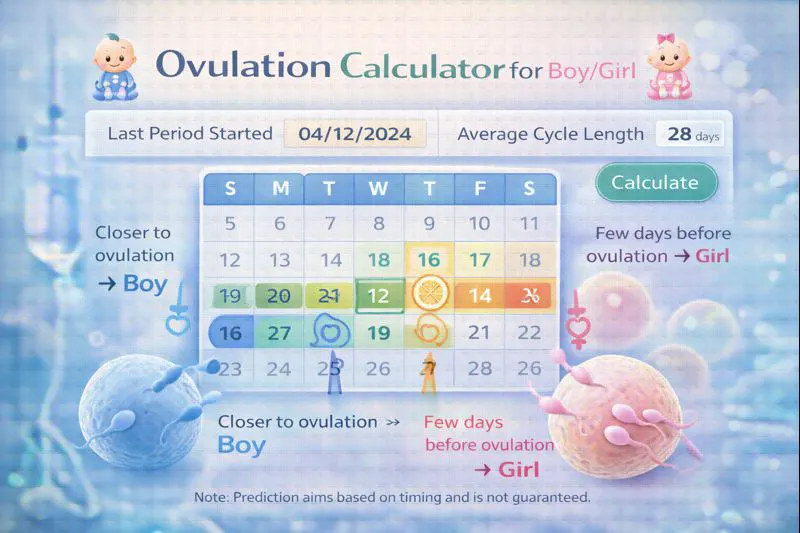
What is an Ovulation Calculator for Gender Planning?
Our ovulation calculator combines traditional fertility tracking with gender prediction timing methods. While no method guarantees a specific gender, understanding your cycle's timing can help you make informed decisions about conception planning.
This calculator is designed for couples who want to:
- Track fertile days accurately - Know exactly when you're most likely to conceive
- Explore timing methods - Understand theories like the Shettles Method and Whelan Method
- Plan conception strategically - Use science-based timing to influence gender probability
- Monitor your cycle patterns - Identify irregularities and optimize conception chances
Whether you're based in Dubai, Abu Dhabi, or anywhere internationally, this calculator uses universal biological principles to help you understand your fertility window. Many couples at hospitals like Burjeel Hospital and Mediclinic use similar tracking methods as part of their fertility planning journey.
html
How Does the Ovulation Calculator for Gender Prediction Work?
Understanding ovulation timing is crucial for both conception and gender planning. Your calculator uses your menstrual cycle data to predict when you're most fertile and applies timing theories that may influence gender probability.
The Science Behind Ovulation Timing
Ovulation typically occurs 14 days before your next period starts. For a standard 28-day cycle, this means ovulation happens around day 14. However, cycle lengths vary from 21 to 35 days, making personalized calculation essential.
The Calculation Method:
- Step 1: Enter your last menstrual period (LMP) start date
- Step 2: Input your average cycle length (typically 25-35 days)
- Step 3: The calculator determines your ovulation day using the formula: Cycle Length - 14 days
- Step 4: Your fertile window is identified (typically 5 days before and 1 day after ovulation)
Gender Prediction Timing Theories
Shettles Method (1960s): This theory suggests that male sperm (Y-chromosome) are faster but less resilient, while female sperm (X-chromosome) are slower but survive longer. According to this method:
- For a boy: Intercourse on the day of ovulation or 24 hours before
- For a girl: Intercourse 2-4 days before ovulation, then abstaining until after ovulation
Whelan Method (1970s): This method suggests different timing based on biochemical changes during the cycle:
- For a boy: Intercourse 4-6 days before ovulation
- For a girl: Intercourse 2-3 days before ovulation
Important Note: These methods are not scientifically proven to guarantee gender selection. Natural conception has approximately a 50/50 chance for either gender. The calculator provides timing guidance based on these historical theories, but results are not guaranteed.
Example 1: Sarah from Dubai Marina - Regular 28-Day Cycle
Background: Sarah has been tracking her cycle for six months and knows she has a consistent 28-day cycle. Her last period started on January 1st, 2026.
Calculator Inputs:
- Last Menstrual Period: January 1, 2026
- Cycle Length: 28 days
- Preference: Exploring timing for a girl
Calculation Process:
- Ovulation Day = 28 - 14 = Day 14 (January 14, 2026)
- Fertile Window = January 9-15, 2026
- Peak Fertility = January 13-14, 2026
- Shettles Method (Girl) = January 10-12, 2026
Result: Sarah's most fertile days are January 13-14. If following the Shettles Method for a girl, she should plan conception attempts for January 10-12, avoiding the peak ovulation days. She can track her progress alongside her pregnancy planning journey.
Example 2: Fatima from Abu Dhabi - Longer 32-Day Cycle
Background: Fatima has a 32-day cycle and wants to understand her fertility pattern. Her last period was December 20, 2025.
Calculator Inputs:
- Last Menstrual Period: December 20, 2025
- Cycle Length: 32 days
- Preference: Exploring timing for a boy
Calculation Process:
- Ovulation Day = 32 - 14 = Day 18 (January 6, 2026)
- Fertile Window = January 1-7, 2026
- Peak Fertility = January 5-6, 2026
- Shettles Method (Boy) = January 5-6, 2026 (on ovulation day)
Result: With her longer cycle, Fatima ovulates later than someone with a 28-day cycle. For the Shettles boy method, she should plan conception attempts on January 5-6, coinciding with her peak fertility. Monitoring basal body temperature can provide additional confirmation.
Example 3: Aisha from Sharjah - Irregular Cycle (26-30 Days)
Background: Aisha's cycle varies between 26-30 days. She uses the average of 28 days but wants to understand the margin of error.
Calculator Inputs:
- Last Menstrual Period: January 5, 2026
- Cycle Length: 28 days (average)
- Cycle Variation: ±2 days
Calculation Process:
- Estimated Ovulation = January 19, 2026 (±2 days)
- Possible Ovulation Range = January 17-21, 2026
- Extended Fertile Window = January 14-22, 2026
- Peak Fertility Period = January 17-20, 2026
Result: For irregular cycles, Aisha should use a wider fertile window. Combining this calculator with ovulation predictor kits (available at pharmacies across UAE) and tracking her menstrual cycle patterns will give the most accurate results.
Understanding Gender Selection Limitations
While timing methods are popular, it's essential to understand that natural conception has approximately 50% probability for either gender, regardless of timing. The only scientifically proven methods for gender selection involve medical procedures like PGD (Preimplantation Genetic Diagnosis), which is regulated differently across countries.
In the UAE, medical gender selection for non-medical reasons has specific regulations. Families interested in medical gender selection should consult with fertility specialists at accredited centers like Fakih IVF or Conceive Hospital.
Common Mistakes to Avoid
- Relying solely on calendar calculations - Use multiple tracking methods including ovulation tests and physical symptoms
- Assuming all cycles are 28 days - Track your individual cycle for 3-6 months for accuracy
- Ignoring cycle irregularities - Stress, travel, and health conditions affect ovulation timing
- Expecting guaranteed results - Timing methods may slightly influence probability but cannot guarantee gender
Expert Tips for Accurate Tracking
Combine Multiple Methods: Use this calculator alongside ovulation predictor kits, cervical mucus monitoring, and basal body temperature tracking for the most accurate fertile window identification.
Track for Several Months: Monitor at least 3-6 cycles before relying on predictions. This helps identify your personal patterns and irregularities.
Consider Professional Guidance: If you're struggling to conceive or want medical gender selection, consult reproductive specialists. Many couples visiting the Health & Fitness calculator section also track their overall health metrics for optimal conception conditions.
Health and Lifestyle Factors: Maintain your healthy weight, ensure adequate nutrition, and optimize your overall wellness to improve fertility regardless of gender preferences.
Start Tracking Your Ovulation Today
Understanding your fertility window is the first step toward conception, whether you're hoping for a boy, girl, or simply planning to start your family. Use our calculator above to identify your most fertile days and explore timing methods used by couples worldwide.
Remember that while timing theories exist, natural conception outcomes remain largely equal. The most important factor is your overall reproductive health and regular ovulation patterns. For personalized medical advice, consult with reproductive specialists at accredited facilities throughout the UAE.
Ready to plan your journey? Try our pregnancy chance calculator to understand your conception probability, or use our due date calculator once you achieve pregnancy. Visit Online Calculator UAE for more health and planning tools.