 OnlineCalculator
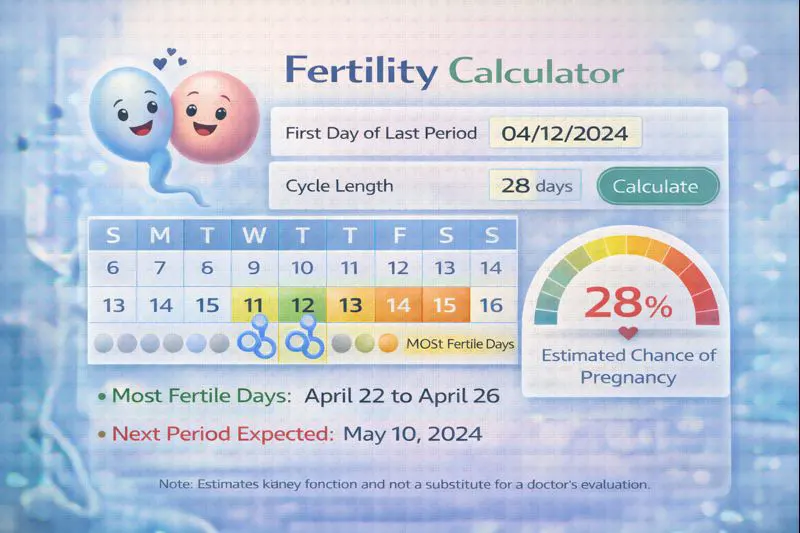
Understanding your fertility window is crucial for family planning. Our fertility calculator helps you identify your most fertile days based on your menstrual cycle, giving you accurate predictions for ovulation and the best time to conceive. Whether you're trying to get pregnant or simply tracking your reproductive health, this tool provides personalized insights for women across the UAE and internationally.
What Is a Fertility Calculator?
A fertility calculator is a specialized tool that analyzes your menstrual cycle data to predict your fertile window—the days when you're most likely to conceive. By tracking your cycle length and the first day of your last period, the calculator estimates when ovulation occurs and highlights your peak fertility days.
This Online Calculator UAE tool is part of our comprehensive Health & Fitness calculator suite, designed to help women make informed decisions about their reproductive health.
Key Benefits:
- Accurate ovulation prediction based on your unique cycle pattern
- Identify your 6-day fertile window when conception is most likely
- Track multiple cycles to understand your body's natural rhythm
- Plan ahead for pregnancy or contraception purposes
- Free and easy to use with instant results
Women throughout Dubai, Abu Dhabi, Sharjah, and internationally trust this calculator for family planning. The tool uses scientifically-backed methods recommended by fertility specialists worldwide.
html
How Does the Fertility Calculator Work?
The fertility calculator uses the standard method employed by gynecologists and reproductive health experts. It's based on the biological fact that ovulation typically occurs 14 days before the start of your next menstrual period.
The Calculation Method:
The calculator follows this scientific approach:
Step 1: Determine Your Cycle Length
Your menstrual cycle is counted from the first day of your period to the day before your next period starts. Most women have cycles between 21-35 days, with 28 days being average.
Step 2: Calculate Ovulation Day
Formula: Cycle Length - 14 days = Ovulation Day
For a 28-day cycle: Day 14 is typically ovulation day
For a 30-day cycle: Day 16 is typically ovulation day
Step 3: Identify the Fertile Window
Your fertile window spans : the 5 days before ovulation plus ovulation day itself. Sperm can survive in the reproductive tract for up to 5 days, while an egg survives for 12-24 hours after release.
Important Notes:
This calculator provides estimates based on average cycle patterns. Individual variations exist due to stress, health conditions, age, and lifestyle factors. For the most accurate tracking, consider combining this tool with our ovulation tracking methods or consulting fertility specialists at reputable clinics in Dubai Healthcare City or Abu Dhabi's specialized centers.
Women with irregular cycles may need additional monitoring. If your cycle varies by more than 7-9 days month-to-month, speak with a healthcare provider for personalized guidance.
Example 1: Regular 28-Day Cycle
Scenario: Fatima, a 29-year-old teacher in Dubai, has a consistent 28-day menstrual cycle. Her last period started on January 1, 2026.
Input Values:
- First day of last period: January 1, 2026
- Average cycle length: 28 days
Calculation:
- Ovulation day = Cycle day 14 (28 - 14 = 14)
- Ovulation date = January 14, 2026
- Fertile window = January 9-14, 2026 (6 days total)
- Most fertile days = January 12-14, 2026
- Next period expected = January 29, 2026
Result: Fatima's best chance of conception is between January 12-14, with ovulation occurring on January 14. She can also use our conception probability tool to understand her chances on specific days.
Example 2: Longer 32-Day Cycle
Scenario: Sarah, a 32-year-old marketing manager in Abu Dhabi, has a 32-day cycle. Her period began on February 1, 2026.
Input Values:
- First day of last period: February 1, 2026
- Average cycle length: 32 days
Calculation:
- Ovulation day = Cycle day 18 (32 - 14 = 18)
- Ovulation date = February 18, 2026
- Fertile window = February 13-18, 2026
- Peak fertility = February 16-18, 2026
- Expected next period = March 5, 2026
Result: Sarah's fertile window is later in her cycle compared to someone with a 28-day cycle. This is perfectly normal for longer cycles, and understanding this timing improves her family planning accuracy.
Example 3: Shorter 25-Day Cycle
Scenario: Layla, a 27-year-old nurse in Sharjah, experiences shorter cycles averaging 25 days. Her last period was on March 1, 2026.
Input Values:
- First day of last period: March 1, 2026
- Average cycle length: 25 days
Calculation:
- Ovulation day = Cycle day 11 (25 - 14 = 11)
- Ovulation date = March 11, 2026
- Fertile window = March 6-11, 2026
- Highest fertility = March 9-11, 2026
- Next period due = March 26, 2026
Result: Layla ovulates earlier than average, meaning her fertile window occurs just a week after her period ends. Women with shorter cycles should track carefully as the fertile window comes quickly. Consider using our fertile day tracker for ongoing monitoring.
Age and Fertility Considerations
Age significantly impacts fertility. Women in their 20s have approximately 25-30% chance of conceiving each cycle, while this decreases to about 15-20% in the mid-30s and below 5% after age 40. Many fertility clinics in Dubai and Abu Dhabi offer comprehensive assessments for women over 35.
Cycle Irregularity Factors
Several factors can affect cycle regularity:
- Stress levels: High-pressure jobs common in Dubai's business districts can impact hormonal balance
- Body weight: Both underweight and overweight conditions affect ovulation—maintain healthy metrics with our weight assessment tool
- Medical conditions: PCOS, thyroid disorders, and endometriosis require specialized care
- Lifestyle factors: Exercise intensity, sleep patterns, and diet quality
Common Mistakes to Avoid
Mistake #1: Assuming a 28-day cycle applies to everyone. Track your own pattern for at least 3 months.
Mistake #2: Only focusing on ovulation day. The 5 days before ovulation are equally important for conception.
Mistake #3: Ignoring cycle variations. If your cycle length changes by more than 7 days between months, consult a gynecologist.
Mistake #4: Not considering other fertility signs like cervical mucus changes and basal body temperature shifts.
Expert Tips for UAE Residents
Schedule fertility consultations at reputable centers like Conceive Fertility Center in Dubai or Fakih IVF in Abu Dhabi if you've been trying for more than 12 months (or 6 months if over 35). Many health insurance plans in the UAE now include fertility assessments.
Optimize your fertility with proper nutritional intake, regular exercise, and stress management. Dubai's climate requires special attention to hydration—use our daily water needs calculator to stay properly hydrated for optimal reproductive health.
Start Tracking Your Fertility Today
Use our free fertility calculator above to identify your most fertile days and take control of your family planning journey. Whether you're a UAE resident in Dubai, Abu Dhabi, or Sharjah, or tracking from anywhere internationally, this tool provides the insights you need for informed reproductive health decisions.
For the most accurate results, track your cycles for at least three months and consider combining this calculator with our menstrual cycle tracker. If you're planning pregnancy, explore our pregnancy planning tools for comprehensive support throughout your journey.
Remember, while this calculator is a valuable planning tool, always consult healthcare professionals for personalized medical advice. Many excellent fertility specialists practice throughout the UAE's major healthcare facilities.