 OnlineCalculator
What Is a Quadratic Calculator?
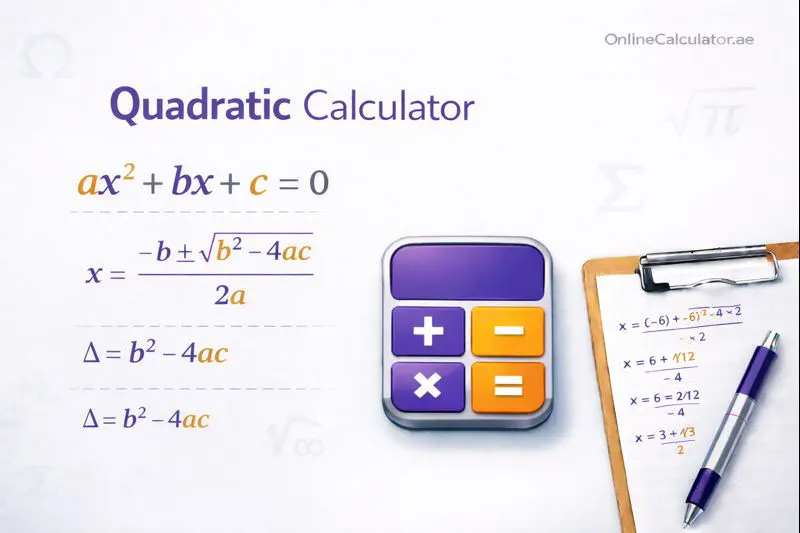
A quadratic calculator is a specialized mathematical tool designed to solve second-degree polynomial equations. These equations follow the standard form , where a, b, and c are coefficients and x represents the unknown variable.
This calculator from Online Calculator UAE handles every type of quadratic equation—whether it yields two distinct roots, one repeated root, or complex conjugate pairs.
Key benefits of using this quadratic solver:
- Instant Solutions: Get both roots within milliseconds, eliminating manual calculation errors
- Step-by-Step Breakdown: Understand the solution process with detailed explanations using the quadratic formula
- Complex Number Support: Handles negative discriminants and displays complex roots in a + bi form
- Visual Graphing: See the parabola plotted with vertex, axis of symmetry, and x-intercepts clearly marked
Trusted by thousands of students and professionals across the UAE and internationally, this tool provides mathematically verified results you can depend on for homework, exams, and real-world applications.
═══════════════════════════════════════════════════════════════════════════════ ADVANCED QUADRATIC CALCULATOR WIDGET For WordPress Elementor HTML Widget ═══════════════════════════════════════════════════════════════════════════════ Header Input Section ⚠️ Results Section ✓ Roots will be inserted here Δ Discriminant info will be inserted here Step by Step 📝
📊 Properties will be inserted here 📈
The Quadratic Formula
Every quadratic equation of the form ax² + bx + c = 0 can be solved using the quadratic formula:
x = (-b ± √(b² - 4ac)) / 2a
This formula, derived from completing the square, guarantees a solution for any quadratic equation—provided the coefficient 'a' is not zero.
Step-by-Step Calculation Process
Step 1: Identify Coefficients
Extract the values of a, b, and c from your equation. For example, in 2x² - 5x + 3 = 0, you have a = 2, b = -5, and c = 3.
Step 2: Calculate the Discriminant
The discriminant (Δ = b² - 4ac) determines the nature of your roots. A positive discriminant yields two distinct real roots, zero gives one repeated root, and a negative discriminant produces complex conjugate roots.
Step 3: Apply the Formula
Substitute your values into x = (-b ± √Δ) / 2a to find both solutions.
Step 4: Simplify Results
The calculator reduces fractions and simplifies radicals automatically, presenting answers in their most elegant form.
Understanding the Discriminant
| Discriminant Value | Nature of Roots | Graph Behavior |
|---|---|---|
| Δ > 0 | Two distinct real roots | Parabola crosses x-axis at two points |
| Δ = 0 | One repeated real root | Parabola touches x-axis at vertex |
| Δ < 0 | Two complex conjugate roots | Parabola doesn't cross x-axis |
Important Note: When working with equations where the leading coefficient is negative (a < 0), the parabola opens downward instead of upward. This affects maximum/minimum value calculations but doesn't change how roots are computed.
Example 1: Standard Equation with Two Real Roots
Scenario: A physics student in Dubai is calculating projectile motion and needs to solve x² - 5x + 6 = 0 to find when an object reaches ground level.
Input Values:
- a = 1
- b = -5
- c = 6
Solution Process:
Discriminant: Δ = (-5)² - 4(1)(6) = 25 - 24 = 1
Since Δ > 0, we have two distinct real roots.
x = (5 ± √1) / 2(1) = (5 ± 1) / 2
x₁ = (5 + 1) / 2 = 3
x₂ = (5 - 1) / 2 = 2
Result: The object reaches ground level at t = 2 seconds and t = 3 seconds. These roots can be verified: both (3)² - 5(3) + 6 = 0 and (2)² - 5(2) + 6 = 0.
Example 2: Equation with a Repeated Root
Scenario: An engineering student needs to find the vertex point of a parabolic arch by solving x² - 6x + 9 = 0.
Input Values:
- a = 1
- b = -6
- c = 9
Solution Process:
Discriminant: Δ = (-6)² - 4(1)(9) = 36 - 36 =
Since Δ = 0, we have exactly one repeated root.
x = (6 ± √0) / 2(1) = 6 / 2 = 3
Result: The single root x = 3 indicates the parabola's vertex touches the x-axis at this point. This represents a perfect square trinomial: (x - 3)² = 0.
Example 3: Complex Roots (Negative Discriminant)
Scenario: A mathematics instructor is demonstrating complex numbers to advanced students using the equation x² + 2x + 5 = 0.
Input Values:
- a = 1
- b = 2
- c = 5
Solution Process:
Discriminant: Δ = (2)² - 4(1)(5) = 4 - 20 = -16
Since Δ < 0, the roots are complex conjugates.
x = (-2 ± √-16) / 2(1) = (-2 ± 4i) / 2
x₁ = -1 + 2i
x₂ = -1 - 2i
Result: The complex conjugate pair indicates the parabola never crosses the x-axis. If you need to work with these complex numbers further, our algebraic equation solver can help with additional operations.
Common Mistakes to Avoid
Sign Errors: The most frequent mistake involves incorrect signs. When your equation is 3x² + 7x - 2 = 0, remember that b = +7 (positive) and c = -2 (negative). Double-check these values before calculating.
Coefficient 'a' Cannot Be Zero: If a = 0, you don't have a quadratic equation—you have a linear equation. Use a linear equation solver instead.
Forgetting the ± Symbol: The quadratic formula always produces two solutions (though they may be equal or complex). Never stop after finding just one root.
When to Factor vs. Use the Formula
Simple equations like x² - 4 = 0 factor easily to (x+2)(x-2) = 0. However, the quadratic formula works universally. Our calculator uses the formula method for consistency and handles all edge cases automatically.
Verification Technique
Always verify your solutions by substituting back into the original equation. Both roots should yield exactly zero (or very close to zero for decimal answers due to rounding).
Applications Beyond Mathematics
- Physics: Projectile motion, kinematic equations, and free-fall problems
- Engineering: Structural load calculations and signal processing
- Finance: Break-even analysis and optimization problems
- Computer Graphics: Ray-sphere intersection calculations for rendering
For statistical analysis involving quadratic relationships, consider using our statistical analysis tools alongside this calculator.
Start Solving Quadratic Equations Now
Enter your coefficients above and get instant, accurate solutions with complete step-by-step explanations. Bookmark this page for quick access during study sessions or professional calculations.
For comprehensive mathematical resources, explore the full Scientific & Math Calculator collection at Online Calculator UAE.
Have questions or suggestions? We continuously improve our tools based on user feedback. Your calculations are processed entirely in your browser—no data is stored or transmitted.