 OnlineCalculator
What Is a Probability Calculator?
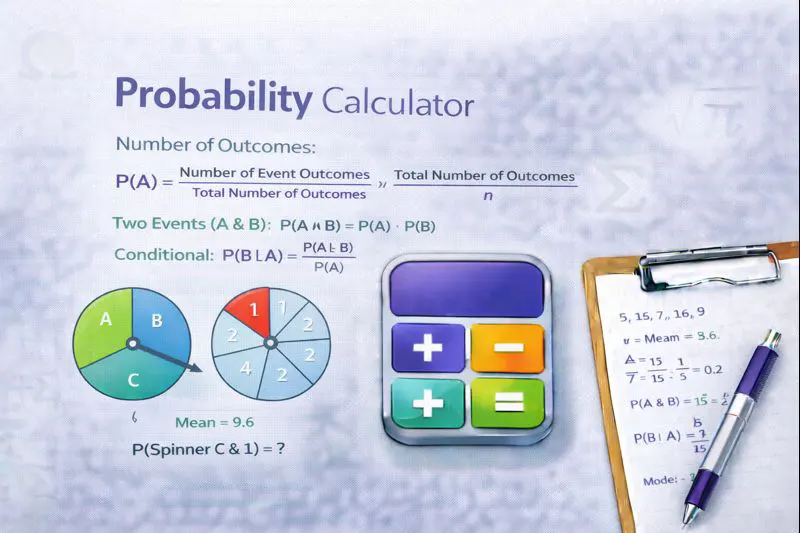
A probability calculator is a mathematical tool that determines the likelihood of specific events occurring. From calculating the chances of winning a game to assessing business risks in Dubai or Abu Dhabi, probability calculations form the foundation of informed decision-making across countless fields.
Key benefits of using this calculator:
- Instant accuracy – Get precise probability values without manual computation errors
- Multiple calculation types – Single events, combined events, conditional probability, and complementary probability
- Step-by-step breakdowns – Understand exactly how each result is calculated
- Free and accessible – No registration required, works on any device
This calculator uses standard probability formulas recognized by educational institutions and statistical organizations worldwide. Whether you're working on academic projects or professional analysis, the results align with internationally accepted mathematical standards.
ADVANCED PROBABILITY CALCULATOR - WordPress Elementor HTML Widget Copy and paste this entire code into your Elementor HTML widget Navigation Tabs Single Event Section P 💡 Combined (AND) Section ∩ 💡
× Either/Or Section ∪ 💡 Conditional Section | 💡 Complement Section ¬ 💡
How the Probability Calculator Works
Probability measures the likelihood of an event occurring, expressed as a value between (impossible) and 1 (certain). You can also express this as a percentage value between 0% and 100%.
Basic Probability Formula
The fundamental probability formula is:
P(A) = Number of favorable outcomes ÷ Total number of possible outcomes
For example, the probability of rolling a 4 on a standard six-sided die equals 1 ÷ 6 = 0.1667 or approximately 16.67%.
Types of Probability Calculations
Single Event Probability: The likelihood of one specific outcome occurring. Simply divide favorable outcomes by total outcomes.
Combined Probability (AND): When you need both events to occur, multiply individual probabilities together. P(A AND B) = P(A) × P(B) for independent events.
Either/Or Probability (OR): When either event satisfies your condition, add probabilities and subtract the overlap. P(A OR B) = P(A) + P(B) - P(A AND B).
Complementary Probability (NOT): The probability that an event does NOT occur equals 1 minus the probability it does occur. P(NOT A) = 1 - P(A).
Conditional Probability: The probability of event A occurring given that event B has already occurred. P(A|B) = P(A AND B) ÷ P(B).
Important Considerations
These formulas assume independent events unless otherwise specified. For dependent events (where one outcome affects another), calculations require adjustment. The calculator handles both scenarios when you provide the correct inputs.
Example 1: Event Planning in Dubai
Scenario: Fatima manages corporate events in Dubai Marina. Historical data shows that 85% of confirmed attendees actually show up to events. She has 200 confirmed guests for an upcoming conference.
Calculation – Expected Attendance:
- Probability of attendance: P = 0.85
- Expected attendees: 200 × 0.85 = 170 people
Calculating probability that at least 160 attend:
Using the normal approximation: Mean = 170, Standard Deviation = √(200 × 0.85 × 0.15) = 5.05
Z-score for 160: (160 - 170) ÷ 5.05 = -1.98
Probability of at least 160 attending: approximately 97.6%
Result: Fatima can confidently plan for 160-180 attendees, with a 97.6% chance of meeting her minimum threshold.
Example 2: Quality Control at a Manufacturing Facility
Scenario: Ahmed works at a factory in Jebel Ali Free Zone. The production line has a 2% defect rate. He randomly selects 5 items for inspection.
Calculation – Probability of finding at least one defect:
- Probability of defect per item: P = 0.02
- Probability of no defect: P(no defect) = 0.98
- Probability all 5 items have no defects: 0.98^5 = 0.9039
- Probability of at least one defect: 1 - 0.9039 = 0.0961 or 9.61%
Result: Ahmed has approximately a 9.61% chance of finding at least one defective item in his 5-item sample.
Example 3: Investment Decision Analysis
Scenario: Sara, a financial analyst in DIFC, evaluates two independent investment opportunities. Investment A has a 60% success probability, and Investment B has a 45% success probability.
Calculation – Various Probability Scenarios:
Both investments succeed (AND):
P(A AND B) = 0.60 × 0.45 = 0.27 or 27%
At least one investment succeeds (OR):
P(A OR B) = 0.60 + 0.45 - 0.27 = 0.78 or 78%
Only Investment A succeeds:
P(A AND NOT B) = 0.60 × (1 - 0.45) = 0.60 × 0.55 = 0.33 or 33%
Result: Sara can present a 78% probability of achieving at least one successful investment, helping stakeholders understand overall portfolio risk. For more complex statistical analysis, she can combine multiple probability calculations.
Independent vs. Dependent Events
Events are when one outcome doesn't affect another. Coin flips and dice rolls are classic examples. Use multiplication directly: P(A AND B) = P(A) × P(B).
Events are when one outcome changes the probability of another. Drawing cards without replacement demonstrates this. Adjust calculations accordingly: P(A AND B) = P(A) × P(B|A).
Two events are when they cannot occur simultaneously. Rolling a 3 and rolling a 5 on a single die roll are mutually exclusive. For such events: P(A OR B) = P(A) + P(B) without subtracting overlap.
Common Mistakes to Avoid
- Assuming independence – Verify whether events actually influence each other before applying simple multiplication
- Probability exceeding 1 – Valid probability values never exceed 1 (or 100%). If your calculation shows otherwise, review your inputs
- Ignoring complementary events – Sometimes calculating P(NOT A) and subtracting from 1 is simpler than direct calculation
- Confusing "and" with "or" – "And" requires multiplication (both must happen); "or" involves addition (either can happen)
Professional Applications
Probability calculations support decision-making across industries: insurance risk assessment, medical diagnosis, financial modeling, quality control, and project management. Organizations in the UAE commonly apply these principles when analyzing market conditions and operational risks.
Start Calculating Probability Now
Use the calculator above to solve any probability question instantly. Enter your values, select the calculation type, and receive step-by-step results. Whether you're analyzing business risks, completing coursework, or satisfying curiosity, accurate probability calculations are just a few clicks away.
For comprehensive mathematical tools, explore Online Calculator UAE. Our collection includes tools for mathematical and scientific calculations, statistical analysis, and much more.
Have questions or feedback? This calculator is regularly updated to ensure accuracy and user-friendliness based on community input.