 OnlineCalculator
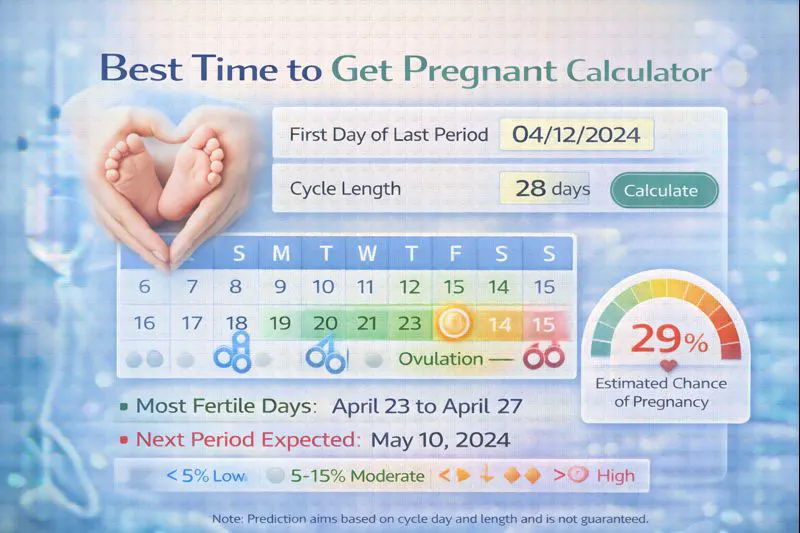
helps you identify your most fertile days each month based on your menstrual cycle. Whether you're actively trying to conceive or planning for the future, this free tool provides personalized insights into your fertility window, ovulation dates, and optimal conception timing. Free to use anywhere, this calculator combines scientific menstrual cycle tracking with user-friendly design.
Understanding Your Fertile Window
The Best Time to Get Pregnant Calculator uses your menstrual cycle information to predict when you're most likely to conceive. Your fertile window typically spans - the five days leading up to ovulation plus ovulation day itself. Sperm can survive in the female reproductive tract for up to 5 days, while an egg remains viable for approximately 12-24 hours after release.
This calculator is designed for women who want to:
- by identifying peak fertility days
- Plan ahead for family planning and timing pregnancy
- Understand their cycle better through tracking patterns
- by knowing exactly when to focus efforts
Whether you're based in Dubai, Abu Dhabi, or anywhere internationally, this tool provides scientifically-backed predictions based on standard gynecological calculations. The calculator works for women with regular cycles and can be used alongside other Health & Fitness calculator tools for comprehensive wellness tracking.
html
How the Best Time to Get Pregnant Calculator Works
Our calculator uses the Calendar Method combined with established ovulation science to predict your fertile window. The calculation is based on the fact that ovulation typically occurs 14 days before your next period starts, regardless of cycle length.
Calculation Methodology
The calculator follows this scientific approach:
Step 1: Ovulation Date Prediction
Ovulation Date = First Day of Last Period + (Cycle Length - 14 days)
Step 2: Fertile Window Calculation
Fertile Window Start = Ovulation Date - 5 days
Fertile Window End = Ovulation Date + 1 day
Step 3: Peak Fertility Days
The 2-3 days before ovulation plus ovulation day represent your peak fertility period, when conception probability is highest (approximately 20-30% per cycle).
The calculator requires two key inputs: the first day of your last menstrual period (LMP) and your . Most women have cycles between 21-35 days, with 28 days being average. For best results, track your cycle for 2-3 months to determine your personal average.
Important Note: This calculator is most accurate for women with regular menstrual cycles. If your cycle varies by more than 7-9 days month-to-month, consider using an ovulation tracking tool or consult a healthcare provider for personalized guidance.
Example 1: Sarah - Regular 28-Day Cycle
Scenario: Sarah, a 29-year-old marketing professional in Dubai Marina, has a regular 28-day cycle. Her last period started on January 1, 2026.
Calculator Inputs:
- Last Menstrual Period: January 1, 2026
- Cycle Length: 28 days
Calculation Process:
- Ovulation Date = January 1 + (28 - 14) = January 15, 2026
- Fertile Window Start = January 15 - 5 = January 10, 2026
- Fertile Window End = January 15 + 1 = January 16, 2026
Results: Sarah's fertile window is January 10-16, with peak fertility days being January 13-15. For maximum conception chances, she should focus on these peak days. Using our fertility planning tools alongside this calculator can provide additional insights.
Example 2: Amira - Longer 32-Day Cycle
Scenario: Amira, a 32-year-old teacher in Abu Dhabi, has a slightly longer but consistent 32-day cycle. Her period began on January 5, 2026.
Calculator Inputs:
- Last Menstrual Period: January 5, 2026
- Cycle Length: 32 days
Calculation Process:
- Ovulation Date = January 5 + (32 - 14) = January 23, 2026
- Fertile Window Start = January 23 - 5 = January 18, 2026
- Fertile Window End = January 23 + 1 = January 24, 2026
Results: Amira's fertile window is January 18-24, with peak conception probability on January 21-23. This example shows how cycle length affects timing - longer cycles mean later ovulation.
Example 3: Linda - Shorter 25-Day Cycle
Scenario: Linda, a 27-year-old nurse at a Sharjah hospital, has a shorter but regular 25-day cycle. Her last period was January 8, 2026.
Calculator Inputs:
- Last Menstrual Period: January 8, 2026
- Cycle Length: 25 days
Calculation Process:
- Ovulation Date = January 8 + (25 - 14) = January 19, 2026
- Fertile Window Start = January 19 - 5 = January 14, 2026
- Fertile Window End = January 19 + 1 = January 20, 2026
Results: Linda's fertile window opens earlier at January 14-20, with optimal days being January 17-19. Women with shorter cycles ovulate earlier in their cycle, making early tracking crucial for conception planning.
Factors That Affect Fertility Timing
While the calculator provides accurate predictions for regular cycles, several factors can influence your actual ovulation timing:
Cycle Irregularity: Stress, travel, illness, or hormonal changes can shift ovulation timing. Women with PCOS or thyroid conditions may experience irregular ovulation patterns. If your cycle varies significantly, consider combining this calculator with menstrual tracking tools or ovulation test kits.
Age-Related Fertility: Fertility naturally declines with age, particularly after 35. While the calculator identifies your fertile window accurately, conception chances per cycle decrease from about 25% in your 20s to 15% in your late 30s. Maintaining overall health through proper and exercise supports reproductive health.
Lifestyle Factors: Weight extremes (underweight or overweight), smoking, excessive alcohol, and poor sleep can impact ovulation regularity. The UAE's hot climate also requires adequate hydration - use a water intake calculator to ensure proper hydration for optimal reproductive function.
Common Mistakes to Avoid
- Assuming all cycles are 28 days - Track your personal cycle length
- Counting from the end of period - Always count from the first day
- Limiting attempts to one day - The entire fertile window offers conception opportunities
- Ignoring cervical mucus signs - Physical fertility signs complement calculator predictions
When to Seek Medical Advice
Consult a healthcare provider if you're under 35 and haven't conceived after 12 months of trying, or if you're over 35 and haven't conceived after 6 months. Dubai and Abu Dhabi have excellent fertility clinics that can provide comprehensive testing and support.
Start Planning Your Journey to Parenthood
Use our today to identify your optimal conception window. Simply enter your last menstrual period date and average cycle length to receive personalized predictions. The calculator is completely free, requires no registration, and provides instant results you can save or print for reference.
For comprehensive family planning support, explore additional resources on Online Calculator UAE. Remember that while this calculator provides scientifically-backed predictions, every woman's body is unique. Combining calculator insights with awareness of your body's natural fertility signs creates the most effective approach to conception planning.