 OnlineCalculator
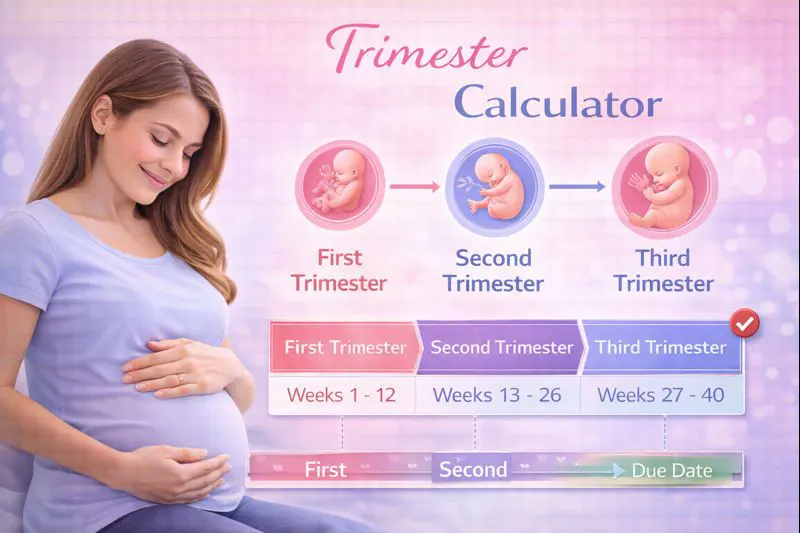
Understanding Your Pregnancy Trimesters
Pregnancy is divided into three distinct trimesters, each lasting approximately 13-14 weeks. Our Health & Fitness calculator helps you determine exactly which trimester you're in based on your last menstrual period (LMP) or conception date.
Here's what our trimester calculator offers:
- Accurate trimester identification based on your due date or LMP
- Week-by-week breakdown of your pregnancy progression
- Key milestones for each trimester to help you prepare
- Development insights about your baby's growth at each stage
This calculator is trusted by expectant mothers worldwide and provides medically accurate information aligned with international pregnancy guidelines. Whether you're planning your maternity leave, scheduling prenatal appointments, or simply curious about your pregnancy stage, this tool gives you instant answers.
html
0%How the Trimester Calculator Works
Understanding how pregnancy trimesters are calculated helps you track your journey accurately. Pregnancy typically lasts 40 weeks (280 days) from the first day of your last menstrual period.
Trimester Breakdown:
First Trimester: Week 1 to Week 13 (approximately 3 months)
Second Trimester: Week 14 to Week 27 (approximately 3 months)
Third Trimester: Week 28 to Week 40+ (approximately 3 months)
Calculation Method:
The calculator uses your or conception date to determine your current week of pregnancy. It then classifies this into the appropriate trimester. Here's the step-by-step process:
- Input your LMP date or conception date into the calculator
- The system calculates how many days have passed since that date
- Days are converted into weeks (divide by 7)
- Current week determines which trimester you're in
- Calculator displays your trimester, current week, and estimated due date
Important Note: Pregnancy dating is most accurate when based on your LMP if you have regular menstrual cycles. If your cycles are irregular, your doctor may use an ultrasound scan to determine more accurate dating. Our due date calculator can help you estimate your delivery date.
Example 1: First-Time Mother in Dubai Marina
Sarah, a 28-year-old marketing professional working in Dubai Marina, had her last menstrual period on October 1, 2025. She wants to know which trimester she's in on January 16, 2026.
Calculation Steps:
- LMP Date: October 1, 2025
- Current Date: January 16, 2026
- Days elapsed: 107 days
- Weeks of pregnancy: 107 ÷ 7 = 15.3 weeks
- Result: Second Trimester (Week 15)
Sarah is now in her second trimester, the period often called the "honeymoon phase" of pregnancy. She can expect reduced nausea and increased energy levels. Her pregnancy milestones indicate she's past the highest risk period for miscarriage.
Example 2: Expecting Mother in Abu Dhabi
Fatima knows her conception date was December 10, 2025 (confirmed by her doctor at Burjeel Hospital). On January 16, 2026, she wants to calculate her trimester.
Calculation Steps:
- Conception Date: December 10, 2025
- Add 14 days to get equivalent LMP: November 26, 2025
- Current Date: January 16, 2026
- Days from equivalent LMP: 51 days
- Weeks of pregnancy: 51 ÷ 7 = 7.3 weeks
- Result: First Trimester (Week 7)
Fatima is in her first trimester, a crucial period for fetal development. Her baby's major organs are beginning to form. She should ensure adequate nutritional intake and avoid certain foods as recommended by her healthcare provider.
Example 3: Late Pregnancy in Sharjah
Aisha, living in Sharjah, had her LMP on June 15, 2025. She's preparing for delivery and wants to confirm her trimester on January 16, 2026.
Calculation Steps:
- LMP Date: June 15, 2025
- Current Date: January 16, 2026
- Days elapsed: 215 days
- Weeks of pregnancy: 215 ÷ 7 = 30.7 weeks
- Result: Third Trimester (Week 30)
Aisha is in her third trimester, the final stretch before delivery. At 30 weeks, her baby is developing rapidly, gaining weight, and preparing for life outside the womb. She should be monitoring her pregnancy weight gain and discussing her birth plan with her obstetrician.
First Trimester Considerations (Weeks 1-13)
The first trimester is critical for fetal development. Many women experience morning sickness, fatigue, and hormonal changes. Key developmental milestones include the formation of the neural tube, heart, and major organs. Prenatal vitamins with folic acid are essential during this period.
Second Trimester Highlights (Weeks 14-27)
Most women find the second trimester more comfortable. Energy levels typically improve, and morning sickness subsides. Your baby's movements become noticeable around weeks 18-20. This is when many expecting parents have their anatomy scan to check fetal development and potentially learn the baby's gender using a gender prediction tool.
Third Trimester Preparation (Weeks 28-40+)
The final trimester focuses on fetal growth and preparation for delivery. Your baby gains most of their birth weight during this period. Common experiences include back pain, frequent urination, and Braxton Hicks contractions. Regular prenatal check-ups become more frequent to monitor your health and baby's position.
Common Mistakes to Avoid:
- Counting from conception instead of LMP: Medical professionals typically date pregnancy from your last period, not conception
- Assuming all trimesters are exactly equal: The third trimester can extend beyond 13 weeks
- Ignoring irregular cycles: If your periods are irregular, ultrasound dating may be more accurate
- Self-diagnosing complications: Always consult healthcare providers for concerns
Expert Tip: Download a pregnancy tracking app or maintain a journal to record symptoms, appointments, and questions for your doctor. Many expecting mothers in Dubai and Abu Dhabi use these tools alongside our calculator to stay organized throughout their pregnancy journey.
Track Your Pregnancy Journey Today
Use our free trimester calculator to instantly determine your pregnancy stage and access valuable information about your baby's development. Whether you're attending appointments at American Hospital Dubai, Mediclinic, or any healthcare facility globally, this tool helps you stay informed and prepared.
For comprehensive pregnancy care in the UAE, consult with qualified obstetricians and gynecologists registered with the Dubai Health Authority (DHA) or Ministry of Health and Prevention (MOHAP). Regular prenatal care is essential for healthy pregnancy outcomes.
Bookmark this Online Calculator UAE tool and share it with other expecting mothers in your community. Your pregnancy journey is unique and special – let us help you track every precious moment.