 OnlineCalculator
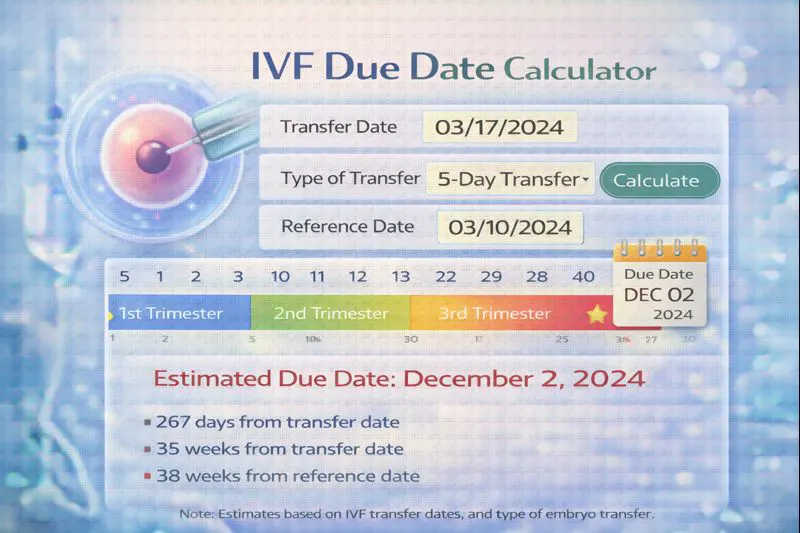
What is an IVF Due Date Calculator?
An IVF Due Date Calculator is a specialized tool that calculates your expected delivery date (EDD) based on the specific dates of your fertility treatment. Unlike traditional pregnancy calculators that use the last menstrual period, IVF calculations are more precise because they account for the exact date of embryo transfer or egg retrieval.
This calculator is essential for couples undergoing fertility treatments across international fertility clinics, including those in the UAE, UK, US, and other countries offering advanced reproductive technologies.
Key Benefits:
- Precise dating: Accurate to within days, not weeks like traditional methods
- Treatment-specific: Accounts for 3-day or 5-day embryo transfers
- Multiple calculation methods: Works with transfer date or egg retrieval date
- International compatibility: Suitable for IVF procedures worldwide
- Instant results: Get your due date, current pregnancy week, and trimester information immediately
With over 8 million babies born through IVF worldwide since 1978, accurate pregnancy dating has become crucial for monitoring fetal development and planning prenatal care. This tool is trusted by couples seeking reliable information for their health and fitness journey.
html
How Does the IVF Due Date Calculator Work?
IVF pregnancy dating differs from natural conception because the exact fertilization date is known. This makes IVF due date calculations more accurate than traditional methods that rely on estimating ovulation from your last menstrual period.
The Calculation Method
The calculator uses a standard 40-week (280-day) pregnancy duration but adjusts the starting point based on your embryo development stage:
For 5-day embryo transfer (blastocyst):
- Transfer date is equivalent to 19 days past last menstrual period (LMP)
- Formula: Due Date = Transfer Date + 261 days
- This accounts for 5 days of embryo development plus 14 days to "LMP"
For 3-day embryo transfer:
- Transfer date is equivalent to 17 days past LMP
- Formula: Due Date = Transfer Date + 263 days
- This accounts for 3 days of embryo development plus 14 days to "LMP"
Using egg retrieval date:
- Retrieval date is equivalent to ovulation (14 days past LMP)
- Formula: Due Date = Retrieval Date + 266 days
- Add days based on transfer type if calculating from retrieval
Step-by-Step Breakdown
Step 1: Enter your embryo transfer date or egg retrieval date into the calculator.
Step 2: Select whether you had a 3-day or 5-day embryo transfer (if using transfer date).
Step 3: The calculator automatically adds the appropriate number of days to determine your 40-week due date.
Step 4: Receive your estimated due date, current pregnancy week, and trimester information.
Important Notes
While this calculator provides highly accurate estimates, remember that only 5% of babies are born on their exact due date. Most births occur within two weeks before or after the calculated date. Your fertility specialist will monitor your pregnancy progress through ultrasounds and may adjust the due date if needed, though IVF dates rarely require modification due to their precision.
Example 1: 5-Day Blastocyst Transfer
Scenario: Sarah, a 34-year-old professional living in Dubai Marina, underwent her first IVF cycle at a leading fertility clinic. She had a successful 5-day blastocyst transfer on March 15, 2026.
Calculation:
- Transfer date: March 15, 2026
- Transfer type: 5-day blastocyst
- Formula: March 15 + 261 days
- Due Date: December 2, 2026
Result: Sarah's expected delivery date is December 2, 2026. As of today (January 16, 2026), she would need to wait until March 15 for her transfer. Once pregnant, her first trimester would end around June 21, and her second trimester around September 28. This information helps her plan maternity leave and prepare for the baby's arrival during Dubai's pleasant winter season.
Example 2: 3-Day Embryo Transfer
Scenario: Fatima and her husband opted for a 3-day embryo transfer at an international fertility center. Their transfer was completed on February 10, 2026, and they received positive pregnancy news two weeks later.
Calculation:
- Transfer date: February 10, 2026
- Transfer type: 3-day embryo
- Formula: February 10 + 263 days
- Due Date: October 31, 2026
Result: With a due date of October 31, 2026, Fatima can expect her baby around Halloween. Her gestational age calculations would show she's approximately 6 weeks pregnant by mid-March. Understanding her timeline helps her schedule crucial prenatal appointments, including the 12-week nuchal translucency scan and the 20-week anatomy scan.
Example 3: Frozen Embryo Transfer (FET) Using Retrieval Date
Scenario: Amira underwent egg retrieval on January 5, 2026, but opted to freeze her embryos for a later transfer. Three months later, on April 10, 2026, she had a 5-day frozen embryo transfer. She wants to calculate using both methods to verify accuracy.
Calculation Method 1 (Using Transfer Date):
- Transfer date: April 10, 2026
- Transfer type: 5-day blastocyst
- Due Date: April 10 + 261 days = December 27, 2026
Calculation Method 2 (Using Retrieval Date for Verification):
- Original retrieval: January 5, 2026
- Actual transfer: April 10, 2026 (5-day embryo)
- Use transfer date for FET: December 27, 2026
Result: Both methods confirm a due date of December 27, 2026, when using the actual transfer date. For frozen embryo transfers, always use the transfer date rather than the original retrieval date, as the embryo's development age at transfer is what matters. Amira's baby is expected just before the New Year, allowing her to plan accordingly for year-end work commitments and holiday celebrations.
Special Considerations for IVF Pregnancies
Multiple pregnancies: IVF procedures have higher rates of twin or multiple pregnancies if more than one embryo was transferred. Your healthcare provider may adjust monitoring schedules and delivery planning for multiples, which often arrive earlier than singleton pregnancies.
Frozen vs. Fresh transfers: Whether you had a fresh or frozen embryo transfer doesn't affect the due date calculation. The calculation is based solely on the embryo's age at transfer and the transfer date itself.
Donor egg or embryo cycles: The same calculation principles apply to donor egg or embryo cycles. Use the transfer date and embryo age at transfer for accurate dating.
International IVF Regulations
While this calculator works for IVF procedures worldwide, be aware that regulations vary by country. The UAE, UK, US, and European countries have different guidelines regarding embryo transfer numbers, screening procedures, and monitoring protocols. Always consult with your fertility specialist who understands local regulations and medical guidelines.
Common Mistakes to Avoid
- Using LMP for IVF pregnancies: Never use traditional last menstrual period calculators for IVF - they'll give incorrect dates
- Confusing retrieval and transfer dates: For frozen embryo transfers, always use the transfer date, not the original retrieval date
- Wrong embryo age: Ensure you know whether your embryo was transferred at day 3 or day 5
- Ignoring ultrasound adjustments: While rare for IVF, if your doctor adjusts the due date based on early ultrasound measurements, follow their guidance
Expert Tips for IVF Pregnancy Tracking
Track your HCG levels: After a positive pregnancy test, monitoring HCG doubling times helps confirm healthy early pregnancy development.
Attend early ultrasounds: Your 6-7 week ultrasound will confirm heartbeat and viability, while your 12-week scan assesses development according to your calculated dates.
Monitor your health: IVF pregnancies require the same prenatal care as natural pregnancies. Maintain proper nutrition, consider using a pregnancy weight gain calculator, and follow your doctor's supplement recommendations.
Plan for the unexpected: While most IVF pregnancies progress normally, be prepared for potential complications like ovarian hyperstimulation syndrome (OHSS) effects in early pregnancy or increased monitoring for certain risk factors.