 OnlineCalculator
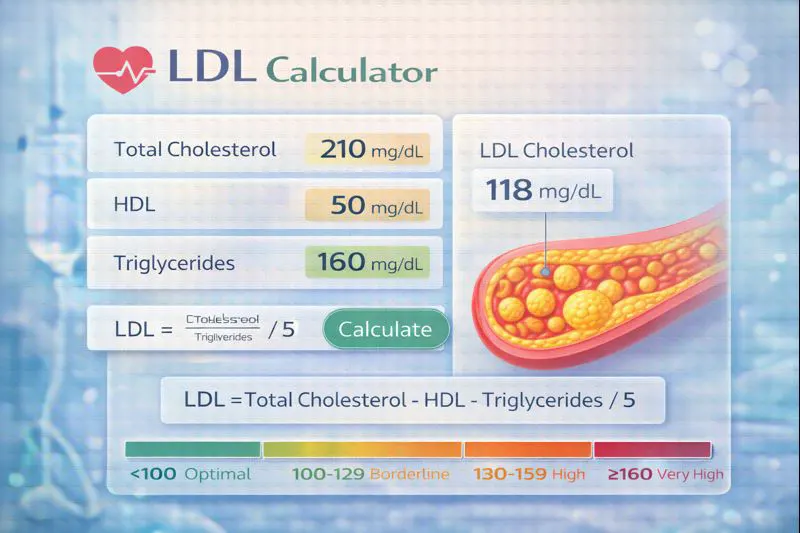
What is the LDL Calculator?
The LDL Calculator is a medical tool that estimates your Low-Density Lipoprotein cholesterol level using values from your lipid panel blood test. LDL cholesterol is often called "bad" cholesterol because high levels can lead to plaque buildup in your arteries, increasing your risk of heart disease and stroke.
This calculator uses the widely-accepted Friedewald equation to determine your LDL cholesterol when direct measurement isn't available. It's commonly used by healthcare professionals and individuals worldwide to assess cardiovascular risk.
Key benefits of using this calculator:
- Instant results - Get your LDL cholesterol level in seconds without complex calculations
- Clinically validated - Uses the Friedewald formula recognized by medical professionals globally
- Track your progress - Monitor changes in your cholesterol levels over time
- Free and accessible - No registration required, available 24/7 from anywhere
Whether you're in Dubai, Abu Dhabi, or anywhere else, understanding your LDL cholesterol is crucial for maintaining heart health. This calculator works with standard lipid panel measurements provided by any medical laboratory or healthcare facility.
html
How Does the LDL Calculator Work?
The LDL Calculator uses the Friedewald equation, a mathematical formula developed in 1972 that remains the standard method for calculating LDL cholesterol levels. This formula has been validated through decades of clinical use and research.
The calculation is straightforward:
LDL Cholesterol = Total Cholesterol - HDL Cholesterol - (Triglycerides ÷ 5)
When using SI units (mmol/L), the formula is:
LDL = Total Cholesterol - HDL - (Triglycerides ÷ 2.2)
Step-by-Step Calculation Process
- Enter your Total Cholesterol - This is the complete amount of cholesterol in your blood, measured in mg/dL or mmol/L
- Input your HDL Cholesterol - Known as "good" cholesterol, this value is also from your lipid panel
- Add your Triglycerides level - Another type of fat in your blood that affects the calculation
- - The tool applies the Friedewald formula automatically
- Review your result - Your estimated LDL cholesterol level appears instantly
Important Limitations
The Friedewald equation works best when triglyceride levels are below 400 mg/dL (4.5 mmol/L). Above this threshold, the formula becomes less accurate, and direct LDL measurement is recommended. Additionally, this calculator should not replace professional medical advice or direct LDL testing when available.
Practical LDL Calculation Examples
Here are three realistic scenarios showing how the LDL Calculator works with different cholesterol profiles:
Example 1: Young Professional with Borderline High Cholesterol
Profile: Ahmed, a 32-year-old marketing manager in Dubai Marina, recently had his annual health checkup. His lipid panel showed concerning numbers, and he wants to calculate his LDL cholesterol.
Blood Test Results:
- Total Cholesterol: 220 mg/dL
- HDL Cholesterol: 45 mg/dL
- Triglycerides: 150 mg/dL
Calculation:
LDL = 220 - 45 - (150 ÷ 5)
LDL = 220 - 45 - 30
LDL = 145 mg/dL
Result Interpretation: Ahmed's LDL of 145 mg/dL falls into the "borderline high" category. His doctor would likely recommend lifestyle modifications including diet changes and increased physical activity. Understanding his cholesterol ratios can provide additional insight into his cardiovascular risk.
Example 2: Active Individual with Optimal Cholesterol
Profile: Sarah, a 28-year-old fitness instructor in Abu Dhabi, maintains a healthy lifestyle with regular exercise and a balanced diet. She's checking her cholesterol as part of her wellness routine.
Blood Test Results:
- Total Cholesterol: 180 mg/dL
- HDL Cholesterol: 60 mg/dL
- Triglycerides: 80 mg/dL
Calculation:
LDL = 180 - 60 - (80 ÷ 5)
LDL = 180 - 60 - 16
LDL = 104 mg/dL
Result Interpretation: Sarah's LDL of 104 mg/dL is in the "near optimal" range, reflecting her healthy lifestyle. Her health metrics show she's on the right track. To maintain these levels, she should continue her current diet and exercise routine.
Example 3: Individual Managing High Triglycerides
Profile: Mohammed, a 45-year-old business owner in Sharjah, has been managing high triglycerides through medication and diet changes. His recent follow-up test shows improvement.
Blood Test Results:
- Total Cholesterol: 240 mg/dL
- HDL Cholesterol: 38 mg/dL
- Triglycerides: 320 mg/dL
Calculation:
LDL = 240 - 38 - (320 ÷ 5)
LDL = 240 - 38 - 64
LDL = 138 mg/dL
Result Interpretation: Despite high triglycerides, Mohammed's calculated LDL of 138 mg/dL is borderline high. However, because his triglycerides are above 200 mg/dL, his doctor should consider direct LDL measurement for more accuracy. Managing both LDL and triglycerides is essential for his cardiovascular health.
Understanding LDL Cholesterol Ranges
Medical organizations worldwide use these LDL cholesterol categories for adults:
- Less than 100 mg/dL (2.6 mmol/L)
- 100-129 mg/dL (2.6-3.3 mmol/L)
- 130-159 mg/dL (3.4-4.1 mmol/L)
- 160-189 mg/dL (4.1-4.9 mmol/L)
- 190 mg/dL and above (4.9 mmol/L and above)
When the Friedewald Formula Isn't Accurate
The calculator may provide inaccurate results in these situations:
- Triglyceride levels above 400 mg/dL (4.5 mmol/L)
- Recent meal consumption (blood test not fasting)
- Certain rare lipid disorders
- Very low LDL cholesterol levels (below 40 mg/dL)
In these cases, direct LDL measurement through specialized laboratory testing is recommended.
Common Mistakes to Avoid
Using non-fasting values: Always ensure your lipid panel was taken after an 8-12 hour fast for accurate results. Eating before the test can significantly alter triglyceride levels.
Mixing measurement units: Don't combine mg/dL and mmol/L values. Ensure all three inputs use the same unit system.
Ignoring medication effects: If you're taking cholesterol-lowering medications, your calculated LDL reflects medicated values, not your baseline levels.
Expert Tips for Managing LDL Cholesterol
Maintaining healthy LDL levels involves lifestyle modifications. Regular physical activity, similar to tracking your calories burned during exercise, can help lower LDL cholesterol. A diet rich in fiber, omega-3 fatty acids, and low in saturated fats is essential.
For individuals in the UAE, working with healthcare providers at facilities like Cleveland Clinic Abu Dhabi or American Hospital Dubai can provide personalized guidance on cholesterol management tailored to your specific health profile.
Take Control of Your Heart Health Today
Understanding your LDL cholesterol is the first step toward better cardiovascular health. Use our free LDL Calculator above to estimate your levels based on your latest lipid panel results. Remember, this tool provides an estimate and should complement, not replace, professional medical advice.
For comprehensive health monitoring, explore more tools on Online Calculator UAE. If you have concerns about your cholesterol levels or cardiovascular health, consult with healthcare professionals at reputable facilities such as Cleveland Clinic Abu Dhabi, Mediclinic Middle East, or your local healthcare provider.
Your heart health matters. Calculate your LDL cholesterol today and take informed steps toward a healthier future.