 OnlineCalculator
Understanding Your Cholesterol Numbers
Cholesterol management is crucial for preventing heart disease, stroke, and other cardiovascular conditions. Our Online Calculator UAE tool helps you track and understand your lipid profile with precision.
This comprehensive Health & Fitness calculator evaluates multiple cholesterol markers to give you a complete picture of your cardiovascular health. Whether you're monitoring existing conditions or taking preventive measures, understanding your numbers is the first step toward better health.
Key Benefits:
- Instant Risk Assessment: Calculate your cholesterol ratios and understand what they mean for your heart health
- Complete Lipid Profile Analysis: Evaluate total cholesterol, LDL, HDL, and triglycerides in one place
- Evidence-Based Ranges: Compare your results against international medical standards
- Personalized Insights: Receive tailored recommendations based on your specific numbers
Our calculator follows guidelines from the American Heart Association and international cardiology standards, ensuring accurate and reliable results you can discuss with your healthcare provider.
html
How the Cholesterol Calculator Works
Understanding your cholesterol levels involves analyzing several key measurements that together paint a picture of your cardiovascular health. Our calculator uses established medical formulas to compute essential ratios and risk indicators.
Calculation Methodology:
Total Cholesterol to HDL Ratio: This primary indicator divides your total cholesterol by your HDL (good cholesterol) level. A ratio below 5:1 is considered optimal, while anything above 5:1 indicates increased cardiovascular risk.
LDL to HDL Ratio: This ratio compares your LDL (bad cholesterol) to HDL levels. The ideal ratio is below 3.5:1, with lower numbers indicating better heart health protection.
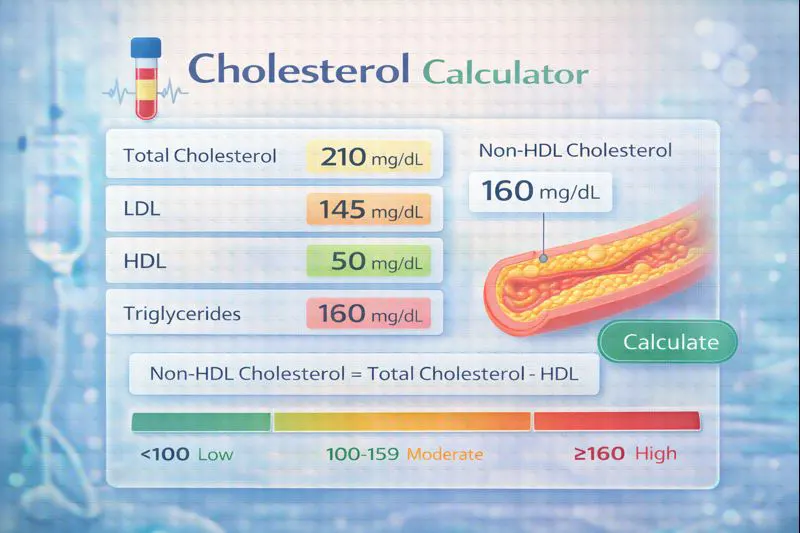
Non-HDL Cholesterol: Calculated by subtracting HDL from total cholesterol, this value should ideally be less than 130 mg/dL for optimal cardiovascular health.
Step-by-Step Process:
- Enter Your Values: Input your total cholesterol, LDL, HDL, and triglyceride levels from your recent blood test
- Automatic Calculation: The calculator instantly computes all relevant ratios and risk indicators
- Result Interpretation: Your numbers are compared against established medical thresholds
- Risk Classification: Receive a clear assessment ranging from optimal to high risk
Important Considerations:
Always use results from a fasting lipid panel (8-12 hours of fasting) for the most accurate assessment. Your age, gender, family history, and existing health conditions also influence your ideal cholesterol targets. This calculator provides general guidance and should not replace professional medical advice.
Example 1: Healthy Adult Profile
Profile: Sarah, 35-year-old marketing professional from Dubai Marina, regular exercise routine, no family history of heart disease.
Blood Test Results:
- Total Cholesterol: 180 mg/dL
- LDL Cholesterol: 100 mg/dL
- HDL Cholesterol: 60 mg/dL
- Triglycerides: 100 mg/dL
Calculations:
- Total/HDL Ratio: 180 ÷ 60 = 3.0 (Optimal - below 5.0)
- LDL/HDL Ratio: 100 ÷ 60 = 1.67 (Excellent - below 3.5)
- Non-HDL: 180 - 60 = 120 mg/dL (Optimal - below 130)
- VLDL (Triglycerides ÷ 5): 100 ÷ 5 = 20 mg/dL (Normal)
Assessment: Sarah's cholesterol profile is excellent. Her ratios are well within optimal ranges, indicating low cardiovascular risk. She should maintain her current lifestyle with regular monitoring every 4-5 years.
Example 2: Moderate Risk Profile
Profile: Ahmed, 48-year-old IT manager from Business Bay, sedentary job, occasional exercise, father had heart attack at age 55.
Blood Test Results:
- Total Cholesterol: 240 mg/dL
- LDL Cholesterol: 160 mg/dL
- HDL Cholesterol: 40 mg/dL
- Triglycerides: 200 mg/dL
Calculations:
- Total/HDL Ratio: 240 ÷ 40 = 6.0 (High risk - above 5.0)
- LDL/HDL Ratio: 160 ÷ 40 = 4.0 (Borderline - above 3.5)
- Non-HDL: 240 - 40 = 200 mg/dL (High - above 160)
- VLDL: 200 ÷ 5 = 40 mg/dL (Borderline high)
Assessment: Ahmed shows multiple risk factors including high total cholesterol, elevated LDL, low HDL, and high triglycerides. Combined with his family history, he should consult a cardiologist immediately. Lifestyle modifications and possibly medication may be recommended. Similar to tracking your blood sugar levels, regular cholesterol monitoring is essential.
Example 3: Post-Treatment Monitoring
Profile: Fatima, 52-year-old teacher from Sharjah, on statin medication for 6 months, following Mediterranean diet, walks 30 minutes daily.
Blood Test Results:
- Total Cholesterol: 195 mg/dL
- LDL Cholesterol: 110 mg/dL
- HDL Cholesterol: 55 mg/dL
- Triglycerides: 150 mg/dL
Calculations:
- Total/HDL Ratio: 195 ÷ 55 = 3.55 (Good - below 5.0)
- LDL/HDL Ratio: 110 ÷ 55 = 2.0 (Excellent - well below 3.5)
- Non-HDL: 195 - 55 = 140 mg/dL (Near optimal - borderline)
- VLDL: 150 ÷ 5 = 30 mg/dL (Normal)
Assessment: Fatima's treatment is working effectively. Her LDL has decreased significantly, and her ratios are now in healthy ranges. She should continue her medication as prescribed and maintain her healthy lifestyle. Regular follow-ups every 3 months are recommended to ensure continued improvement.
Understanding the Numbers:
Total Cholesterol: This measures all cholesterol in your blood. Desirable levels are below 200 mg/dL, borderline high is 200-239 mg/dL, and high is 240 mg/dL or above. However, total cholesterol alone doesn't tell the complete story.
LDL (Bad Cholesterol): Often called "bad" cholesterol because high levels lead to plaque buildup in arteries. Optimal is below 100 mg/dL, near optimal is 100-129 mg/dL, borderline high is 130-159 mg/dL, high is 160-189 mg/dL, and very high is 190 mg/dL or above.
HDL (Good Cholesterol): This "good" cholesterol helps remove other forms of cholesterol from your bloodstream. Higher levels are better. Men should aim for 40 mg/dL or higher, while women should target 50 mg/dL or above. Levels of 60 mg/dL or higher provide extra protection against heart disease.
Triglycerides: High levels contribute to hardening of arteries. Normal is below 150 mg/dL, borderline high is 150-199 mg/dL, high is 200-499 mg/dL, and very high is 500 mg/dL or above.
Common Mistakes to Avoid:
- Testing Without Fasting: Always fast for 9-12 hours before a lipid panel for accurate triglyceride measurements
- Ignoring HDL Levels: High total cholesterol with high HDL may actually indicate lower risk than moderate total cholesterol with low HDL
- Single Test Reliance: One abnormal result doesn't define your health - patterns over time matter more
- Self-Medication: Never start or stop cholesterol medications without medical supervision
Factors Affecting Your Results:
Recent illness, stress, diet changes, alcohol consumption, certain medications, pregnancy, and even seasonal variations can impact cholesterol levels. For the most reliable assessment, maintain consistent lifestyle habits before testing and discuss any recent changes with your healthcare provider. Just as you would monitor other health metrics through tools like a blood pressure assessment, regular cholesterol tracking is vital.
Take Control of Your Heart Health Today
Understanding your cholesterol numbers is crucial for preventing cardiovascular disease. Use our calculator regularly to track your progress, but remember that these results are for educational purposes only. Always consult with qualified healthcare professionals for proper diagnosis and treatment.
For comprehensive health assessments, consider scheduling regular check-ups with your doctor and maintaining a heart-healthy lifestyle. Early detection and management of high cholesterol can significantly reduce your risk of heart attack and stroke.
Official Health Resources: For authoritative information on cholesterol management, visit the American Heart Association or consult with cardiologists at reputable medical facilities in your area.