 OnlineCalculator
What Is a Macro Calculator?
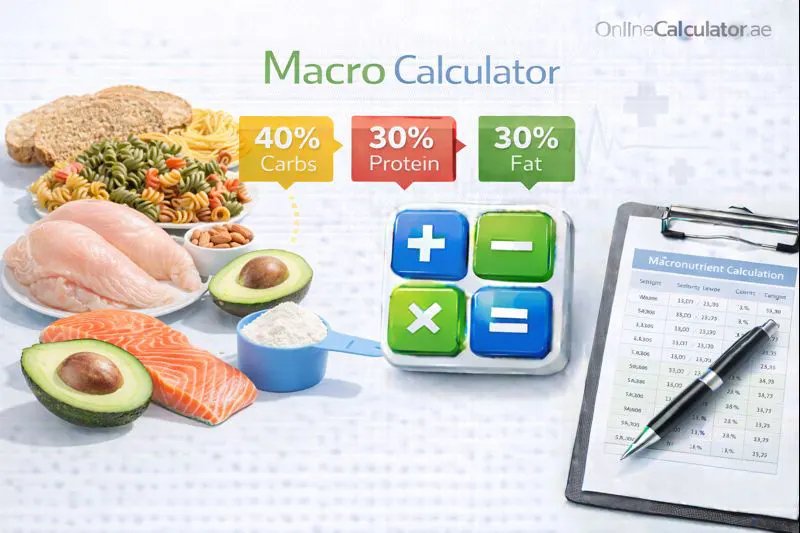
A macro calculator is a specialized tool that determines your optimal daily intake of the three primary macronutrients: protein, carbohydrates, and fats. Unlike simple calorie counting, tracking macros gives you precise control over your nutrition, helping you achieve specific fitness goals more effectively.
This Health & Fitness calculator provides:
- based on your age, weight, height, and activity level
- Goal-specific recommendations for weight loss, muscle gain, or maintenance
- Both grams and percentages of each macronutrient for easy meal planning
- Daily calorie requirements calculated using proven formulas
Whether you're training at Fitness First in Dubai Marina or working out at home in Sharjah, understanding your macros helps you fuel your body properly for optimal results.
0g 0% 0g 0% 0g 0%
How the Macro Calculator Works
The macro calculator uses scientifically-validated formulas to determine your nutritional needs. Here's the step-by-step methodology:
Step 1: Calculate Your BMR (Basal Metabolic Rate)
We use the Mifflin-St Jeor equation, considered the most accurate formula for modern populations:
For Men: BMR = (10 × weight in kg) + (6.25 × height in cm) - (5 × age) + 5
For Women: BMR = (10 × weight in kg) + (6.25 × height in cm) - (5 × age) - 161
This represents the calories your body burns at rest, just maintaining basic functions like breathing and circulation.
Step 2: Determine Your TDEE (Total Daily Energy Expenditure)
Your BMR is multiplied by an activity factor to account for daily movement and exercise:
- Sedentary (office job, minimal exercise): BMR × 1.2
- Lightly active (light exercise 1-3 days/week): BMR × 1.375
- Moderately active (exercise 3-5 days/week): BMR × 1.55
- Very active (intense exercise 6-7 days/week): BMR × 1.725
- Extremely active (physical job + intense training): BMR × 1.9
Step 3: Adjust for Your Goal
Based on your objective, we adjust your daily energy expenditure:
- Weight Loss: Reduce TDEE by 15-25% (creating a calorie deficit)
- Muscle Gain: Increase TDEE by 10-15% (creating a calorie surplus)
- Maintenance: Keep TDEE as is
Step 4: Calculate Macro Distribution
The calculator distributes your calories across macronutrients based on your goal:
Protein: Essential for muscle maintenance and growth (4 calories per gram)
Carbohydrates: Primary energy source for workouts (4 calories per gram)
Fats: Critical for hormone production and nutrient absorption (9 calories per gram)
Important Note: These are starting recommendations. You may need to adjust based on how your body responds after 2-3 weeks. Many UAE residents working in DIFC or Downtown Dubai find they need slightly higher protein due to stressful work environments.
Example 1: Weight Loss for a Dubai Professional
Profile: Sarah, 32-year-old marketing manager at Dubai Internet City
- Gender: Female
- Weight: 72 kg
- Height: 165 cm
- Activity: Lightly active (gym 2x/week, walks)
- Goal: Lose fat while maintaining muscle
Calculation:
BMR: (10 × 72) + (6.25 × 165) - (5 × 32) - 161 = 720 + 1,031.25 - 160 - 161 = 1,430 calories
TDEE: 1,430 × 1.375 = 1,966 calories
Weight Loss Target: 1,966 - (1,966 × 0.20) = 1,573 calories/day
Macro Breakdown:
- Protein: 130g (33% of calories, 520 calories) - High protein preserves lean muscle mass
- Fats: 52g (30% of calories, 468 calories) - Supports hormone balance
- Carbs: 146g (37% of calories, 585 calories) - Provides workout energy
Result: Sarah can expect to lose 0.3-0.5 kg per week eating these macros while maintaining her muscle mass.
Example 2: Muscle Gain for an Active Athlete
Profile: Ahmed, 26-year-old personal trainer at Warehouse Gym
- Gender: Male
- Weight: 78 kg
- Height: 180 cm
- Activity: Very active (trains 6 days/week)
- Goal: Build muscle mass
Calculation:
BMR: (10 × 78) + (6.25 × 180) - (5 × 26) + 5 = 780 + 1,125 - 130 + 5 = 1,780 calories
TDEE: 1,780 × 1.725 = 3,071 calories
Muscle Gain Target: 3,071 + (3,071 × 0.12) = 3,440 calories/day
Macro Breakdown:
- Protein: 180g (21% of calories, 720 calories) - Optimal for muscle building
- Fats: 95g (25% of calories, 855 calories) - Supports testosterone production
- Carbs: 466g (54% of calories, 1,865 calories) - Fuels intense training sessions
Result: Ahmed can expect to gain 0.25-0.5 kg per week of primarily muscle mass with his training program.
Example 3: Maintenance for a Busy Parent
Profile: Fatima, 38-year-old mother working from home in Al Barsha
- Gender: Female
- Weight: 65 kg
- Height: 162 cm
- Activity: Moderately active (yoga 3x/week, daily walks)
- Goal: Maintain current weight and energy levels
Calculation:
BMR: (10 × 65) + (6.25 × 162) - (5 × 38) - 161 = 650 + 1,012.5 - 190 - 161 = 1,312 calories
TDEE: 1,312 × 1.55 = 2,034 calories
Maintenance Target: 2,034 calories/day (no adjustment needed)
Macro Breakdown:
- Protein: 115g (23% of calories, 460 calories) - Maintains muscle and satiety
- Fats: 68g (30% of calories, 612 calories) - Healthy hormone function
- Carbs: 241g (47% of calories, 962 calories) - Sustained daily energy
Result: Fatima maintains her current physique while having energy for her family and fitness routine.
Understanding Macro Flexibility
The calculator provides starting points, not rigid rules. Many successful UAE fitness enthusiasts adjust their macros based on personal response. Some people feel better with higher fats and lower carbs, while others thrive on the opposite ratio.
Protein Requirements in Hot Climates
UAE residents should pay special attention to protein intake. The hot climate and air conditioning can affect hydration and protein synthesis. Aim for 1.6-2.2g per kg of body weight if you're active, especially during summer months.
Common Mistakes to Avoid
Not tracking consistently: Track your macros for at least 2 weeks before making judgments. Use apps like MyFitnessPal that have extensive UAE food databases including local restaurants and supermarket items from Carrefour and Lulu.
Ignoring meal timing: While total daily intake matters most, spreading protein across 3-4 meals optimizes muscle protein synthesis. This is especially important if you train at popular times (6-8 AM or 6-9 PM) when UAE gyms are busiest.
Forgetting about fiber: When tracking carbs, ensure at least 25-35g comes from fiber-rich sources like vegetables, fruits, and whole grains. This supports digestive health in the UAE's rich food culture.
Expert Tips for UAE Residents
Restaurant dining: UAE has incredible dining options, but restaurant meals often contain hidden fats and sugars. When eating at Dubai Mall, Mall of the Emirates, or Yas Mall, choose grilled proteins, request sauces on the side, and load up on vegetables.
Ramadan considerations: During fasting periods, focus on nutrient-dense foods during eating windows. Many athletes successfully maintain macros by consuming larger meals at Iftar and Suhoor, prioritizing protein and complex carbs.
Hydration matters: In UAE's climate, proper hydration is crucial for macro utilization. Dehydration can impair protein synthesis and energy metabolism.
Start Tracking Your Macros Today
Use this macro calculator to discover your personalized nutrition targets and take control of your fitness journey. Whether you're aiming to lean down for summer beach season in Jumeirah or building strength at your local gym, proper macro tracking removes the guesswork from nutrition.
For additional support, consider consulting with registered dietitians at sports nutrition centers like Dubai Sports City or Abu Dhabi's Sports Council facilities. Many health insurance plans in the UAE cover nutrition consultations.
Remember: consistency beats perfection. Track honestly, adjust as needed, and trust the process. Your body composition goals are within reach with the right nutritional approach.