 OnlineCalculator
What Does This Speed Calculator Do?
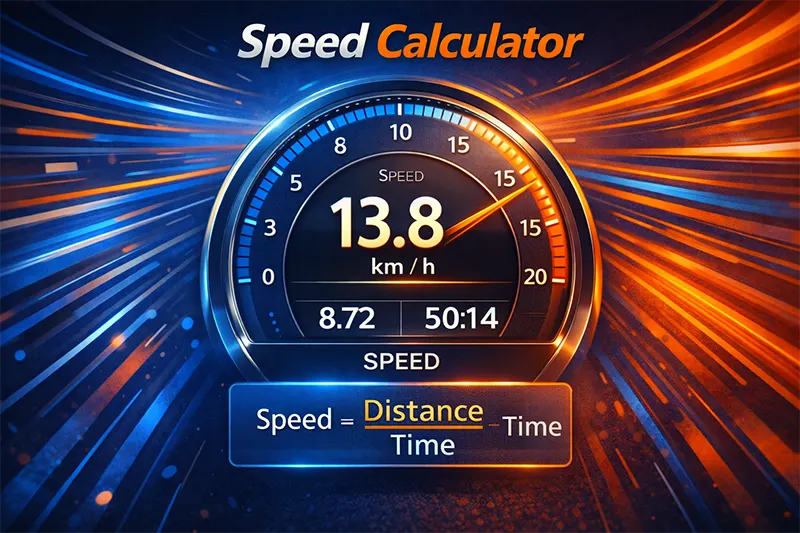
The uses the fundamental speed-distance-time relationship to solve for any missing variable. Provide two of the three values, and the tool does the rest — no manual math required.
Here's what makes it useful:
- Solve for speed, distance, or time — just fill in two fields and the third is calculated automatically.
- Multiple unit support — switch between km/h, mph, m/s, knots, and more with a single click.
- Built for real scenarios — from jogging around Dubai Marina to calculating flight durations or cycling on Yas Island.
- 100% free and private — no sign-ups, no data stored, instant results every time.
The calculations follow standard physics formulas trusted by engineers, athletes, and educators worldwide. Whether you're using it from Abu Dhabi or Amsterdam, the math is universal and reliable. For more free tools, explore Online Calculator UAE.
ADVANCED SPEED CALCULATOR WIDGET For WordPress Elementor HTML Widget Version: 2.0 Header
Body Solve For Selector Input Fields Error
Buttons Result — Footer
The Core Formula
Every speed calculation relies on one simple equation:
From this, you can rearrange to find the other two variables:
- Distance = Speed × Time
- Time = Distance ÷ Speed
Step-by-Step Breakdown
Step 1: Choose what you want to calculate. Select whether you need to find speed, distance, or time. The calculator adjusts the input fields automatically.
Step 2: Enter your known values. For example, if you drove 150 km in 1.5 hours, enter those numbers into the distance and time fields.
Step 3: Select your preferred units. Choose from kilometers, miles, meters, or nautical miles for distance. Time can be entered in hours, minutes, or seconds. Speed output appears in your chosen unit — km/h, mph, m/s, or knots.
Step 4: Get your result. The calculator instantly computes the answer. In the example above: 150 ÷ 1.5 = 100 km/h.
Important Notes
The calculator assumes constant (average) speed. If you accelerated and decelerated during your journey — like driving through Dubai's Sheikh Zayed Road during rush hour — the result represents your average speed over the entire distance, not your instantaneous speed at any specific moment.
For runners and cyclists who want to think in terms of pace (minutes per km), you might also find a running pace tool helpful alongside this speed calculator.
Example 1: Road Trip From Dubai to Abu Dhabi
Scenario: Ahmed is driving from Dubai Marina to Yas Island in Abu Dhabi. His GPS shows the distance is 140 km, and he completes the trip in 1 hour 24 minutes.
Calculation:
- Convert time: 1 hour 24 minutes = 1 + (24 ÷ 60) = 1.4 hours
- Apply formula: Speed = 140 km ÷ 1.4 hours
- Result: 100 km/h average speed
This makes sense — the E11 highway between Dubai and Abu Dhabi has a speed limit of 120–140 km/h on most stretches, and accounting for city exits and slight traffic, an average of 100 km/h is realistic.
Example 2: Morning Jog Along the Corniche
Scenario: Fatima runs along the Abu Dhabi Corniche every morning. She wants to know her average speed if she covers 7.5 km in 45 minutes.
Calculation:
- Convert time: 45 minutes = 45 ÷ 60 = 0.75 hours
- Apply formula: Speed = 7.5 km ÷ 0.75 hours
- Result: 10 km/h
That's a solid recreational running pace — roughly a 6-minute kilometer. Fatima can track her improvement over time by using this calculator after each run. She might also want to check her total route distance using a mapping tool.
Example 3: Converting a Ship's Speed From Knots
Scenario: A cargo vessel departing Jebel Ali Port travels at 18 knots. The captain needs to know the distance covered in 6 hours, and the operations team wants the result in kilometers.
Calculation:
- Convert speed: 18 knots = 18 × 1.852 = 33.336 km/h
- Apply formula: Distance = 33.336 km/h × 6 hours
- Result: 200.02 km (approximately 200 km)
This example demonstrates the calculator's unit conversion capability — particularly useful for maritime and aviation professionals operating out of UAE's major ports and airports.
Average Speed vs. Instantaneous Speed
This calculator computes average speed. If you drive 120 km in 2 hours, your average speed is 60 km/h — even if you spent 30 minutes stuck in DIFC traffic and then drove at 90 km/h on the highway. Your car's speedometer shows instantaneous speed, which changes every moment.
UAE Speed Limits and Radar Tolerance
The UAE's Ministry of Interior enforces speed limits across all emirates. Common limits include 60–80 km/h in urban areas, 100–120 km/h on main highways, and 120–140 km/h on select routes like the E11. While understanding your average speed is useful for trip planning, always respect posted limits and radar zones.
Common Mistakes to Avoid
- Mixing units: Entering distance in miles but expecting output in km/h will give misleading results. Always confirm your units match.
- Forgetting to convert minutes to hours: If you ran for 30 minutes, enter 0.5 hours, not 30. Alternatively, use the calculator's minute input if available.
- Ignoring stops: If your 2-hour drive included a 20-minute fuel stop, your actual driving time was 1 hour 40 minutes. Use the net driving time for accurate speed results.
Expert Tip
For fitness tracking, calculate your speed after every session and log the results. Over weeks, you'll see clear trends in your improvement — this works for running, cycling, and swimming alike. Check your fuel consumption per distance if you're also tracking driving efficiency.
Start Calculating Now
Scroll up to the speed calculator above and enter your values. Whether you're planning a drive, tracking your fitness, or solving a physics problem, you'll have your answer in seconds. Bookmark this page for quick access whenever you need it.
For questions about UAE traffic regulations and speed limits, visit the Roads and Transport Authority (RTA) official website. For comprehensive tools beyond speed, explore the full range of calculators at Online Calculator UAE.