 OnlineCalculator
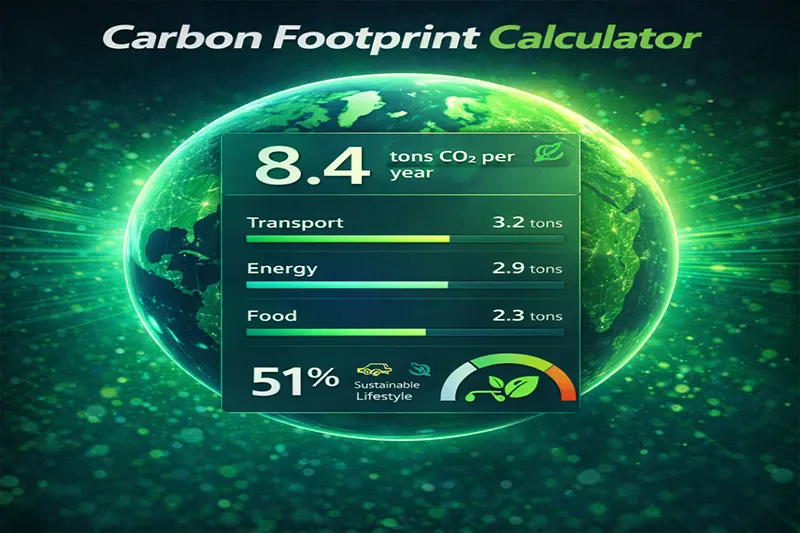
Find out exactly how much carbon dioxide your daily habits produce each year. Whether you live in Dubai, Abu Dhabi, Riyadh, London, or New York, this free carbon footprint calculator breaks down emissions from transport, home energy, food, and shopping — so you can take meaningful steps toward a lower-carbon life. Built for individuals, families, students, and professionals who want clear numbers, not guesswork.
What Does This Carbon Footprint Calculator Do?
This estimates the total amount of greenhouse gases — measured in tonnes of CO₂ equivalent (tCO₂e) — generated by your lifestyle each year. It considers four major emission categories: transportation, household energy, diet, and consumption habits.
Here's why thousands of users rely on it:
- Personalized results — Enter your actual driving distance, flight hours, electricity usage, and eating habits for an estimate tailored to you, not a generic average.
- Global benchmarking — Compare your footprint against worldwide and regional averages, including the UAE's per-capita figure of roughly 21 tCO₂e and the global average of about 4.7 tCO₂e.
- Actionable reduction tips — Receive specific suggestions on where to cut emissions, from switching to public transport in Dubai Metro to adjusting your AC thermostat by 2°C.
- Transparent methodology — Calculations use emission factors from the IPCC, the International Energy Agency (IEA), and peer-reviewed research.
Whether you're preparing a sustainability report for a DIFC-based firm or simply curious about your household impact on Yas Island, this tool delivers numbers you can act on. You can also explore other helpful tools on Online Calculator UAE.
═══════════════════════════════════════════════════════════════ ADVANCED CARBON FOOTPRINT CALCULATOR For WordPress Elementor HTML Widget ═══════════════════════════════════════════════════════════════ Instructions: 1. In Elementor, add an "HTML" widget 2. Paste this entire code block into the widget 3. Save and preview ═══════════════════════════════════════════════════════════════ Header Progress STEP 0: Transport STEP 1: Home Energy STEP 2: Diet 🥩 🍗 🐟 🥚 🌱 🍽️ STEP 3: Consumption / Lifestyle 🚗 Transport0 t ⚡ Home Energy0 t 🥗 Diet0 t 🛍️ Lifestyle0 t Global Comparison Actions
Emission Categories & Factors
Your total annual carbon footprint is the sum of four categories. Each uses well-documented emission factors — coefficients that convert an activity (e.g., driving 1 km) into CO₂ equivalent.
Total Footprint (tCO₂e/year) = Transport Emissions + Home Energy Emissions + Diet Emissions + Consumption Emissions
Step-by-Step Breakdown
1. Transport: Enter your weekly driving distance (km), fuel type, and number of return flights per year. The calculator multiplies driving distance by the fuel-specific factor (petrol ≈ 0.21 kg CO₂/km, diesel ≈ 0.27 kg CO₂/km, hybrid ≈ 0.12 kg CO₂/km, EV ≈ 0.05 kg CO₂/km depending on grid mix). Flights use an average of 0.255 kg CO₂ per passenger-km, with short-haul averaging 1,500 km round-trip and long-haul averaging 8,000 km.
2. Home Energy: Provide your monthly electricity bill in kWh (or AED, converted using average UAE tariff of ~AED 0.30/kWh). The tool applies a grid emission factor — for the UAE this is roughly 0.42 kg CO₂/kWh, while the global average sits near 0.48 kg CO₂/kWh. Natural gas usage, if applicable, adds approximately 2.0 kg CO₂ per m³.
3. Diet: Select from five diet types. A heavy meat-eater's food footprint averages about 3.3 tCO₂e/year, while a vegan diet drops to roughly 1.5 tCO₂e/year. Medium meat, low meat, and vegetarian options fall in between.
4. Consumption & Lifestyle: This covers shopping frequency, waste habits, and general spending. The calculator uses simplified multipliers based on spending brackets and recycling behaviour.
Important Notes
Emission factors are updated annually and sourced from internationally recognised bodies. Results are estimates — actual emissions vary based on vehicle efficiency, building insulation, appliance age, and local grid conditions. For corporate-grade audits, consult a certified sustainability firm accredited by the UAE Ministry of Climate Change and Environment (MoCCAE).
Example 1: Office Professional in Dubai Marina
Profile: Fatima drives a petrol SUV 40 km/day (round-trip commute to DIFC), takes 4 short-haul flights and 2 long-haul flights per year, lives in a 2-bedroom apartment using 900 kWh/month of electricity, and follows a medium meat diet.
| Category | Calculation | Annual CO₂e |
|---|---|---|
| 40 km × 260 workdays × 0.21 kg/km | 2.18 t | |
| 4 flights × 1,500 km × 0.255 kg/km | 1.53 t | |
| 2 flights × 8,000 km × 0.255 kg/km | 4.08 t | |
| 900 kWh × 12 months × 0.42 kg/kWh | 4.54 t | |
| Diet (medium meat) | Fixed estimate | 2.50 t |
| Consumption (moderate) | Moderate shopping, some recycling | 1.50 t |
| Total | 16.33 tCO₂e |
Fatima's footprint sits below the UAE average of 21 t but well above the global average. Switching to a hybrid vehicle and cutting one long-haul flight could save over 3 tCO₂e per year.
Example 2: University Student in Sharjah
Profile: Ahmed uses public transport (bus + metro, 30 km/day), takes no flights, shares a dorm using 400 kWh/month (his share is 200 kWh), and follows a vegetarian diet.
| Category | Calculation | Annual CO₂e |
|---|---|---|
| Public transport | 30 km × 300 days × 0.089 kg/km (bus avg) | 0.80 t |
| 0.00 t | ||
| 200 kWh × 12 × 0.42 kg/kWh | 1.01 t | |
| Diet (vegetarian) | Fixed estimate | 1.70 t |
| Consumption (low) | Minimal shopping, good recycling | 0.80 t |
| Total | 4.31 tCO₂e |
Ahmed's footprint is close to the global average — a strong result driven by no flights and plant-based eating.
Example 3: Remote Worker with High Energy Use (Hot Climate)
Profile: Sarah works from home in a villa in Abu Dhabi. She drives only 10 km/week for errands (petrol car), takes 6 long-haul flights to visit family in the UK, uses 2,500 kWh/month (AC running most of the year in a large villa), and eats a heavy meat diet.
| Category | Calculation | Annual CO₂e |
|---|---|---|
| 10 km × 52 weeks × 0.21 kg/km | 0.11 t | |
| 6 × 8,000 km × 0.255 kg/km | 12.24 t | |
| 2,500 kWh × 12 × 0.42 kg/kWh | 12.60 t | |
| Diet (heavy meat) | Fixed estimate | 3.30 t |
| Consumption (high) | Frequent online shopping, low recycling | 2.50 t |
| Total | 30.75 tCO₂e |
Sarah's footprint exceeds even the UAE per-capita average, with flights and electricity accounting for over 80%. Improving villa insulation, using a smart thermostat, and consolidating trips home would make the biggest difference. For tracking her vehicle fuel efficiency, she could also benefit from a dedicated driving tool.
UAE-Specific Considerations
The UAE has one of the highest per-capita carbon footprints globally, driven largely by energy-intensive cooling (AC can represent 60–70% of residential electricity in summer), desalinationcar-dependent urban design. The government's UAE Net Zero 2050 Strategic Initiative aims to achieve net-zero emissions by 2050, with significant investments in solar (e.g., the Mohammed bin Rashid Al Maktoum Solar Park) and nuclear energy (Barakah Plant).
Common Mistakes to Avoid
- Ignoring indirect emissions: Your footprint includes goods you buy — electronics, clothing, and food all carry embedded carbon from manufacturing and shipping.
- Underestimating flights: A single Dubai-to-London return flight produces roughly 2 tCO₂e per passenger. Frequent flyers often find air travel dominates their total.
- Using outdated electricity figures: If you estimate electricity from your AED bill, make sure to use the correct tariff for your emirate and slab (DEWA, ADDC, SEWA, or FEWA).
Expert Tips for Reducing Your Footprint
Set your AC to 24°C instead of 20°C — this alone can cut cooling energy by up to 30%. Opt for the Dubai Metro or Abu Dhabi bus network where possible. Consider measuring travel distances to find shorter commute routes. When shopping, choose local produce to reduce food-mile emissions, and cut red meat consumption to 2–3 meals per week.
Start Measuring Your Impact Today
Scroll up and enter your details into the to get your personalised result in under two minutes. Understanding your footprint is the first step toward reducing it — and every tonne matters. For more resources, visit the UAE Ministry of Climate Change and Environment or explore our full range of tools in the fun & lifestyle tools section.
Have questions or suggestions? We're committed to making sustainability accessible and data-driven for everyone.