 OnlineCalculator
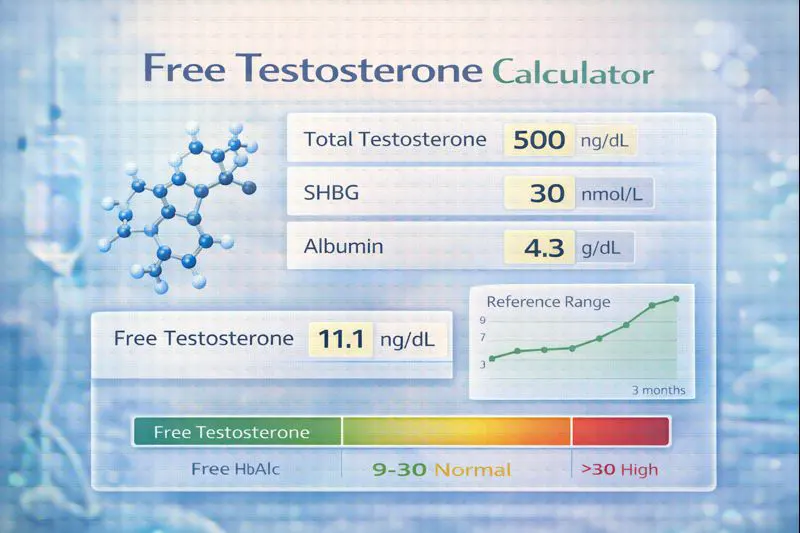
Understanding Your Free Testosterone Levels
Total testosterone doesn't tell the whole story. Most testosterone in your bloodstream is bound to proteins and unavailable for use. This calculator determines how much testosterone is actually active in your body.
When you get testosterone blood work done, the total testosterone number only shows what's circulating in your blood. However, only 2-3% of total testosterone is "free" and biologically active. Another 50-68% is bioavailable, meaning it can become active when needed.
Key benefits of using this calculator:
- Accurately determine your free testosterone percentage and absolute values
- Calculate bioavailable testosterone for complete hormonal assessment
- Monitor hormonal health for fitness, medical, or wellness purposes
- Compare your results against reference ranges for your age and gender
- Make informed decisions about testosterone replacement therapy (TRT) or lifestyle changes
This calculator is used by fitness professionals, endocrinologists, and health-conscious individuals across the UAE and internationally. The Online Calculator UAE platform provides medically accurate tools based on established scientific formulas, including this free testosterone calculator used in clinical settings worldwide.
html
How the Free Testosterone Calculator Works
This calculator uses the , the gold standard formula recognized by endocrinologists worldwide. It calculates free and bioavailable testosterone based on the equilibrium between testosterone and binding proteins in your blood.
The Calculation Method
Your body has three forms of testosterone:
- Free Testosterone (2-3%): Not bound to any protein, immediately available for cellular uptake
- Albumin-bound Testosterone (50-68%): Weakly bound, easily released and considered bioavailable
- SHBG-bound Testosterone (~30-44%): Tightly bound and not bioavailable
The calculator requires three input values from your blood work:
Total Testosterone: Usually measured in ng/dL or nmol/L. Normal ranges vary by age and gender. For adult males: 300-1,000 ng/dL (10.4-34.7 nmol/L). For adult females: 15-70 ng/dL (0.5-2.4 nmol/L).
SHBG (Sex Hormone-Binding Globulin): Measured in nmol/L. Normal ranges: Males 10-57 nmol/L, Females 18-114 nmol/L. Higher SHBG means less free testosterone.
Albumin: Measured in g/dL or g/L. Normal range: 3.5-5.5 g/dL (35-55 g/L). This protein binds testosterone weakly.
Step-by-Step Calculation Process
Step 1: The calculator converts all values to consistent units (typically nmol/L for hormones, g/L for albumin).
Step 2: Using the Vermeulen equation, it calculates the distribution of testosterone among free, albumin-bound, and SHBG-bound forms based on their binding affinities.
Step 3: Free testosterone is calculated as a percentage and absolute value. Bioavailable testosterone combines free testosterone plus albumin-bound testosterone.
Step 4: Results are compared against age and gender-specific reference ranges to indicate whether levels are low, normal, or high.
Important note: This calculation is an estimate based on equilibrium equations. Direct measurement via equilibrium dialysis or ultrafiltration is more accurate but expensive and not routinely available. The Vermeulen equation correlates well with direct measurements (r > 0.95) and is the standard calculation method used clinically.
Practical Calculation Examples
Understanding how the calculator works is easier with real-world scenarios. Here are three detailed examples showing different testosterone situations.
Example 1: Male Fitness Enthusiast with Low Free Testosterone
Profile: Ahmed, 35-year-old gym regular in Dubai, has been feeling fatigued despite regular workouts and good sleep. His doctor ordered comprehensive hormone testing.
Blood Test Results:
- Total Testosterone: 450 ng/dL (15.6 nmol/L)
- SHBG: 65 nmol/L (elevated)
- Albumin: 4.2 g/dL (42 g/L)
Calculation:
Input the values into the calculator. With elevated SHBG, more testosterone is tightly bound and unavailable.
Results:
- Free Testosterone: 1.8% of total = 0.28 nmol/L (8.1 ng/dL)
- Bioavailable Testosterone: 52% of total = 8.1 nmol/L (234 ng/dL)
Interpretation: Despite normal total testosterone, Ahmed's free testosterone is at the lower end of normal (reference: 0.3-0.7 nmol/L for his age). The high SHBG is binding too much testosterone. This explains his symptoms. For more information on optimizing your fitness based on your body composition metrics, consider comprehensive hormonal and physical assessment.
Example 2: Female Checking for PCOS-Related Elevated Testosterone
Profile: Sarah, 28-year-old working professional in Abu Dhabi, experiencing irregular periods and concerns about polycystic ovary syndrome (PCOS).
Blood Test Results:
- Total Testosterone: 85 ng/dL (2.95 nmol/L)
- SHBG: 22 nmol/L (low-normal)
- Albumin: 4.0 g/dL (40 g/L)
Calculation:
Female testosterone levels are much lower than males, but the same calculation principles apply. Lower SHBG means more free testosterone.
Results:
- Free Testosterone: 3.2% of total = 0.094 nmol/L (2.7 ng/dL)
- Bioavailable Testosterone: 68% of total = 2.0 nmol/L (58 ng/dL)
Interpretation: Sarah's total testosterone is slightly elevated for a female (normal upper limit ~70 ng/dL), and her free testosterone is also elevated (normal <0.07 nmol/L). Combined with low SHBG, this suggests hyperandrogenism possibly related to PCOS. She should discuss these results with her endocrinologist. Understanding your menstrual cycle patterns can also provide valuable insights into hormonal health.
Example 3: Older Male Considering Testosterone Replacement Therapy
Profile: Robert, 58-year-old executive in Sharjah, experiencing decreased libido, reduced muscle mass despite exercise, and general fatigue. Considering TRT.
Blood Test Results:
- Total Testosterone: 320 ng/dL (11.1 nmol/L)
- SHBG: 48 nmol/L (normal)
- Albumin: 4.3 g/dL (43 g/L)
Calculation:
With age, testosterone typically declines. Total testosterone is at the lower end of normal, but free testosterone may be even lower.
Results:
- Free Testosterone: 2.1% of total = 0.23 nmol/L (6.6 ng/dL)
- Bioavailable Testosterone: 56% of total = 6.2 nmol/L (179 ng/dL)
Interpretation: Robert's free testosterone is below the optimal range for his age (should be >0.25 nmol/L). This confirms true hypogonadism beyond just low total testosterone. His symptoms correlate with low free testosterone, making him a candidate for TRT discussion with his physician. Optimizing your protein intake and overall nutrition may also support hormonal health.
Understanding Your Results
Free testosterone levels change throughout the day, peaking in the morning and declining by evening. For accurate results, blood tests should be performed between 7-10 AM. If your first test shows abnormal results, your doctor will likely order a repeat test to confirm.
Reference ranges vary by laboratory and testing methodology. Always compare your results to the specific reference range provided by your lab. The calculator provides general guidance based on commonly used ranges.
Factors That Affect Free Testosterone
Several factors influence your free testosterone beyond total testosterone levels:
- Age: SHBG typically increases with age, reducing free testosterone even if total testosterone remains stable
- Body composition: Higher body fat percentage often correlates with lower free testosterone and higher SHBG
- Insulin resistance: Can lower SHBG, paradoxically increasing free testosterone percentage
- Thyroid function: Hyperthyroidism increases SHBG; hypothyroidism decreases it
- Liver disease: Affects albumin and SHBG production
- Medications: Some drugs affect SHBG levels (oral estrogens increase it, androgens decrease it)
Common Mistakes to Avoid
Don't rely on total testosterone alone: Two people with identical total testosterone can have vastly different free testosterone levels based on SHBG. Always check free testosterone for accurate assessment.
Don't use outdated reference ranges: Some labs use reference ranges that include unhealthy individuals. Optimal ranges may differ from "normal" ranges.
Don't ignore symptoms: If you have symptoms of low testosterone (fatigue, low libido, difficulty building muscle, depression) but "normal" total testosterone, check your free testosterone. You may have functional hypogonadism.
Don't self-diagnose or self-treat: Use this calculator as an educational tool. Always work with a qualified healthcare provider for diagnosis and treatment decisions.
When to Consult a Healthcare Provider
Consult an endocrinologist or hormone specialist if:
- Your free testosterone is below reference range with symptoms
- You're experiencing unexplained fatigue, mood changes, or sexual dysfunction
- You're considering testosterone replacement therapy
- You have conditions affecting hormone balance (PCOS, diabetes, thyroid disease)
- Your SHBG is significantly abnormal (very high or very low)
Many hospitals and specialized clinics across Dubai, Abu Dhabi, and Sharjah offer comprehensive hormone testing and endocrinology services. Always seek medical advice before making treatment decisions.