 OnlineCalculator
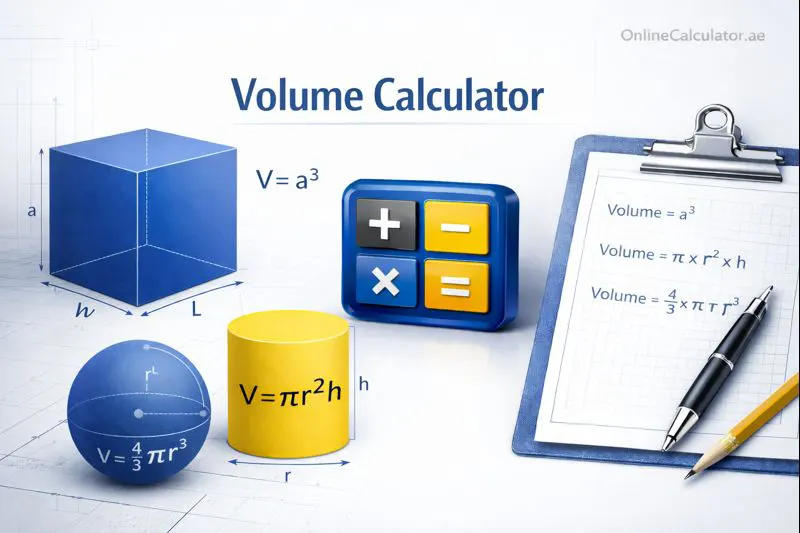
What Is a Volume Calculator?
A volume calculator is a mathematical tool that determines how much three-dimensional space an object occupies. Volume is measured in cubic units such as cubic meters (m³), cubic centimeters (cm³), liters (L), or gallons. This calculator supports multiple geometric shapes and provides instant conversions between different measurement units.
Key Benefits:
- Multi-shape support: Calculate volumes for cubes, rectangular boxes, cylinders, spheres, cones, pyramids, and irregular shapes
- Unit flexibility: Switch between metric (meters, centimeters, liters) and imperial (feet, inches, gallons) measurements
- Instant results: Get accurate calculations without manual formula memorization
- Practical applications: Perfect for construction estimates, shipping costs, aquarium sizing, and material ordering
This calculator uses standard mathematical formulas trusted by professionals worldwide. Whether you're a contractor estimating concrete volumes for a project in DIFC or a student solving geometry homework, the results are mathematically precise and reliable. For more helpful calculation tools, visit .
ADVANCED VOLUME CALCULATOR WIDGET For WordPress Elementor HTML Widget Copy and paste this entire code block into your Elementor HTML widget Features: - 8 Different 3D shapes - Multiple unit support (metric + imperial) - Real-time calculations - Visual shape preview with SVG icons - Copy results functionality - Mobile responsive design - Professional dark/light theme Header Body Shape Selection Input Section Unit Selection Dimension Inputs Cube inputs Box inputs Cylinder inputs Sphere inputs Cone inputs Pyramid inputs Hemisphere inputs Capsule inputs Formula Display Calculate Button Results Section m³ Footer
How the Volume Calculator Works
The volume calculator applies specific mathematical formulas based on the shape you select. Each formula uses the dimensions you input to calculate the total space enclosed within the shape.
Volume Formulas by Shape
Cube: V = a³ (where a = side length)
A cube has equal sides, so you only need one measurement. The calculator multiplies this value by itself three times.
Rectangular Box (Cuboid): V = l × w × h (length × width × height)
The most common calculation for shipping boxes, rooms, and containers. Simply multiply all three dimensions together.
Cylinder: V = π × r² × h (where r = radius, h = height)
Used for tanks, pipes, and circular containers. The calculator squares the radius, multiplies by pi (3.14159), then multiplies by the height.
Sphere: V = (4/3) × π × r³
Common for balls, globes, and rounded tanks. The radius is cubed, multiplied by pi, then multiplied by 4/3.
Cone: V = (1/3) × π × r² × h
One-third the volume of a cylinder with the same base and height. Useful for funnels, piles of material, and conical storage.
Pyramid: V = (1/3) × base area × h
The base area depends on the base shape (square, rectangular, triangular). Multiply by height and divide by three.
Step-by-Step Calculation Process
- Select your shape from the dropdown menu
- Choose your input units (meters, feet, centimeters, inches)
- Enter the required dimensions for your selected shape
- View instant results displayed in multiple unit formats
- Copy or note the result for your project
Important Note: Ensure all measurements use the same unit before entering them. The calculator will convert your final result into various units, but input dimensions must be consistent for accurate results.
Practical Volume Calculation Examples
Example 1: Swimming Pool Volume in Abu Dhabi
Ahmed is installing a rectangular swimming pool at his villa near Yas Island. The pool dimensions are 8 meters long, 4 meters wide, and 1.5 meters deep. He needs to know the water volume for chemical treatment calculations.
Calculation:
- Shape: Rectangular box
- Formula: V = l × w × h
- V = 8 × 4 × 1.5
- 48 cubic meters (m³)
Unit Conversion: 48 m³ = 48,000 liters of water
Ahmed now knows he needs approximately 48,000 liters to fill his pool. This helps him calculate chlorine quantities and estimate water costs at current DEWA rates.
Example 2: Concrete Order for Foundation in Sharjah
A construction company in Sharjah is pouring a concrete foundation. The slab measures 12 meters × 10 meters × 0.3 meters. They need to order ready-mix concrete from a local supplier.
Calculation:
- Shape: Rectangular box
- Formula: V = l × w × h
- V = 12 × 10 × 0.3
- 36 cubic meters (m³)
Practical Application: Concrete is sold by the cubic meter. Adding 10% for wastage (standard practice), the company should order 39.6 m³, rounded up to 40 m³ to ensure sufficient material.
Example 3: Cylindrical Water Tank Capacity in Dubai
Sara manages a residential building in Dubai Marina. She's replacing the rooftop water storage tank and needs to verify the new tank's capacity. The cylindrical tank has a radius of 1.2 meters and a height of 2.5 meters.
Calculation:
- Shape: Cylinder
- Formula: V = π × r² × h
- V = 3.14159 × (1.2)² × 2.5
- V = 3.14159 × 1.44 × 2.5
- 11.31 cubic meters (m³)
Unit Conversion: 11.31 m³ = 11,310 liters
Sara confirms the tank holds approximately 11,310 liters, which meets the building's daily consumption requirements of around 150 liters per resident for a 70-unit building.
Important Information About Volume Calculations
Unit Conversion Reference
Understanding unit relationships prevents costly mistakes:
- 1 cubic meter (m³) = 1,000 liters = 35.31 cubic feet = 264.17 US gallons
- 1 cubic foot (ft³) = 28.32 liters = 7.48 US gallons
- 1 liter = 0.001 m³ = 0.264 US gallons = 1,000 cubic centimeters
Common Mistakes to Avoid
Mixing units: Entering length in meters and width in centimeters produces incorrect results. Always convert all measurements to the same unit before calculating.
Confusing radius and diameter: For cylinders and spheres, the radius is half the diameter. Measure from the center to the edge, not across the entire circle.
Ignoring irregular shapes: Real-world objects often aren't perfect geometric shapes. For complex objects, break them into simpler shapes, calculate each volume separately, then add them together.
Professional Tips
Construction projects: Add 10-15% extra material when ordering concrete, gravel, or soil. This accounts for compression, spillage, and irregular ground surfaces.
Shipping and logistics: Carriers often charge by "dimensional weight" rather than actual weight. Calculate your package volume accurately to estimate shipping costs—especially important for international shipments from UAE free zones.
Water and liquid storage: Remember that tanks are rarely filled to 100% capacity. Account for expansion space (typically 5-10% headroom) when sizing storage containers.
Frequently Asked Questions
How accurate is this volume calculator?
The calculator uses standard mathematical formulas and provides results accurate to multiple decimal places. Results are as accurate as the measurements you input—precision in your measurements equals precision in your results.
What's the difference between volume and capacity?
Volume refers to the three-dimensional space an object occupies. Capacity refers to how much a container can hold. For practical purposes, they're often used interchangeably, but capacity typically refers to liquid measurements (liters, gallons).
Can I calculate the volume of irregular shapes?
Break complex shapes into combinations of basic geometric forms. Calculate each section separately, then add or subtract volumes as needed. For highly irregular objects, water displacement methods may be more practical.
Why do I need to calculate volume for shipping?
Shipping companies charge based on "volumetric weight" when packages are large but light. The formula varies by carrier but typically converts cubic dimensions to a weight equivalent. Knowing your package volume helps estimate these costs accurately.
How do I measure the volume of a room?
Measure the length, width, and ceiling height in meters or feet. Use the rectangular box formula (L × W × H). For rooms with alcoves or bay windows, calculate each section separately and combine the results.
What volume units are used in the UAE?
The UAE primarily uses metric measurements. Construction projects typically use cubic meters (m³), while liquid volumes are expressed in liters. However, international shipping may require cubic feet or inches for documentation.
How much concrete do I need for a column?
Most columns are cylindrical. Measure the radius and height, then use the cylinder formula. For square columns, use the rectangular box formula. Always add 10% for wastage when ordering materials.
Can this calculator help with aquarium sizing?
Absolutely. Enter your aquarium dimensions using the rectangular box formula. The result in liters helps determine appropriate fish stocking levels and filtration requirements based on standard aquarist guidelines.
Start Calculating Now
Use the volume calculator above to get instant, accurate measurements for any project. Whether you're planning construction, estimating material costs, or simply solving a geometry problem, precise volume calculations are just a few clicks away.
For official measurement standards and regulations in the UAE, visit the Ministry of Industry and Advanced Technology (MoIAT). Need assistance with your calculations? Explore additional tools at .