 OnlineCalculator
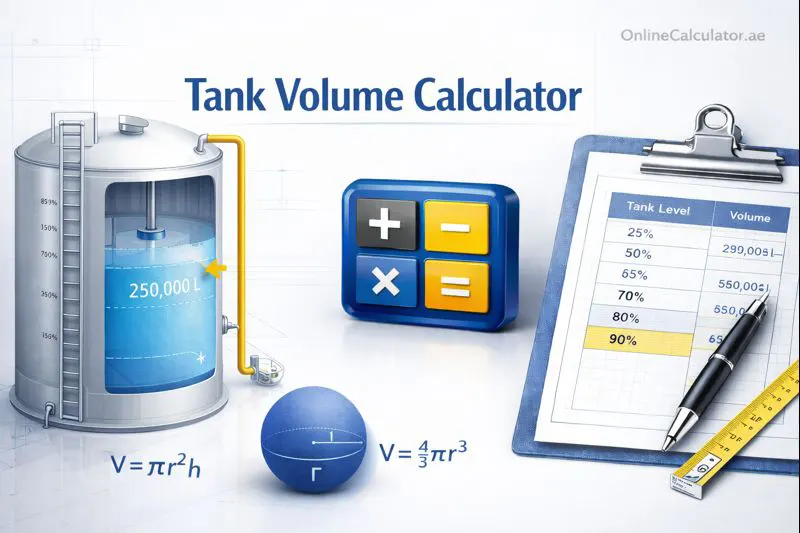
What Is a Tank Volume Calculator?
A tank volume calculator is a specialized tool that computes the internal capacity of storage tanks based on their dimensions and shape. Instead of manually applying complex geometric formulas, you simply enter your tank's measurements and receive accurate results in seconds.
This free Online Calculator UAE tool supports multiple tank shapes commonly used across residential, commercial, and industrial applications:
- Cylindrical tanks – horizontal and vertical orientations
- Rectangular/square tanks – water storage, aquariums, reservoirs
- Oval tanks – underground fuel storage, septic systems
- Capsule (pill-shaped) tanks – pressure vessels, LPG storage
Results display in liters, US gallons, imperial gallons, and cubic meters—giving you flexibility regardless of your measurement preferences or industry standards.
html
How the Tank Volume Calculator Works
The calculator applies geometric formulas specific to each tank shape. Here's the methodology behind each calculation:
Cylindrical Tank Formula
For vertical cylinders, the volume equals π multiplied by the radius squared, then multiplied by height:
Where r = radius (diameter ÷ 2) and h = height. For horizontal cylinders, the same formula applies, but fill-level calculations differ when the tank isn't completely full.
Rectangular Tank Formula
The simplest calculation—multiply length by width by height:
V = L × W × H
This applies to square tanks, fish tanks, concrete reservoirs, and any box-shaped container.
Oval (Elliptical) Tank Formula
Oval tanks require accounting for two different radii. The formula uses:
V = π × a × b × L
Where a = semi-major axis, b = semi-minor axis, and L = tank length.
Capsule Tank Formula
Capsule tanks combine a cylinder with two hemispherical ends:
V = π × r² × (L + (4/3 × r))
This accounts for both the cylindrical middle section and the curved ends.
Unit Conversions
The calculator automatically converts between cubic centimeters (cm³), liters (L), cubic meters (m³), US gallons, and imperial gallons using standard conversion factors:
- 1 liter = 1,000 cm³
- 1 cubic meter = 1,000 liters
- 1 US gallon = 3.78541 liters
- 1 imperial gallon = 4.54609 liters
Tank Volume Calculation Examples
Example 1: Residential Water Tank in Dubai
Ahmed owns a villa in Dubai Marina and needs to calculate his rooftop water tank capacity for maintenance planning. The tank is cylindrical with a diameter of 1.2 meters and height of 1.5 meters.
Calculation:
- Radius = 1.2 ÷ 2 = 0.6 meters
- V = π × 0.6² × 1.5
- V = 3.14159 × 0.36 × 1.5
- 1.696 cubic meters
- 1,696 liters (approximately 448 US gallons)
Ahmed now knows his tank holds nearly 1,700 liters—enough for about 3-4 days of typical household usage during a water supply interruption.
Example 2: Industrial Fuel Storage in Jebel Ali
A logistics company in Jebel Ali Free Zone needs to calculate the capacity of a horizontal oval diesel tank. Dimensions: length 4 meters, width 2 meters, height 1.5 meters.
Calculation:
- Semi-major axis (a) = 2 ÷ 2 = 1 meter
- Semi-minor axis (b) = 1.5 ÷ 2 = 0.75 meters
- V = π × 1 × 0.75 × 4
- V = 3.14159 × 3
- 9.42 cubic meters
- 9,420 liters (approximately 2,489 US gallons)
The facility manager can now order fuel deliveries knowing the exact tank capacity and calculate optimal refill schedules.
Example 3: Custom Aquarium in Abu Dhabi
Fatima is designing a large rectangular saltwater aquarium for her home in Yas Island. The planned dimensions are 2 meters long, 0.8 meters wide, and 0.6 meters tall.
Calculation:
- V = 2 × 0.8 × 0.6
- 0.96 cubic meters
- 960 liters (approximately 253 US gallons)
Fatima can now properly size her filtration system and calculate salt requirements. A 960-liter marine aquarium requires approximately 32-34 kg of marine salt for proper salinity levels.
Important Considerations for Tank Volume Calculations
Account for Wall Thickness
Tank dimensions provided by manufacturers often include wall thickness. For accurate internal volume calculations, subtract the wall thickness from each dimension. A steel tank with 5mm walls reduces usable capacity by approximately 2-5% depending on overall size.
Consider Working Capacity vs. Total Capacity
Most tanks shouldn't be filled to 100% capacity. Industrial standards recommend:
- Fuel tanks: 95% maximum fill to allow for thermal expansion
- Water tanks: 90-95% to prevent overflow and pressure buildup
- Chemical tanks: 80-85% for safety margins (consult Dubai's Security Industry Regulatory Agency guidelines for hazardous materials)
Temperature Effects on Volume
Liquids expand when heated. Diesel fuel expands approximately 0.083% per degree Celsius. A 10,000-liter tank filled at 20°C will show about 83 liters more volume at 30°C. This matters significantly for fuel purchase and inventory management in the UAE's hot climate.
Common Mistakes to Avoid
- Mixing units: Ensure all measurements use the same unit (all meters or all centimeters)
- Diameter vs. radius confusion: Remember to divide diameter by 2 for radius-based formulas
- Ignoring fittings: Internal baffles, heating elements, and inlet/outlet pipes reduce actual capacity
- Assuming perfect shapes: Older tanks may have dents or deformations affecting volume
Frequently Asked Questions
How accurate is this tank volume calculator?
The calculator uses standard geometric formulas and provides mathematically precise results. Real-world accuracy depends on how precisely you measure your tank dimensions. For critical applications, professional tank calibration services can verify capacity to within 0.5%.
Can I calculate partially filled tank volumes?
Yes. For rectangular tanks, multiply the result by the fill percentage. For cylindrical horizontal tanks, partial fill calculations are more complex due to the curved bottom—our advanced calculator includes this functionality.
What's the difference between US gallons and imperial gallons?
US gallons equal 3.785 liters while imperial (UK) gallons equal 4.546 liters. The imperial gallon is about 20% larger. This distinction matters when ordering equipment or fuel from different regions.
How do I measure an underground tank I can't access?
Check original installation documentation, manufacturer specifications, or tank data plates. Alternatively, use known fill volumes—if you know how many liters were pumped in to fill the tank, you have your answer directly.
Does tank orientation affect volume?
Total volume remains identical whether a cylindrical tank sits horizontally or vertically. However, orientation affects how you measure dimensions and calculate partial fill levels. Always note your tank's orientation before measuring.
How do I calculate volume for irregular or custom-shaped tanks?
Break complex shapes into simpler components. Calculate each section separately using appropriate formulas, then add the results. For highly irregular tanks, water displacement testing or professional calibration may be necessary.
Why do my manual calculations differ from the calculator results?
Check for unit inconsistencies and ensure you're using radius (not diameter) where required. Also verify you're applying the correct formula for your tank shape. The calculator uses π to 15 decimal places for maximum precision.
Can this calculator help with tank purchase decisions?
Absolutely. Input your required capacity, and work backward to determine what dimensions you need. This helps when comparing tank options from different suppliers or planning installation space requirements.
Start Calculating Your Tank Volume Now
Enter your tank dimensions above and get instant, accurate capacity calculations. Whether you're managing water storage, planning fuel inventory, or designing custom containers, this tool delivers the precision you need.
For large-scale industrial tank installations in the UAE, consult with Dubai Municipality regarding permits and safety requirements. Commercial fuel storage facilities should also review regulations from Civil Defence authorities.
Bookmark this page for quick access whenever you need tank volume calculations—it's free, requires no registration, and works on any device.