 OnlineCalculator
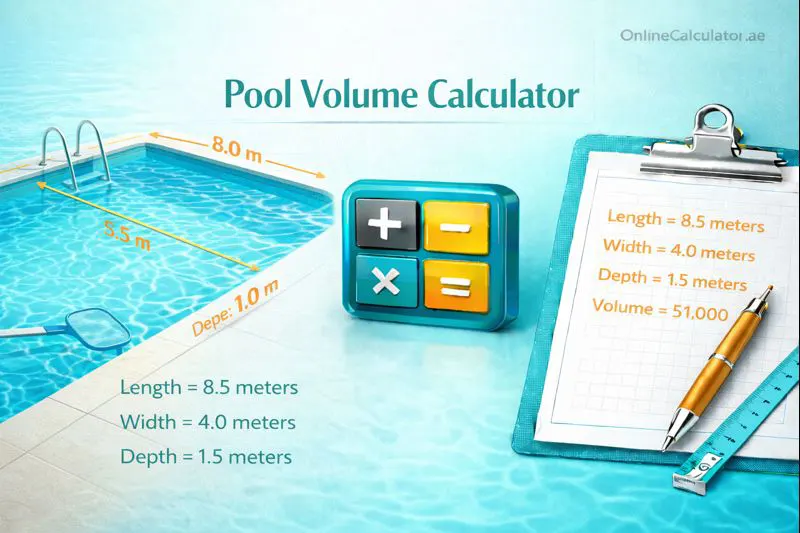
Why Calculate Your Pool Volume?
Understanding your swimming pool's water capacity isn't just helpful—it's necessary for safe and efficient pool ownership. From chlorine dosing to heat pump sizing, nearly every aspect of pool maintenance depends on accurate volume measurements.
This calculator helps you:
- Dose chemicals correctly – Prevent under or over-chlorination that can cause skin irritation or algae growth
- Size equipment properly – Choose the right pump, filter, and heater for your pool's capacity
- Estimate water costs – Know exactly how much water you need to fill or top up your pool
- Plan maintenance schedules – Calculate turnover rates and filtration cycles accurately
Our calculator uses standard geometric formulas trusted by pool professionals worldwide. Whether you have a small plunge pool in Dubai Marina or a large resort pool on Yas Island, this tool delivers precise results every time. For more helpful tools, visit Online Calculator UAE.
Advanced Pool Volume Calculator for WordPress Elementor HTML Widget Copy and paste this entire code into an Elementor HTML widget Shape Selector Unit Toggle Input Fields Rectangular/Oval Inputs m
m Circular Input m Kidney Shape Inputs m
m
m Depth Toggle m
m
m Calculate Button Results Section
How the Pool Volume Calculator Works
Calculating pool volume requires different formulas depending on your pool's shape. Here's how each calculation method works:
Rectangular and Square Pools
The simplest calculation multiplies length × width × average depth. If your pool has a sloped bottom, add the shallow end depth and deep end depth together, then divide by two to get the average.
Formula: Volume = Length × Width × Average Depth
Circular (Round) Pools
Round pools use pi (3.14159) multiplied by the radius squared, then by the depth. The radius is half of your pool's diameter.
Formula: Volume = π × Radius² × Depth
Oval Pools
Oval pools combine the rectangular and circular formulas. You'll need the longest length, the widest width, and the average depth.
Formula: Volume = π × (Length/2) × (Width/2) × Depth
Irregular Shapes
For freeform or kidney-shaped pools, divide the pool into regular shapes, calculate each section separately, then add them together. Most irregular pools can be broken into rectangles and semicircles.
Unit Conversions
The calculator automatically converts between measurement systems:
- 1 cubic meter = 1,000 liters = 264.17 US gallons
- 1 cubic foot = 7.48 US gallons = 28.32 liters
Always double-check your unit selections before entering dimensions. Mixing meters with feet will produce incorrect results.
Example 1: Standard Rectangular Pool
Scenario: Sarah owns a villa in Jumeirah with a rectangular pool. She needs to calculate the volume before adding chlorine.
Pool dimensions:
- Length: 10 meters
- Width: 5 meters
- Shallow end: 1.2 meters
- Deep end: 2.0 meters
Calculation:
Average depth = (1.2 + 2.0) ÷ 2 = 1.6 meters
Volume = 10 × 5 × 1.6 = 80 cubic meters
Result: Sarah's pool holds 80,000 liters (80 m³ × 1,000).
For her 80,000-liter pool, she'll need approximately 160-240 grams of chlorine per week for regular maintenance, depending on usage and weather conditions.
Example 2: Circular Above-Ground Pool
Scenario: Ahmed set up a round above-ground pool in his garden in Sharjah. He wants to know how long his garden hose will take to fill it.
Pool dimensions:
- Diameter: 4.5 meters
- Depth: 1.2 meters (uniform)
Calculation:
Radius = 4.5 ÷ 2 = 2.25 meters
Volume = π × 2.25² × 1.2 = 3.14159 × 5.0625 × 1.2 = 19.09 cubic meters
Result: Ahmed's pool holds approximately 19,090 liters.
With a standard garden hose flowing at 15 liters per minute, filling this pool takes roughly 21 hours of continuous flow.
Example 3: Oval Spa Pool with Variable Depth
Scenario: A luxury hotel on Palm Jumeirah needs to calculate the volume of their oval spa pool for heat pump sizing.
Pool dimensions:
- Length: 6 meters
- Width: 3 meters
- Depth: 1.0 meter (uniform for spa)
Calculation:
Volume = π × (6÷2) × (3÷2) × 1.0 = 3.14159 × 3 × 1.5 × 1.0 = 14.14 cubic meters
Result: The spa holds approximately 14,140 liters.
For a spa of this size, a 15-20 kW heat pump would be appropriate for maintaining temperatures between 28-32°C throughout the year.
Measurement Tips for Accuracy
Always measure from the inside walls of your pool, not the outer edges. For depth measurements, measure from the water surface level to the bottom—not from the pool deck. If your pool has benches, steps, or ledges, subtract their volume from your total calculation.
Common Measurement Mistakes
- Forgetting to average the depth – Most pools aren't uniformly deep
- Measuring external dimensions – Pool walls can be 15-30 cm thick
- Ignoring steps and benches – These can reduce volume by 5-10%
- Mixing unit systems – Don't combine meters with feet in the same calculation
When Precision Matters Most
Chemical dosing requires the most accurate volume measurements. Overdosing chlorine can cause eye irritation, bleached swimwear, and equipment corrosion. Underdosing allows algae growth and potentially harmful bacteria to thrive.
For heat pump sizing, being within 10% of actual volume is usually acceptable. However, for salt chlorinator systems, accuracy within 5% ensures optimal salt levels between 3,000-4,000 ppm.
Professional Verification
If you're installing expensive equipment or managing a commercial pool, consider having a pool professional verify your calculations. Many pool companies in the UAE offer free site assessments that include accurate volume measurements using professional tools.