 OnlineCalculator
What Is a Marks Percentage Calculator?
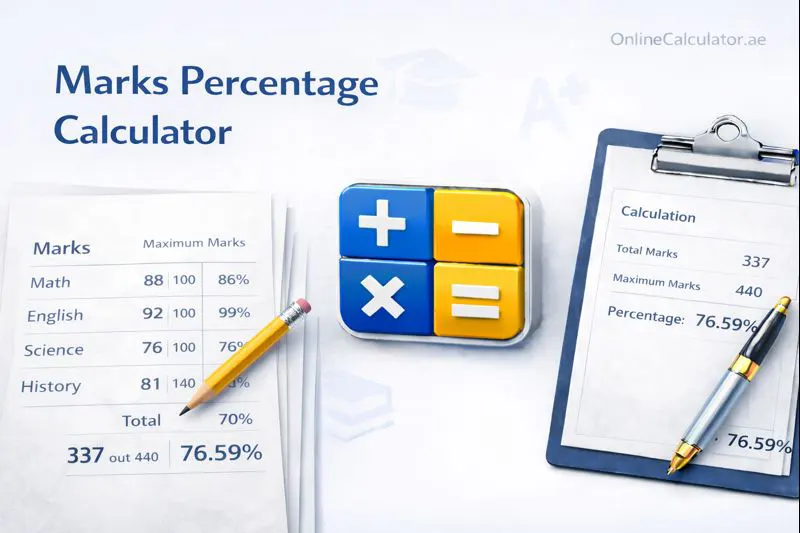
A marks percentage calculator transforms your raw exam scores into a percentage value that's universally understood. This straightforward conversion helps you understand exactly where you stand academically, compare performance across different subjects, and track your improvement over time.
Key benefits of using this calculator:
- Instant accuracy - eliminates manual calculation errors that can misrepresent your true performance
- Universal compatibility - works with any marking scheme, from 10-point quizzes to 1000-point comprehensive exams
- Multi-subject tracking - calculate percentages for individual subjects or combine them for an overall percentage score
- Time-saving - get results in seconds instead of working through formulas manually
This calculator is trusted by thousands of students and educators across the UAE and worldwide. It uses the standard mathematical formula recognized by educational institutions globally, ensuring your calculated percentage matches official results.
ADVANCED MARKS PERCENTAGE CALCULATOR - WordPress Elementor Compatible Copy this entire code into an Elementor HTML Widget Mode Tabs Single Subject Mode 0% Multiple Subjects Mode Subject rows will be added here 0% Reverse Calculator Mode
How the Marks to Percentage Calculation Works
Converting marks to percentage follows a simple yet precise mathematical formula. Understanding this process helps you verify calculations and apply the concept across various academic scenarios.
The Formula
The percentage formula divides your obtained marks by the total possible marks, then multiplies by 100:
Percentage = (Obtained Marks ÷ Total Marks) × 100
Step-by-Step Breakdown
Step 1: Identify your obtained marks. This is the score you received on your exam, assignment, or test. For example, if you scored 78 out of 100, your obtained marks are 78.
Step 2: Identify the total marks. This represents the maximum possible score for the assessment. Using the same example, total marks would be 100.
Step 3: Divide obtained marks by total marks. This gives you a decimal value representing your proportional performance. Example: 78 ÷ 100 = 0.78
Step 4: Multiply by 100 to convert the decimal to a percentage. Example: 0.78 × 100 = 78%
Important Considerations
The formula works regardless of the marking scale. Whether your exam was out of 50, 100, 150, or any other total, the calculation remains consistent. Some assessments may include bonus marks that push scores above 100% - the calculator handles these scenarios accurately.
For cumulative calculations involving multiple subjects, you'll need to either add all obtained marks and total marks together, or use a grade average tool for weighted calculations.
Example 1: Standard Exam Score
Scenario: Ahmed, a Grade 10 student at GEMS Wellington Academy in Dubai, received his mathematics mid-term results. He scored 87 marks out of a possible 100.
Calculation:
- Obtained Marks: 87
- Total Marks: 100
- Percentage = (87 ÷ 100) × 100 = 87%
Ahmed's percentage is straightforward since the exam was out of 100. His 87% places him in the A grade category at most UAE schools.
Example 2: Non-Standard Total Marks
Scenario: Fatima completed her physics practical exam at Abu Dhabi International School. The assessment was worth 75 marks total, and she earned 63 marks.
Calculation:
- Obtained Marks: 63
- Total Marks: 75
- Percentage = (63 ÷ 75) × 100 = 84%
Despite the unusual total, Fatima's 84% demonstrates strong performance. This percentage can now be compared directly with her other subjects scored out of different totals.
Example 3: Multiple Subject Aggregate
Scenario: Omar, preparing for university admissions, needs to calculate his aggregate percentage across five subjects. His results from RAK Academy are:
| Mathematics | 92 | 100 |
| Physics | 78 | 100 |
| Chemistry | 85 | 100 |
| English | 88 | 100 |
| Arabic | 72 | 100 |
Calculation:
- Total Obtained: 92 + 78 + 85 + 88 + 72 = 415
- Total Maximum: 100 × 5 = 500
- Aggregate Percentage = (415 ÷ 500) × 100 = 83%
Omar's aggregate of 83% meets admission requirements for most UAE universities. For converting this to a GPA format, he can use dedicated conversion tools.
Grading System Variations
Different educational boards use distinct grading scales. UAE schools following the American curriculum typically use percentage-based grading, while British curriculum schools may use letter grades. Indian curriculum (CBSE/ICSE) schools commonly work with percentages, making this calculator particularly useful for students in those systems.
When Percentages Differ from Grades
A calculated percentage doesn't automatically translate to a specific letter grade across all institutions. For example, 75% might be a B+ at one school but an A- at another. Always reference your specific institution's grading policy when converting percentages to letter grades.
Common Mistakes to Avoid
- Inverting the formula - Always divide obtained by total, never the reverse
- Forgetting to multiply by 100 - This converts the decimal to an actual percentage
- Mixing weighted and unweighted scores - If subjects have different credit weights, simple aggregation won't give accurate results
- Including incomplete assessments - Only calculate with finalized marks
Expert Tips
Keep a running record of your percentages throughout the academic year. This helps identify subjects needing additional attention early. Many students find that tracking performance using the report card calculation method provides clearer insights than examining raw scores alone.
Start Calculating Your Percentage Now
Enter your marks above and get instant, accurate percentage results. Bookmark this page for quick access throughout your academic year. For more academic calculation tools, explore Online Calculator UAE - your trusted resource for educational calculations and planning tools.
Need to calculate your cumulative academic performance? Try our CGPA calculator or semester GPA tool for comprehensive academic tracking.