 OnlineCalculator
What Is an Overall Percentage Calculator?
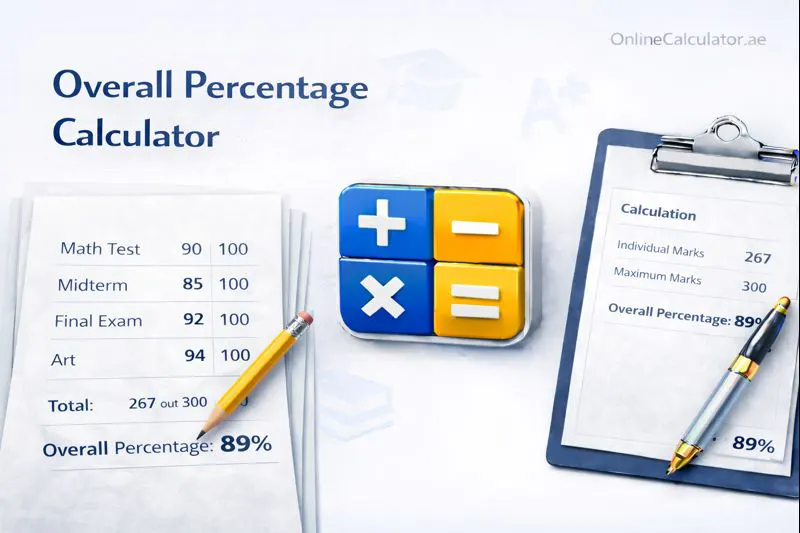
An overall percentage calculator is a tool that combines marks from multiple subjects, tests, or assessments to give you a single percentage score. Whether you're calculating your semester results, annual exam performance, or cumulative academic record, this calculator handles the math accurately.
Key benefits of using this calculator:
- Multiple subjects: Add unlimited subjects with different maximum marks
- Weighted calculations: Accounts for subjects with varying total marks
- Instant accuracy: No manual calculation errors
- Free and unlimited: Use as many times as you need
This tool is trusted by thousands of students across the UAE, from university students in Dubai to high school students in Abu Dhabi. It follows standard mathematical formulas used by educational institutions worldwide, ensuring your results match official calculations.
Need help with other academic calculations? Visit Online Calculator UAE for a complete collection of educational tools.
ADVANCED OVERALL PERCENTAGE CALCULATOR For WordPress Elementor HTML Widget Features: Multiple subjects, weighted calculations, visual results, export, print-friendly Copy and paste this entire code into Elementor's HTML widget Mode Toggle Subject rows will be added here Quick Mode Results Section 0%
How the Overall Percentage Calculator Works
The calculator uses a straightforward weighted average formula that accounts for subjects with different maximum marks. This ensures fair representation of your performance across all subjects.
The Formula
The overall percentage is calculated using this formula:
Overall Percentage = (Total Marks Obtained ÷ Total Maximum Marks) × 100
Step-by-Step Calculation Process
Step 1: Enter your obtained marks for each subject or exam.
Step 2: Enter the maximum marks possible for each subject.
Step 3: The calculator adds all obtained marks together.
Step 4: It also adds all maximum marks together.
Step 5: The total obtained marks are divided by total maximum marks and multiplied by 100.
Important Notes
This method is called the weighted percentage method. It differs from simply averaging individual subject percentages. The weighted method is more accurate because subjects with higher maximum marks contribute proportionally more to your final score.
For example, a subject worth 200 marks has double the impact of a subject worth 100 marks. This reflects how most educational institutions calculate overall results.
If you need to convert your percentage to a GPA format, use our percentage to GPA conversion tool for accurate results.
Example 1: University Student in Dubai Marina
Ahmed is a business student at a Dubai university. He completed his semester with the following results:
- Accounting: 78/100
- Business Statistics: 85/100
- Marketing Fundamentals: 72/100
- Organizational Behavior: 88/100
- Business Law: 65/100
Calculation:
Total Obtained = 78 + 85 + 72 + 88 + 65 = 388
Total Maximum = 100 + 100 + 100 + 100 + 100 = 500
Overall Percentage = (388 ÷ 500) × 100 = 77.6%
Ahmed's overall percentage is 77.6%, placing him in the B+ grade range at most UAE universities.
Example 2: High School Student with Different Maximum Marks
Sara is a Grade 12 student in Abu Dhabi. Her subjects have different weightings:
- Mathematics: 156/200
- Physics: 88/100
- Chemistry: 82/100
- English: 142/150
- Arabic: 135/150
Calculation:
Total Obtained = 156 + 88 + 82 + 142 + 135 = 603
Total Maximum = 200 + 100 + 100 + 150 + 150 = 700
Overall Percentage = (603 ÷ 700) × 100 = 86.14%
Sara's overall percentage is 86.14%. Notice how the math subject (200 marks) has more impact on her final score than individual 100-mark subjects.
Example 3: Professional Certification Assessment
Khalid, working in DIFC, is completing a professional certification with multiple assessment components:
- Written Exam: 68/80
- Practical Assessment: 45/50
- Project Work: 38/40
- Continuous Assessment: 27/30
Calculation:
Total Obtained = 68 + 45 + 38 + 27 = 178
Total Maximum = 80 + 50 + 40 + 30 = 200
Overall Percentage = (178 ÷ 200) × 100 = 89%
Khalid's overall score of 89% exceeds most certification pass thresholds.
For more detailed mark-based calculations, check our marks to percentage converter.
Weighted vs. Simple Average: Understanding the Difference
A common mistake is calculating the average of individual subject percentages. This method only works when all subjects have equal maximum marks. Our calculator uses the weighted method, which is mathematically correct for subjects with different maximum marks.
Example of the difference:
Subject A: 80/100 (80%) | Subject B: 160/200 (80%)
Simple Average: (80% + 80%) ÷ 2 = 80%
Weighted Method: (80 + 160) ÷ (100 + 200) × 100 = 80%
In this case, both methods give the same result. But if the percentages differ:
Subject A: 90/100 (90%) | Subject B: 140/200 (70%)
Simple Average: (90% + 70%) ÷ 2 = 80%
Weighted Method: (90 + 140) ÷ (100 + 200) × 100 = 76.67%
The weighted method gives 76.67% because Subject B (200 marks) carries more weight.
Common Mistakes to Avoid
- Entering percentages instead of marks: Always enter raw marks, not percentages
- Forgetting to update maximum marks: Ensure each subject's maximum marks match your grading system
- Including incomplete subjects: Only add subjects where you have final marks
- Rounding too early: Let the calculator handle precision for accurate results
Expert Tips
Track your semester progress throughout the term using this calculator. Enter estimated marks before exams to set realistic goals. This helps identify which subjects need more attention.
For comprehensive semester tracking, our semester grade point average tool provides additional insights.
Start Calculating Your Overall Percentage Now
Enter your marks in the calculator above to get your overall percentage instantly. For related academic calculations, explore our complete suite of tools in the academic calculators section.
Have questions about percentage calculations or need help interpreting your results? The formulas and methods used here align with international educational standards. For institution-specific grading policies in the UAE, consult your school's academic office or the Ministry of Education UAE guidelines.