 OnlineCalculator
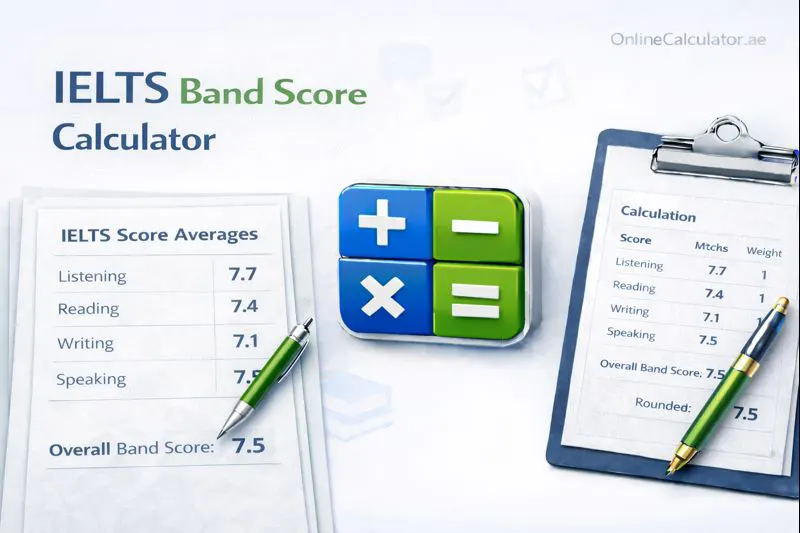
Planning to study abroad, migrate, or advance your career? Our free IELTS band score calculator helps you instantly determine your overall band score from your Listening, Reading, Writing, and Speaking results. Whether you're preparing for IELTS Academic or General Training, this tool provides accurate calculations based on official IELTS scoring guidelines. Perfect for students, professionals, and immigration applicants worldwide who need to understand their English proficiency level.
What Is the IELTS Band Score Calculator?
The IELTS (International English Language Testing System) band score calculator is an essential tool that converts your individual module scores into an overall band score. This calculator eliminates guesswork and provides you with precise results following the official IELTS rounding rules used by test centres globally.
Key benefits of using our IELTS calculator:
- Instant Overall Score: Enter your four module scores and get your overall band immediately
- Raw Score Conversion: Convert your correct answers (out of 40) to band scores for Listening and Reading
- Academic & General Training: Separate calculations for both test types with different Reading conversion tables
- Official Rounding Rules: Uses the exact IELTS rounding methodology (.25 rounds up to .5, .75 rounds up to whole)
Trusted by thousands of IELTS candidates, this calculator mirrors the scoring system used by British CouncilIDP test centres. Whether you're targeting university admission requirements or immigration point thresholds, knowing your exact score helps you plan effectively. Visit Online Calculator UAE for more academic tools to support your educational journey.
html
How the IELTS Band Score Calculation Works
Understanding how your IELTS score is calculated helps you set realistic targets and identify areas for improvement. The scoring methodology is straightforward but includes specific rounding rules that can affect your final result.
The Overall Band Score Formula
Your overall IELTS band score is calculated by averaging your four individual module scores:
Overall Band Score = (Listening + Reading + Writing + Speaking) ÷ 4
After calculating the average, IELTS applies specific rounding rules to determine your final score. The result is always reported as a whole number or half band (e.g., 6.0, 6.5, 7.0).
IELTS Rounding Rules Explained
The official IELTS rounding system works as follows:
- Average ends in .25: Rounds UP to the next half band (6.25 becomes 6.5)
- Average ends in .75: Rounds UP to the next whole band (6.75 becomes 7.0)
- Average ends in .1 to .24: Rounds DOWN to the nearest whole band (6.1 becomes 6.0)
- Average ends in .5 to .74: Rounds DOWN to the nearest half band (6.6 becomes 6.5)
Raw Score to Band Score Conversion
For Listening and Reading modules, your raw score (correct answers out of 40) converts to a band score. The Listening conversion remains identical for both Academic and General Training tests. However, Reading conversions differ because General Training passages are generally easier than Academic texts.
For example, achieving 30 correct answers in Listening gives you . The same 30 correct answers in Academic Reading also yields , but in General Training Reading, you would need 34 correct answers for Band 7.0.
Writing and Speaking are assessed holistically by trained examiners using four criteria each, with scores awarded directly as band levels. If you're also preparing for other standardised tests, our TOEFL score converter can help you compare equivalent scores.
Practical IELTS Score Calculation Examples
Understanding how scores work in real scenarios helps you plan your preparation strategy. Here are three examples demonstrating different score combinations and outcomes.
Example 1: University Admission Requirement (Band 6.5)
Scenario: Fatima from Dubai is applying to a postgraduate programme at a UK university requiring an overall Band 6.5 with no module below 6.0.
Her practice test scores:
- Listening: 27 correct answers → Band 6.5
- Reading (Academic): 26 correct answers →
- Writing:
- Speaking:
(6.5 + 6.0 + 6.0 + 7.0) ÷ 4 = 25.5 ÷ 4 = 6.375
Rounding: Since 6.375 falls between .25 and .75, it rounds to the nearest half band.
Final Overall Band Score: 6.5
Fatima meets her target! She can confidently proceed with her UK university application. For tracking her academic performance, she might also find our cumulative grade point calculator useful.
Example 2: Canadian Immigration Points (Band 7.0 Target)
Scenario: Khalid from Abu Dhabi needs CLB 9 (equivalent to IELTS 7.0) for maximum points in his Express Entry application to Canada.
His test results:
- Listening: 32 correct answers → Band 7.5
- Reading (General Training): 34 correct answers →
- Writing: Band 6.5
- Speaking:
(7.5 + 7.0 + 6.5 + 7.0) ÷ 4 = 28 ÷ 4 =
Final Overall Band Score: 7.0
Khalid achieves his target overall score. However, for Express Entry, individual module scores matter too. His Writing score of 6.5 corresponds to CLB 8, which affects his total CRS points. He may want to retake the test focusing specifically on improving his writing skills.
Example 3: Edge Case – When 0.25 Makes a Difference
Scenario: Sarah from Sharjah receives the following scores on her IELTS Academic test:
- Listening:
- Reading: Band 6.5
- Writing:
- Speaking: Band 6.5
(6.0 + 6.5 + 6.0 + 6.5) ÷ 4 = 25 ÷ 4 = 6.25
Rounding: Because the average ends exactly in .25, IELTS rounds UP to the next half band.
Final Overall Band Score: 6.5
This is significant because if even one of Sarah's modules had been 0.5 lower (making the average 6.125), her overall score would round DOWN to 6.0. Understanding these rounding rules helps you identify where an extra 0.5 band in any module could push your overall score to the next level.
Academic vs General Training Differences
The primary scoring difference between IELTS Academic and General Training lies in the Reading module conversion table. Since General Training reading texts are considered less challenging than academic passages, you need more correct answers to achieve the same band score. Listening, Writing, and Speaking are scored identically for both test versions.
Score Requirements by Purpose
Different institutions and immigration programmes have varying IELTS requirements:
- University undergraduate admission: Typically Band 5.5 – 6.5
- Postgraduate programmes: Usually Band 6.5 – 7.5
- Professional registration (nursing, medicine): Often Band 7.0 with minimum 7.0 in each module
- Immigration (Canada, Australia, UK): Varies by visa category, typically Band 6.0 – 7.0
Common Mistakes to Avoid
- Assuming equal difficulty: Academic Reading requires fewer correct answers for the same band as General Training
- Ignoring individual module minimums: Many programmes require no module below a certain threshold
- Miscalculating averages: Always verify your calculation includes all four modules equally weighted
- Forgetting rounding rules: The .25 and .75 thresholds are crucial for borderline scores
Expert Tips for Score Improvement
If your calculated score falls short of your target, focus on your weakest module first. Improving from 6.0 to 6.5 in Writing contributes the same to your overall score as improving from 7.5 to 8.0 in Listening. Additionally, practising under timed conditions replicates actual test pressure and improves performance consistency. Check out our academic and educational tools for additional resources.
Start Calculating Your IELTS Score Now
Ready to discover your overall IELTS band score? Simply enter your Listening, Reading, Writing, and Speaking scores into the calculator above. For raw score conversions, select your test type (Academic or General Training) and input your correct answers out of 40.
For official information about IELTS scoring and test registration, visit the official IELTS website. To book your test or find a test centre near you, check with British Council or IDP Education.
Our calculator provides reliable estimates to help you plan your preparation strategy and understand your current proficiency level. Good luck with your IELTS journey!