 OnlineCalculator
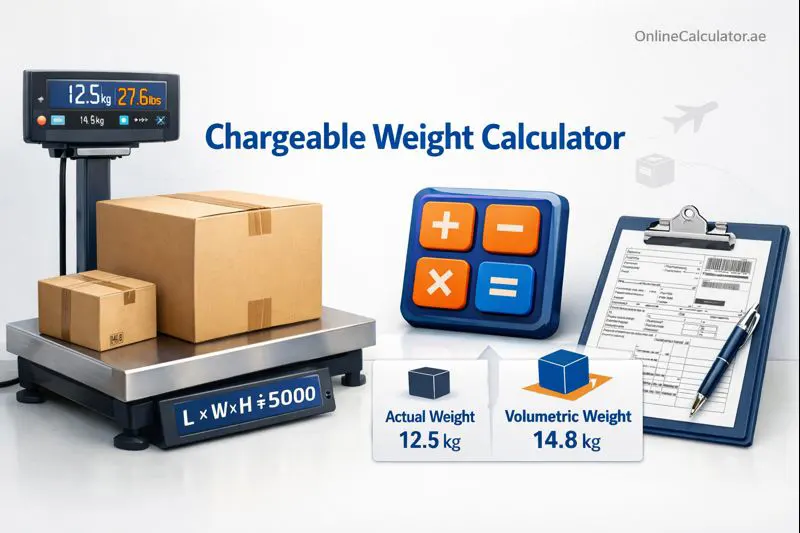
Shipping goods from Dubai, Abu Dhabi, or anywhere in the UAE? Stop overpaying for freight. Our free instantly compares your shipment's actual weight against its volumetric weight—showing you exactly what carriers will bill you for. Whether you're using air freight, sea freight, or express couriers like DHL international shipping, FedEx delivery services, or Aramex local courier, this tool helps UAE businesses and individuals avoid surprise charges.
What Is a Chargeable Weight Calculator?
A chargeable weight calculator determines the billable weight freight carriers use to price your shipment. Carriers don't simply charge based on what your package weighs on a scale. Instead, they compare two measurements and charge you for whichever is higher:
- Actual Weight (Gross Weight): The physical weight of your shipment including packaging, measured in kilograms
- Volumetric Weight (Dimensional Weight): A calculated weight based on the space your package occupies, using length × width × height divided by a dimensional factor
This system exists because a large box of lightweight items (like cushions or clothing) takes up valuable cargo space that could hold denser, heavier goods. UAE exporters shipping through Jebel Ali Port or Dubai International Airport need this calculation to accurately budget their logistics costs.
Our calculator supports multiple shipping modes with their respective DIM factors:
- Air Freight: Divisor of 6,000 (IATA standard)
- Express Courier: Divisor of 5,000 (DHL, FedEx, UPS)
- Sea Freight (LCL): 1 CBM = 1,000 kg
- Road Freight (LTL): Divisor of 3,000
ADVANCED CHARGEABLE WEIGHT CALCULATOR For WordPress Elementor HTML Widget Supports: Air Freight, Sea Freight (LCL), Express Courier, Road Freight (LTL) Features: Multi-package support, Unit conversion, Cost estimation, Export results Shipping Mode Tabs ✈️ 🚚 🚢 🛣️ Unit Selection Package Input Package List 📋 Packages Added (0) 📭 Optional Cost Estimation Results Section KG KG KG
How the Chargeable Weight Calculation Works
Understanding the chargeable weight formula helps you make smarter shipping decisions. Here's the step-by-step methodology our calculator uses:
Step 1: Measure Your Package Dimensions
Measure the length, width, and height of each package at its longest points. Include any bulging or irregular edges, as carriers measure from the outermost points. Record measurements in centimetres for consistency.
Step 2: Calculate the Volume
Multiply your three dimensions together:
Volume (cm³) = Length × Width × Height
Step 3: Apply the Dimensional Factor
Divide the volume by the appropriate DIM factor based on your shipping method:
| Formula | Equivalent | ||
|---|---|---|---|
| L × W × H ÷ 6,000 | 1 CBM = 167 kg | ||
| 5,000 | L × W × H ÷ 5,000 | 1 CBM = 200 kg | |
| Sea Freight (LCL) | 1,000 | Compare CBM vs Tonnes | 1 CBM = 1,000 kg |
| Road Freight (LTL) | 3,000 | L × W × H ÷ 3,000 | 1 CBM = 333 kg |
Step 4: Compare and Select the Higher Value
The carrier will charge based on whichever weight is greater—actual or volumetric. This final figure is your , the number that determines your shipping cost.
Important: Different carriers may use slightly different DIM factors. For instance, some express couriers in Asia still use 5,000 while others have moved to 6,000. Always confirm with your specific carrier or freight forwarder. For more complex shipments, consider using our comprehensive freight estimation tool.
Example 1: E-commerce Shipment from Dubai to Europe
Scenario: Fatima runs an online fashion boutique in Dubai Marina. She's shipping 5 cartons of abayas to a customer in Germany via air freight.
Package Details:
- Each carton: 60 cm × 40 cm × 30 cm
- Actual weight per carton: 8 kg
- Total cartons: 5
Calculation:
- Volume per carton: 60 × 40 × 30 = 72,000 cm³
- Volumetric weight per carton: 72,000 ÷ 6,000 = 12 kg
- Actual weight per carton: 8 kg
- Chargeable weight per carton: 12 kg (volumetric is higher)
- Total chargeable weight: 12 kg × 5 = 60 kg
Result: Despite the shipment weighing only 40 kg on the scale, Fatima will be billed for 60 kg because the volumetric weight exceeds the actual weight. Using our air cargo cost estimator can help her compare rates.
Example 2: Industrial Equipment via Sea Freight
Scenario: Ahmed's manufacturing company in Jebel Ali Free Zone is shipping machine parts to Mumbai via LCL sea freight.
Package Details:
- Crate dimensions: 1.5 m × 1.2 m × 1.0 m
- Actual weight: 2,500 kg (2.5 tonnes)
Calculation:
- CBM volume: 1.5 × 1.2 × 1.0 = 1.8 CBM
- Volumetric equivalent: 1.8 CBM = 1.8 tonnes (since 1 CBM = 1,000 kg for sea freight)
- Actual weight: 2.5 tonnes
- Chargeable weight: 2.5 tonnes (actual is higher)
Result: Because the machine parts are dense and heavy, the actual weight exceeds the volumetric equivalent. Ahmed pays based on 2.5 tonnes. For planning container loads, our shipping container capacity tool offers additional insights.
Example 3: Express Courier Parcel to USA
Scenario: Rashid works in DIFC and needs to send product samples to a client in New York via DHL Express.
Package Details:
- Box dimensions: 50 cm × 40 cm × 35 cm
- Actual weight: 5 kg
Calculation:
- Volume: 50 × 40 × 35 = 70,000 cm³
- Volumetric weight (DIM factor 5,000): 70,000 ÷ 5,000 = 14 kg
- Actual weight: 5 kg
- Chargeable weight: 14 kg (volumetric is significantly higher)
Result: Rashid's 5 kg parcel will be charged as if it weighs 14 kg. This nearly triples his expected shipping cost. He should consider using smaller, more compact packaging or compare rates using our overall shipping price comparison tool.
Carrier-Specific DIM Factors
While our calculator uses industry-standard divisors, individual carriers may apply different rates:
- FedEx International: Uses 5,000 cm³/kg (standard) or 6,000 for some routes
- DHL Express: Generally applies 5,000 cm³/kg worldwide
- Emirates SkyCargo: Follows IATA standard of 6,000 cm³/kg
- Aramex: Varies by service type and destination
Always confirm the DIM factor with your chosen carrier before finalising shipping costs.
UAE Customs Considerations
When importing goods into the UAE, the Federal Customs Authority requires accurate weight and dimension declarations. Underestimating your shipment's chargeable weight can lead to customs delays and additional charges. Use our import duty estimation tool alongside this calculator for complete cost planning.
Common Mistakes to Avoid
- Measuring only the product: Always include all packaging materials—bubble wrap, cartons, pallets, and strapping add volume
- Using the wrong DIM factor: Air freight (6,000), courier (5,000), and road freight (3,000) each use different divisors
- Forgetting multiple packages: Calculate each package individually, then sum the chargeable weights
- Ignoring irregular shapes: Carriers measure the longest point on each axis—a cylinder is charged as if it were a rectangular box
Tips to Reduce Your Chargeable Weight
- Use right-sized boxes that fit your products snugly
- Consider vacuum packaging for soft goods like textiles
- Disassemble bulky items when possible
- Consolidate multiple small shipments into one optimised load
- Compare shipping modes—sometimes sea freight is more economical for lightweight, bulky cargo