 OnlineCalculator
What Is Creatinine Clearance and Why Does It Matter?
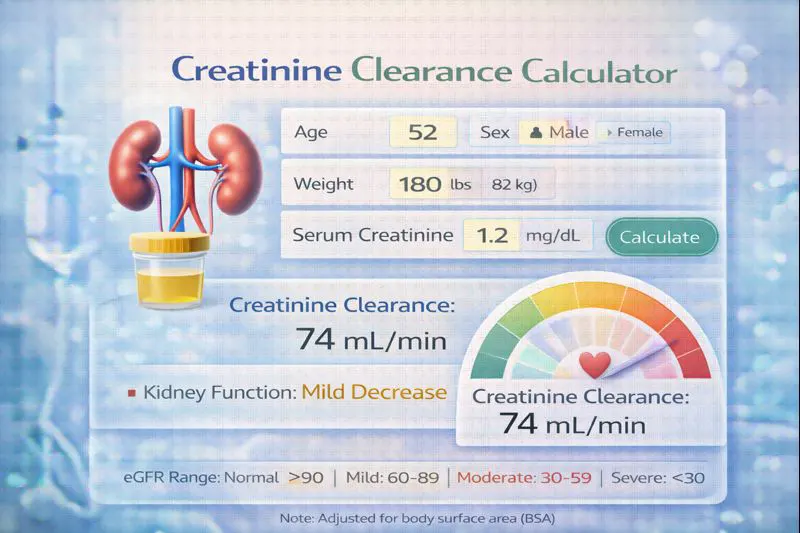
Creatinine clearance (CrCl) measures how efficiently your kidneys filter waste from your blood. This essential calculation helps doctors assess kidney function, adjust medication dosages, and detect early signs of kidney disease.
Online Calculator UAE provides a professional-grade tool that delivers results in seconds. Whether you're a healthcare provider at Dubai Healthcare City or a patient monitoring your kidney health, this calculator gives you the information you need.
Key benefits of using this calculator:
- Medical accuracy: Uses the gold-standard Cockcroft-Gault formula trusted by nephrologists worldwide
- Instant results: Calculate CrCl in mL/min immediately without complex manual calculations
- Medication safety: Helps determine appropriate drug dosages for patients with reduced kidney function
- Early detection: Identifies declining kidney function before symptoms appear
html
This calculator provides estimates for educational purposes only. Results should be interpreted by a qualified healthcare professional. Always consult your doctor for medical advice, diagnosis, and treatment decisions.How the Creatinine Clearance Calculator Works
This calculator uses the Cockcroft-Gault equation, the most widely accepted method for estimating creatinine clearance in clinical practice. The formula accounts for age, weight, gender, and serum creatinine levels to provide an accurate assessment of kidney function.
The Cockcroft-Gault Formula
For males:
CrCl (mL/min) = [(140 - age) × weight (kg)] / [72 × serum creatinine (mg/dL)]
For females:
CrCl (mL/min) = [(140 - age) × weight (kg) × 0.85] / [72 × serum creatinine (mg/dL)]
The female calculation includes a 0.85 correction factor because women typically have lower muscle mass than men, which affects creatinine production.
Step-by-Step Calculation Process
Step 1: Enter your age in years. Kidney function naturally declines with age, making this a critical factor.
Step 2: Input your current weight in kilograms. Higher body weight generally correlates with higher creatinine production.
Step 3: Provide your serum creatinine level from recent blood work. This value is measured in mg/dL and reflects how much creatinine is in your bloodstream.
Step 4: Select your gender. The calculator applies the appropriate formula based on this selection.
Step 5: Review your result, displayed in mL/min, which indicates your estimated kidney filtration rate.
Important notes: Results should be interpreted by a qualified healthcare professional. Normal CrCl ranges from 90-120 mL/min for healthy adults. Values below 60 mL/min may indicate chronic kidney disease, while values below 15 mL/min suggest kidney failure requiring dialysis or transplantation.
Real-World Calculation Examples
Understanding how the calculator works becomes clearer with practical examples. These scenarios represent common situations healthcare providers encounter daily.
Example 1: Healthy Adult Male Assessment
Patient profile: Ahmed is a 45-year-old engineer working in DIFC who came for his annual health screening at a Dubai clinic. He weighs 78 kg and his recent blood test showed a serum creatinine level of 1.1 mg/dL.
Calculation breakdown:
- Age: 45 years
- Weight: 78 kg
- Serum creatinine: 1.1 mg/dL
- Gender: Male
Formula application:
CrCl = [(140 - 45) × 78] / [72 × 1.1]
CrCl = [95 × 78] / 79.2
CrCl = 7,410 / 79.2
Result: 93.6 mL/min
Interpretation: Ahmed's creatinine clearance of 93.6 mL/min falls within the normal range, indicating healthy kidney function appropriate for his age. No medication adjustments needed.
Example 2: Elderly Female with Chronic Conditions
Patient profile: Fatima is a 72-year-old retired teacher living in Abu Dhabi with type 2 diabetes. She weighs 62 kg and her nephrologist ordered kidney function tests showing serum creatinine at 1.4 mg/dL.
Calculation breakdown:
- Age: 72 years
- Weight: 62 kg
- Serum creatinine: 1.4 mg/dL
- Gender: Female
Formula application:
CrCl = [(140 - 72) × 62 × 0.85] / [72 × 1.4]
CrCl = [68 × 62 × 0.85] / 100.8
CrCl = 3,583.6 / 100.8
Result: 35.5 mL/min
Interpretation: Fatima's CrCl of 35.5 mL/min indicates Stage 3 chronic kidney disease (CKD). Her doctor will need to adjust diabetes medications, particularly metformin, and monitor kidney function every 3-6 months. Similar to checking your estimated filtration rate, regular monitoring becomes essential at this stage.
Example 3: Young Adult with Suspected Kidney Issues
Patient profile: Rashid is a 28-year-old athlete from Sharjah who noticed unusual fatigue and swelling. His sports medicine doctor ordered comprehensive blood work showing elevated serum creatinine at 2.0 mg/dL despite his weight of 85 kg.
Calculation breakdown:
- Age: 28 years
- Weight: 85 kg
- Serum creatinine: 2.0 mg/dL
- Gender: Male
Formula application:
CrCl = [(140 - 28) × 85] / [72 × 2.0]
CrCl = [112 × 85] / 144
CrCl = 9,520 / 144
Result: 66.1 mL/min
Interpretation: A CrCl of 66.1 mL/min is significantly below normal for a 28-year-old, suggesting early kidney disease. Rashid needs immediate referral to a nephrologist for further evaluation, possible kidney biopsy, and investigation of underlying causes such as autoimmune conditions or undiagnosed hypertension.
When to Calculate Creatinine Clearance
Healthcare providers in UAE hospitals and clinics typically order creatinine clearance calculations for several specific situations. Patients with diabetes, hypertension, or family history of kidney disease should have regular assessments. Anyone starting medications that affect kidney function needs baseline measurements.
The calculation becomes particularly important before prescribing antibiotics, chemotherapy drugs, or contrast dye for imaging studies. Many medications require dose adjustments based on kidney function to prevent toxicity.
Limitations and Considerations
The Cockcroft-Gault formula has important limitations:
- Muscle mass variations: Bodybuilders or severely malnourished patients may get inaccurate results because creatinine production depends on muscle tissue
- Obesity adjustments: For patients with BMI above 30, actual body weight may overestimate kidney function. Some clinicians use adjusted or ideal body weight instead
- Pregnancy considerations: Kidney function increases during pregnancy, making standard formulas less accurate. Similar to using a pregnancy tracking tool, specialized calculators may be needed
- Acute conditions: Rapidly changing kidney function (acute kidney injury) requires 24-hour urine collection for accurate measurement
Common Mistakes to Avoid
Using outdated creatinine values: Always use the most recent blood test results. Creatinine levels can change within weeks, especially during illness or medication changes.
Incorrect unit conversions: Ensure serum creatinine is in mg/dL and weight in kilograms. Some labs report creatinine in µmol/L, requiring conversion (divide by 88.4 to get mg/dL).
Ignoring clinical context: Numbers alone don't tell the complete story. A doctor must consider symptoms, other lab values, and medical history when interpreting results.
Expert Tips for Accurate Results
Schedule your blood test in the morning after fasting for the most consistent creatinine measurements. Avoid intense exercise 24 hours before testing, as muscle breakdown temporarily elevates creatinine levels.
If you're monitoring kidney function over time, try to maintain similar conditions for each test. Use the same laboratory when possible, as different testing methods can produce slightly different results.
Take Control of Your Kidney Health Today
Understanding your creatinine clearance empowers you to make informed health decisions and catch potential kidney problems early. Use our calculator above to estimate your kidney function, then discuss results with your healthcare provider.
For reliable kidney function testing in the UAE, consult nephrologists at major healthcare facilities including Burjeel Hospital, Mediclinic City Hospital, or Sheikh Khalifa Medical City. Early detection and proper management can significantly slow kidney disease progression and improve long-term outcomes.
Remember, this calculator provides estimates for educational purposes. Always work with qualified medical professionals for diagnosis, treatment planning, and medication management. Your kidney health deserves expert attention and comprehensive care.