 OnlineCalculator
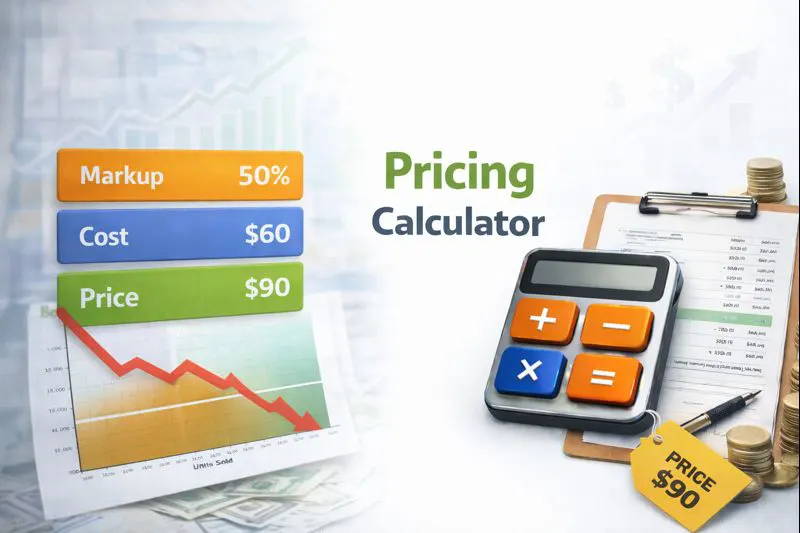
What Is a Pricing Calculator and Why Do You Need One?
A pricing calculator is an essential business tool that helps you determine how much to charge for your products or services. It takes into account your base costs, desired profit margins, and market positioning to suggest the ideal selling price. For businesses operating in competitive markets like the UAE and beyond, getting your pricing strategy right is crucial for sustainable growth.
Online Calculator UAE tool delivers instant results based on proven pricing formulas used by successful businesses worldwide.
Key benefits of using this pricing calculator:
- Instant calculations: Get selling prices, profit amounts, and margins within seconds
- Multiple pricing methods: Calculate using cost-plus, margin-based, or markup-based approaches
- Profit visualization: See exactly how much you'll earn per unit and total revenue projections
- Break-even analysis: Understand the minimum price needed to cover your costs
This calculator uses the same methodologies trusted by retail businesses in DIFC, e-commerce sellers on major platforms, and entrepreneurs across the GCC region.
======================================== For WordPress Elementor HTML Widget ======================================== Features: - Multiple calculation modes (Markup, Margin, Reverse) - Real-time calculations - Visual profit breakdown chart - Currency formatting (AED) - Unit-based projections - Mobile responsive - Print/Export functionality ======================================== Mode Selector Mode Description Input Fields %
% Calculate Button Results Section 0% 0% Visual Chart Cost (0%) Profit (0%) Breakdown Table
| Total (1 units) |
|---|
Action Buttons
How the Pricing Calculator Works
Understanding the Pricing Formula
Our pricing calculator uses three core formulas that professional accountants and business consultants rely on. These formulas work together to give you a complete picture of your pricing strategy.
1. Cost-Plus Pricing Formula:
Selling Price = Cost Price + (Cost Price × Markup Percentage)
This method adds a fixed percentage to your cost. For example, if a product costs AED 100 and you apply a 50% markup, your selling price becomes AED 150.
2. Margin-Based Pricing Formula:
Selling Price = Cost Price ÷ (1 - Profit Margin Percentage)
This approach calculates price based on your target profit margin. With a 30% margin goal on a AED 100 cost item, you'd price at AED 142.86.
3. Reverse Calculation (Finding Margin from Price):
Profit Margin = (Selling Price - Cost Price) ÷ Selling Price × 100
Use this when you have a set selling price and need to verify your margin.
Step-by-Step Calculation Process
Step 1: Enter your product's cost price (what you pay to acquire or produce it)
Step 2: Choose your calculation method: markup percentage OR desired profit margin
Step 3: Input your target percentage value
Step 4: Optionally add the number of units for total revenue projection
Step 5: Review your results including selling price, profit per unit, and total profit
Important Notes
Remember that markup and margin are different. A 50% markup doesn't equal a 50% profit margin. A 50% markup on AED 100 gives you AED 150 selling price with a 33.33% margin. Understanding this distinction prevents costly pricing errors.
For sellers using platforms like Amazon or eBay, remember to factor in platform fees before setting your price. You can use our Amazon seller fee calculator to account for these costs.
Real-World Pricing Calculator Examples
Example 1: Fashion Retailer in Dubai Mall
Scenario: Sarah runs a boutique in Dubai Mall selling designer accessories. She sources handbags from a supplier for AED 350 each and wants a 45% profit margin to cover rent, staff, and other overheads.
Calculation:
- Cost Price: AED 350
- Desired Profit Margin: 45%
- Formula: Selling Price = 350 ÷ (1 - 0.45) = 350 ÷ 0.55
- Selling Price: AED 636.36
- Profit per bag: AED 286.36
Sarah rounds this to AED 649 for psychological pricing appeal. If she sells 50 bags monthly, her gross profit reaches AED 14,950.
Example 2: E-commerce Seller Shipping Internationally
Scenario: Ahmed operates an electronics store from Sharjah, selling gadgets globally. His cost for wireless earbuds (including shipping to his warehouse) is AED 85. He prefers using a 70% markup to stay competitive with international sellers.
Calculation:
- Cost Price: AED 85
- Markup Percentage: 70%
- Formula: Selling Price = 85 + (85 × 0.70) = 85 + 59.50
- Selling Price: AED 144.50
- Profit per unit: AED 59.50
- Actual Profit Margin: 41.18%
Ahmed lists at AED 145. With 200 units sold monthly, he generates AED 11,900 in gross profit. He uses the profit margin analyzer to track his performance across different product categories.
Example 3: Food Service Business with Multiple Cost Factors
Scenario: A café owner on Yas Island creates specialty coffee blends. The total cost per cup (beans, milk, cup, lid, labor allocation) comes to AED 8.50. The café industry typically operates on 60-65% markup due to high overhead costs.
Calculation:
- Cost Price: AED 8.50
- Markup Percentage: 65%
- Formula: Selling Price = 8.50 + (8.50 × 0.65) = 8.50 + 5.525
- Selling Price: AED 14.03
- Profit per cup: AED 5.53
- Actual Profit Margin: 39.39%
The owner rounds to AED 14 (or AED 15 for premium presentation). Selling 300 cups daily translates to AED 1,659 daily profit before fixed costs. Business owners can also check total operational expenses using a business cost estimation tool.
Key Pricing Considerations and Expert Tips
Understanding Markup vs. Margin
One of the most common pricing mistakes is confusing markup with margin. Here's a quick reference:
| Equivalent Margin % | |
|---|---|
| 25% | 20% |
| 50% | 33.33% |
| 100% | 50% |
| 200% | 66.67% |
UAE-Specific Pricing Factors
Businesses operating in the UAE should account for these regional considerations:
- VAT Impact: The 5% VAT must be factored into consumer-facing prices. Use our sales tax computation tool for accurate VAT calculations
- Import Duties: Customs charges (typically 5% for most goods) should be included in your cost price
- Currency Fluctuations: If sourcing internationally, build a buffer for AED exchange rate changes
- Seasonal Demand: Dubai's tourism peaks (November-March) may support higher pricing
Common Pricing Mistakes to Avoid
- Ignoring all costs: Include shipping, packaging, returns, and payment processing fees
- Copying competitors blindly: Their cost structure may differ significantly from yours
- Setting prices too low: Underpricing damages perceived value and long-term sustainability
- Forgetting volume discounts: Factor in bulk purchase savings from suppliers
Expert Tips for Optimal Pricing
Use psychological pricing (AED 99 instead of AED 100) for consumer products. Test different price points through A/B testing on e-commerce platforms. Review and adjust prices quarterly based on cost changes and market conditions.
Frequently Asked Questions About Pricing Calculations
How do I calculate the selling price from cost and desired profit margin?
Divide your cost price by (1 minus your desired margin as a decimal). For a AED 200 cost with 40% margin goal: 200 ÷ 0.60 = AED 333.33 selling price. This ensures your profit represents exactly 40% of the final price.
What's the difference between markup and profit margin?
Markup is calculated on your cost price, while margin is calculated on the selling price. A 100% markup doubles your cost to get the selling price, resulting in a 50% margin. Use our markup percentage tool to switch between these metrics.
How accurate is this pricing calculator?
The calculator uses standard financial formulas with precision to two decimal places. Results match what professional accountants would calculate manually. For complex scenarios involving multiple cost factors, we recommend verifying with a financial advisor.
Should I include shipping costs in my product cost?
Yes. Your "cost price" should include every expense to get the product ready for sale: purchase price, shipping, customs, handling, and packaging. This gives you a true profit picture.
What profit margin should I aim for?
Healthy margins vary by industry. Retail typically targets 40-60%, e-commerce 30-50%, and services 50-80%. Research your specific industry benchmarks and adjust based on your overhead costs and competitive position.
Can I use this calculator for service-based pricing?
Absolutely. Input your hourly cost (wages plus overhead allocation) as the cost price and apply your desired margin or markup. Service businesses often use higher markups (100-300%) due to expertise value.
How do I account for platform fees when selling online?
Add platform fees to your cost price before calculating. If Amazon charges 15% on a AED 100 item, your effective cost becomes AED 115 (product cost + AED 15 fee). Check our online marketplace fee calculator for various platforms.
Does the calculator work for bulk pricing scenarios?
Enter your quantity in the units field to see total profit projections. For tiered pricing (different margins at different volumes), calculate each tier separately using the sales revenue estimator.
Start Calculating Your Optimal Product Price
Proper pricing protects your profit margins and positions your business for growth. Use our pricing calculator above to determine the ideal selling price for your products. For businesses seeking deeper financial analysis, our complete suite of business and financial tools offers additional resources including break-even analysis, commission calculations, and valuation tools.
The calculations provided are based on standard pricing formulas. For significant business decisions, consider consulting with a certified accountant or financial advisor familiar with UAE commercial regulations.
Related Business Calculators
- Profit Calculator – Calculate net profit from revenue and expenses
- Break-Even Point Calculator – Find when your business becomes profitable
- Margin Calculator – Convert between margin and markup instantly
- Discount Calculator – Calculate sale prices and savings
- Commission Calculator – Compute sales commissions accurately
- Business Valuation Tool – Estimate your business worth