 OnlineCalculator
What This Battery Backup Calculator Does
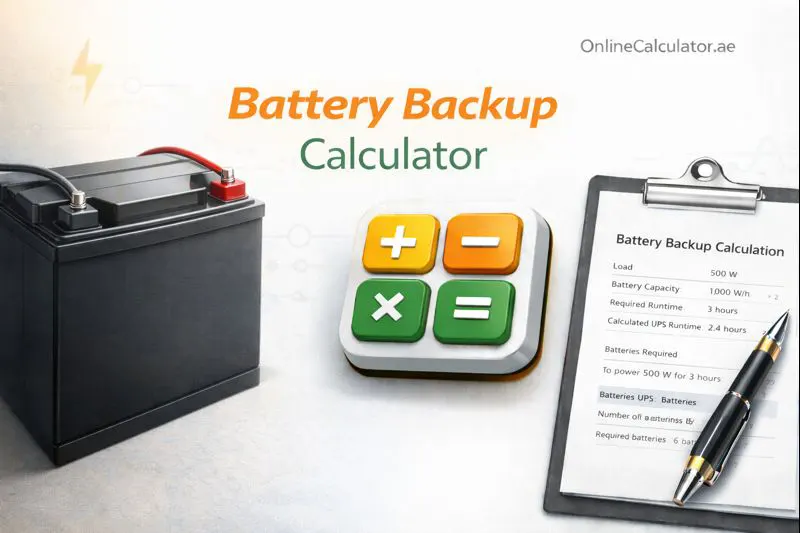
This free tool calculates exactly how long your battery backup system can power your appliances during an electricity outage. Simply input your battery specifications and total device wattage, and the calculator determines your estimated runtime with professional-grade accuracy.
Key benefits of using this calculator:
- Accurate runtime estimates – Uses the industry-standard formula accounting for inverter efficiency
- UAE-optimized – Includes common appliance wattages for homes across Dubai, Sharjah, and other Emirates
- Multiple calculation modes – Calculate backup time or determine required battery capacity
- Preset device library – Quick-add common UAE household appliances
Thousands of residents across the Emirates trust Online Calculator UAE for accurate electrical calculations. While DEWA maintains one of the world's most reliable grids with only 1.06 minutes average outage per customer annually, having backup power remains essential for protecting sensitive equipment and ensuring uninterrupted comfort.
Battery Backup Calculator UAE - Advanced Widget for WordPress Elementor Copy this entire code into an Elementor HTML Widget Runtime Calculator Tab ⚡
Ah
85% 🏠 Appliances populated by JavaScript W
⏱️ ⚠️ High temperatures reduce battery performance by 15-20%. For critical equipment, add a 20% safety margin. Replace batteries every 2-4 years for optimal performance. Capacity Calculator Tab 🎯
W
85%
🔋 💡 Always size your battery 20-30% larger than calculated. Battery capacity degrades over time, and UAE heat accelerates this process. Consider lithium batteries for better heat tolerance.
How the Battery Backup Calculation Works
Understanding your UPS runtime requires three essential values: battery capacity, battery voltage, and total load wattage. The calculator uses the standard battery backup formula trusted by electrical engineers across the UAE.
The Battery Backup Formula
Battery Backup Time (Hours) = (Battery Capacity × Battery Voltage × Inverter Efficiency) ÷ Total Load (Watts)
Each component plays a specific role:
Battery Capacity (Ah) – This is the ampere-hour rating of your battery. A higher Ah rating means more stored energy. Common UPS batteries in the UAE market range from 7Ah (small desktop units) to 200Ah (large inverter systems). You can find this value printed on your battery or in the product specifications.
Battery Voltage (V) – Most residential UPS systems in the UAE use either 12V (single battery) or 24V (dual battery) configurations. Larger commercial systems may use 48V or higher. Check your UPS specifications to confirm the voltage.
– No inverter converts 100% of battery power to usable electricity. Quality inverters operate at 80-90% efficiency. This calculator defaults to 85%, which reflects the performance of most mid-range to premium units sold in the Emirates.
– The combined wattage of all devices you want to power during an outage. Add up the wattage of each connected appliance. You can find wattage ratings on device labels or use our preset library for typical values.
Important Note: Actual runtime may vary based on battery age, temperature conditions (UAE heat can affect performance), and load fluctuations. For critical applications like medical equipment or server rooms, add a 20% safety margin to your calculations. If you're planning a larger solar installation, consider using our photovoltaic system calculator for comprehensive power planning.
Practical Examples for UAE Homes
Here are three real-world scenarios showing how UAE residents calculate their battery backup needs:
Example 1: Dubai Marina Apartment – Basic Electronics Protection
Scenario: Ahmed lives in a Dubai Marina apartment and wants to keep his WiFi router, laptop, and TV running during brief outages.
His devices:
- WiFi Router: 20W
- Laptop: 65W
- LED TV (42"): 60W
- Total Load: 145W
His UPS specifications:
- Battery Capacity: 9Ah
- Battery Voltage: 12V
- Inverter Efficiency: 85%
Calculation:
Backup Time = (9Ah × 12V × 0.85) ÷ 145W = 0.63 hours (approximately 38 minutes)
Ahmed can expect roughly 38 minutes of backup time – sufficient to save work and safely shut down devices if needed.
Example 2: Sharjah Villa – Home Office Setup
Scenario: Fatima works from home in Sharjah and needs extended backup for her entire home office during occasional maintenance outages.
Her devices:
- Desktop Computer: 300W
- Two Monitors: 80W (40W each)
- WiFi Router: 20W
- Desk Lamp (LED): 10W
- Phone Charger: 15W
- Total Load: 425W
Her inverter specifications:
- Battery Capacity: 150Ah
- Battery Voltage: 24V (two 12V batteries)
- Inverter Efficiency: 85%
Calculation:
Backup Time = (150Ah × 24V × 0.85) ÷ 425W = 7.2 hours
Fatima's setup provides over 7 hours of backup – more than enough to complete her workday uninterrupted or wait out most maintenance windows.
Example 3: Al Ain Family Home – Essential Appliances Only
Scenario: The Rahman family wants to power only essential items during extended outages: refrigerator and lights.
Their priority devices:
- Refrigerator (running watts, cycling average): 150W
- 5 LED Bulbs: 50W (10W each)
- Total Load: 200W
Their backup system:
- Battery Capacity: 200Ah
- Battery Voltage: 24V
- Inverter Efficiency: 85%
Calculation:
Backup Time = (200Ah × 24V × 0.85) ÷ 200W = 20.4 hours
With a properly sized system, the family can keep food fresh and maintain lighting for over 20 hours. This calculation helps them understand their actual backup capacity versus what sales representatives might claim. To estimate your monthly electricity costs during normal operation, try our power bill estimator.
Battery Performance in UAE Climate
The UAE's high temperatures significantly affect battery performance. Lead-acid batteries (common in most UPS systems) operate optimally between 20-25°C. During summer months when temperatures exceed 45°C, battery capacity can drop by 15-20%. Keep your UPS in air-conditioned spaces whenever possible to maximize lifespan and performance.
Choosing the Right System for Your Needs
For apartments and small offices, a UPS with 650VA to 1500VA rating handles most electronics. Villas and larger spaces requiring extended backup typically need inverter systems with separate battery banks. When sizing your system, consider that appliances with motors (refrigerators, air conditioners, water pumps) require 2-3 times more power to start than to run.
Common Mistakes to Avoid
Overestimating battery capacity – Manufacturer ratings assume ideal conditions. Apply an 85% derating factor for real-world UAE conditions.
Ignoring battery age – Batteries lose 20% capacity after 2 years and up to 50% after 4 years. Replace batteries on schedule.
Connecting too many devices – Drawing power close to the inverter's maximum rating reduces efficiency and strains the system. Aim for 70-80% of rated capacity.
Forgetting ghost loads – Many devices draw power even when "off." Standby electronics, phone chargers, and appliances with clocks add up to 50W or more of constant draw.
Expert Tips
Test your backup system quarterly by disconnecting from mains power briefly. Ensure proper ventilation around your UPS or inverter. Consider connecting your backup system to a dedicated circuit breaker. For accurate readings on your current electrical consumption, a wattage measurement tool can help identify power-hungry appliances.