 OnlineCalculator
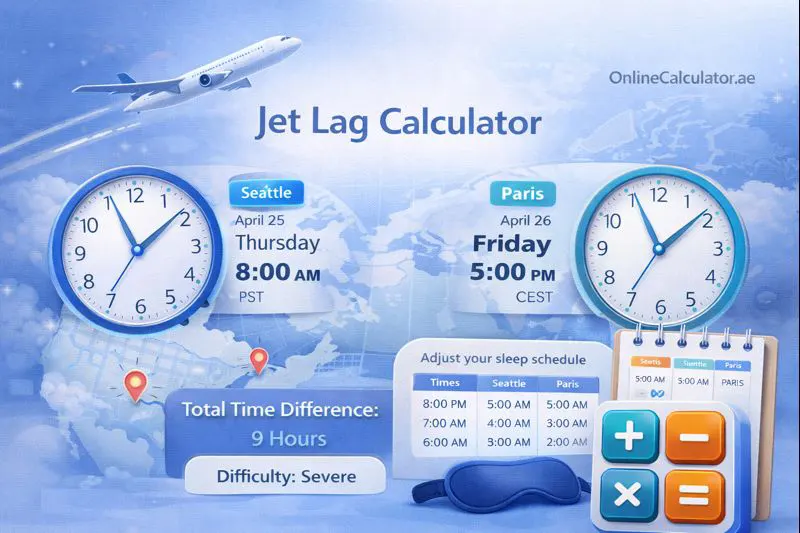
What Is the Jet Lag Calculator?
The UAE serves as a global aviation hub, with Dubai International Airport connecting travelers to over 270 destinations worldwide. This means countless UAE residents and visitors regularly cross multiple time zones—and experience the exhaustion that follows. Our jet lag calculator analyzes your travel route and creates a science-backed adjustment schedule tailored specifically to your journey.
The calculator considers several factors to generate your personalized plan:
- Number of time zones crossed – More zones mean longer recovery
- Direction of travel – Eastward flights typically cause more severe symptoms
- Your usual sleep schedule – Night owls and early risers adjust differently
- Flight timing – Departure and arrival times affect your adjustment strategy
Built on circadian rhythm research, this tool provides actionable recommendations rather than vague suggestions. You'll receive specific times for light exposure, sleep windows, and optional melatonin use—all calculated around your actual travel itinerary.
=========================================== ADVANCED JET LAG CALCULATOR FOR UAE WordPress Elementor HTML Widget Compatible =========================================== Copy this entire code into an Elementor HTML widget Results Section Severity Indicator
How the Jet Lag Calculator Works
Jet lag occurs when your internal body clock—your circadian rhythm—falls out of sync with local time at your destination. This 24-hour biological cycle regulates when you feel alert or sleepy, and it doesn't instantly reset when you land in a new time zone. Your body needs external signals, primarily light exposure, to gradually shift.
The Core Calculation Method
The calculator uses your time zone difference to determine your phase shift requirement. From Dubai (GMT+4), a flight to London represents a 3-4 hour westward shift, while New York requires an 8-9 hour adjustment. The formula accounts for travel direction because your circadian rhythm responds differently:
- Westward travel: Your body clock can shift approximately 1.5-2 hours per day
- Eastward travel: Adjustment is slower at roughly 1 hour per day
This explains why returning to Dubai from European or American destinations often feels harder than the outbound journey.
Your Personalized Schedule
After entering your details, the calculator identifies your minimum temperature point (MinT)—the time when your core body temperature is lowest, typically occurring several hours before your natural wake time. Light exposure before MinT delays your body clock (useful for westward travel), while light after MinT advances it (necessary for eastward travel).
The output includes specific windows for seeking bright light, avoiding light exposure, optimal sleep times, and when to consider melatonin supplements. Following this schedule can reduce adaptation time by several days compared to no intervention.
Important note: Individual results vary based on age, overall health, and sleep quality. Those who struggle with irregular sleep patterns may find our sleep cycle optimization tool helpful for establishing better baseline habits before travel.
Example 1: Business Trip from Dubai to London
Traveler: Fatima, a 34-year-old marketing executive based in DIFC, flying Emirates for a Monday morning meeting in London.
Flight details:
- Departure: Dubai (DXB) at 8:00 AM local time
- Arrival: London Heathrow (LHR) at 12:30 PM local time
- Time zones crossed: 4 hours westward (GMT+4 to GMT)
- Usual sleep: 11:00 PM – 7:00 AM
Calculator results:
Because Fatima is traveling west (gaining time), her body can adjust at roughly 1.5 hours per day. Recovery estimate: 2-3 days. The calculator recommends seeking bright light between 6:00 PM and 9:00 PM London time on arrival day, avoiding light before 6:00 AM the next morning, and keeping her first London bedtime at 10:00 PM local time—even if she feels sleepy earlier.
Example 2: Family Holiday from Abu Dhabi to Sydney
Traveler: The Al-Rashid family departing from Abu Dhabi International for a two-week Australian vacation.
Flight details:
- Departure: Abu Dhabi (AUH) at 10:00 PM local time
- Arrival: Sydney (SYD) at 5:30 PM local time (next day)
- Time zones crossed: 6-7 hours eastward (GMT+4 to GMT+10/11)
- Usual sleep: 10:30 PM – 6:30 AM
Calculator results:
Eastward travel to Australia requires advancing the body clock—the harder direction. Recovery estimate: 5-7 days. The plan suggests starting schedule adjustments 3-4 days before departure using our elapsed time tracker to monitor progress. Upon arrival, the family should seek morning sunlight between 6:00 AM and 10:00 AM Sydney time, wear sunglasses in late afternoon, and aim for a 9:00 PM bedtime despite any urge to stay up later.
Example 3: Long-Haul Return from New York
Traveler: Omar, a 28-year-old software developer returning to Dubai Marina after a tech conference in Manhattan.
Flight details:
- Departure: JFK at 11:00 PM New York time
- Arrival: Dubai (DXB) at 7:30 PM local time (next day)
- Time zones crossed: 9 hours eastward (EST to GMT+4)
- Usual sleep: 12:00 AM – 8:00 AM
Calculator results:
This is one of the most challenging routes for UAE residents. Recovery estimate: 6-9 days. Omar's plan emphasizes avoiding screens and bright light after arriving in Dubai until 10:00 PM, then getting maximum morning light exposure the following days. The calculator flags that attempting to return to work immediately may impair performance, recommending at least one recovery day before important meetings.
UAE-Specific Considerations
The UAE operates on Gulf Standard Time (GST/GMT+4) year-round—no daylight saving adjustments. This consistency simplifies calculations but creates varying time differences with destinations that do observe DST. Your London meeting in July means a 3-hour difference, but the same trip in December involves 4 hours.
Dubai International and Abu Dhabi International serve as major long-haul hubs. Common routes from these airports cross significant time zones:
- London: 3-4 hours west
- Frankfurt/Paris: 2-3 hours west
- New York: 8-9 hours west
- Los Angeles: 11-12 hours west
- Bangkok/Singapore: 3-4 hours east
- Sydney: 6-7 hours east
- Tokyo: 5 hours east
Common Mistakes to Avoid
Many travelers undermine their recovery by sleeping immediately upon arrival (for daytime landings), consuming excessive caffeine to fight drowsiness, spending arrival day indoors away from natural light, or attempting to adjust only after landing rather than preparing beforehand.
Expert Tips
Set your watch to the destination time zone immediately upon boarding. Hydrate consistently during your flight—cabin humidity drops to 10-20%, significantly lower than normal indoor levels. Consider short-acting melatonin (0.5-3mg) at your target bedtime if recommended by your plan, but consult a healthcare provider first. For trips shorter than three days, some experts suggest maintaining your home schedule entirely rather than attempting adjustment.
Start Planning Your Trip Today
Don't let jet lag waste precious days of your business trip or vacation. Enter your flight details above to receive your personalized adjustment schedule. The Online Calculator UAE platform offers this tool completely free—no registration required.
For comprehensive trip planning, explore our full suite of travel and time tools. Your body's adjustment to new time zones follows predictable patterns, and with the right preparation, you can minimize jet lag's impact significantly.