 OnlineCalculator
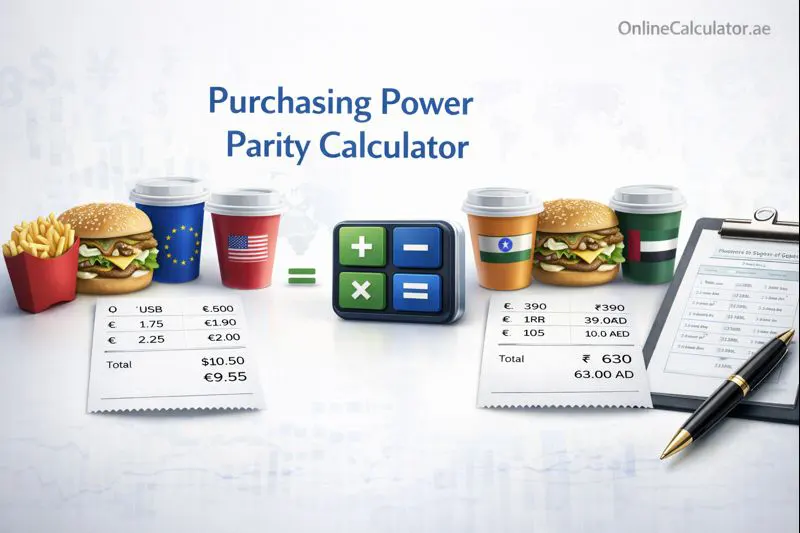
What is the Purchasing Power Parity Calculator?
The Purchasing Power Parity (PPP) Calculator is a financial tool that compares the real value of salaries and expenses across different countries. Unlike simple currency converters that use market exchange rates, PPP calculations account for the actual cost of goods and services in each location.
Here's what makes this tool valuable for UAE residents:
- Accurate salary comparison – Know what you need to earn abroad to maintain your Dubai lifestyle
- Cost of living insights – Understand how far your AED goes compared to USD, GBP, EUR, or INR
- Relocation planning – Make informed decisions before accepting job offers in other countries
- Business budgeting – Calculate fair compensation for international employees
This calculator uses data from the , the same methodology used by economists, governments, and multinational corporations worldwide. Whether you're based in DIFC, Dubai Marina, or Abu Dhabi's business districts, you'll get reliable results backed by official statistics.
html
How Does the PPP Calculator Work?
Purchasing Power Parity is based on the economic principle that identical goods should cost the same across different countries when adjusted for currency differences. The famous "Big Mac Index" from The Economist uses this exact concept—comparing burger prices worldwide to illustrate currency valuations.
The PPP Formula
The core calculation follows this methodology:
PPP Exchange Rate = Price of Goods in Country A ÷ Price of Same Goods in Country B
For salary conversions, the formula becomes:
Equivalent Salary = (Your Salary × Target Country PPP Factor) ÷ Home Country PPP Factor
Step-by-Step Process
When you use this calculator, here's what happens behind the scenes:
- Input your current salary – Enter your monthly or annual income in AED (or your home currency)
- Select source and target countries – Choose the UAE and the country you want to compare
- PPP adjustment applied – The tool retrieves current PPP conversion factors from World Bank data
- Result generated – You receive the equivalent salary needed in the target country to maintain similar purchasing power
Important Considerations
PPP calculations provide excellent guidance, but remember these caveats:
- Individual spending patterns vary—housing might be your biggest expense in Dubai but healthcare in the US
- Tax implications differ between countries (the UAE has no personal income tax, unlike most destinations)
- PPP factors are updated periodically and may not capture recent economic changes
For detailed currency conversions using real-time market rates, you can also explore our live forex rate converter.
Real-World PPP Calculation Examples
Understanding PPP becomes clearer with practical scenarios. Here are three examples relevant to UAE professionals:
Example 1: Software Engineer Moving from Dubai to London
Scenario: Ahmed works at a tech company in Internet City, Dubai, earning AED 25,000 per month. He's received a job offer in London and wants to know what salary would maintain his current lifestyle.
Calculation:
- Current salary: AED 25,000/month (AED 300,000/year)
- UAE PPP factor: approximately 2.22 (LCU per international $)
- UK PPP factor: approximately 0.72 (LCU per international $)
- Market exchange rate: 1 GBP = 4.68 AED
PPP-Adjusted Result: Ahmed would need approximately £5,800-6,200 per month (around £72,000/year) to match his Dubai purchasing power. Note this is higher than simply converting at market rates because London has higher price levels than Dubai for many goods and services.
Key Insight: A salary offer below £70,000 would likely mean a reduced standard of living despite appearing similar after currency conversion.
Example 2: Indian Professional Considering UAE Relocation
Scenario: Priya earns ₹1,200,000 per year (₹100,000/month) as a marketing manager in Mumbai. She's evaluating an offer from a Dubai media agency.
Calculation:
- Current salary: ₹100,000/month
- India PPP factor: approximately 22.88 (LCU per international $)
- UAE PPP factor: approximately 2.22 (LCU per international $)
PPP-Adjusted Result: To maintain equivalent purchasing power in Dubai, Priya would need approximately AED 9,700-10,500 per month. This accounts for the higher cost of living in Dubai compared to Mumbai.
Key Insight: While this seems modest by Dubai standards, remember that India has significantly lower price levels. If offered AED 15,000, Priya would actually gain purchasing power. For converting remittances back home, check our AED to Rupee conversion tool.
Example 3: American Expat Package Evaluation
Scenario: Michael, a finance professional from New York earning $150,000 annually, receives an offer from an Abu Dhabi investment firm. He wants to understand the real value of different package options.
Calculation:
- Current salary: $150,000/year ($12,500/month)
- US PPP factor: 1.00 (base currency)
- UAE PPP factor: approximately 2.22
- Market exchange rate: 1 USD = 3.67 AED
PPP-Adjusted Result: Michael's purchasing power equivalent in the UAE would be approximately AED 38,000-42,000 per month. However, factoring in no income tax (he pays ~30% in the US), he could accept AED 35,000 and still come out ahead financially.
Key Insight: UAE packages often include housing allowances. A base of AED 40,000 plus housing can significantly exceed his current purchasing power. Compare dollar amounts using our Dirham to Dollar calculator.
UAE-Specific Considerations
The UAE presents unique factors that impact purchasing power calculations:
No Personal Income Tax: Unlike most countries, the UAE doesn't levy income tax on individuals. This means your gross salary equals your net salary, which dramatically affects comparisons with countries like the US (up to 37% federal tax), UK (up to 45%), or India (up to 30%).
Cost Variations by Emirate: Dubai's cost of living is approximately 15-20% higher than Abu Dhabi, and significantly higher than Sharjah, Ajman, or Ras Al Khaimah. When calculating PPP, consider where in the UAE you'll be based.
Housing Market Impact: Rental costs in areas like Downtown Dubai, Palm Jumeirah, or Yas Island can heavily influence your actual cost of living. The Real Estate Regulatory Agency (RERA) maintains rental indices that can inform your budget planning.
Common Mistakes to Avoid
- Ignoring benefits packages – Many UAE roles include housing, schooling, annual flights, and health insurance worth AED 50,000-150,000 annually
- Using only market exchange rates – This can over or undervalue salaries by 20-40%
- Forgetting lifestyle differences – Household help, dining out, and domestic travel may be cheaper in the UAE than Western countries
- Not accounting for savings goals – Higher nominal salaries in the UAE often enable better savings rates for remittances
Expert Tips
When negotiating international packages:
- Request PPP-adjusted comparisons from HR departments
- Factor in at least 3-6 months of living expenses as an emergency fund when relocating
- Consider using our comprehensive Online Calculator UAE resources for related financial planning
- Review the latest cost of living data from sources like Numbeo or Mercer surveys
Start Comparing Your Purchasing Power
Use the calculator above to discover what your salary means across borders. Whether you're an expat evaluating UAE opportunities or planning your next career move abroad, understanding purchasing power parity helps you make financially informed decisions.
For additional financial planning tools, explore the full range of calculators at Online Calculator UAE. Our currency and finance tools section includes everything from real-time conversion rates to profit margin calculators.
Data sources: , World Bank PPP Indicators