 OnlineCalculator
Why Use a Tube Weight Calculator?
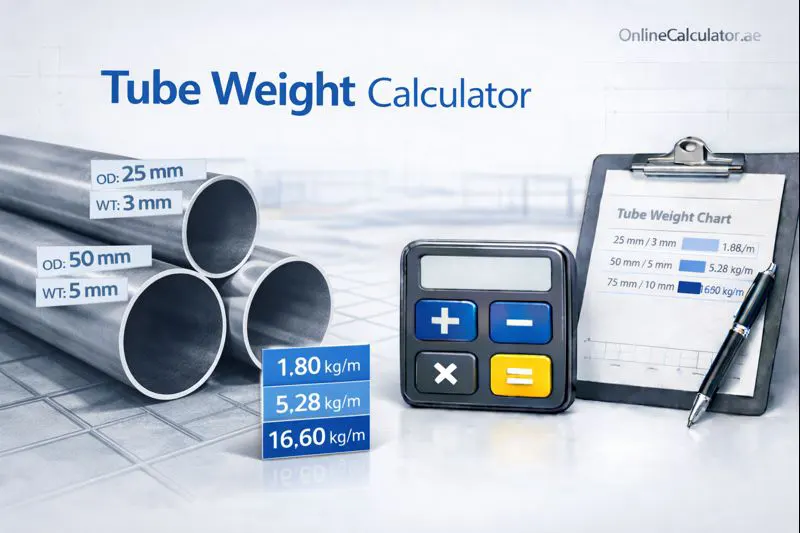
A converts a tube's dimensions — outer diameter (or width/height), wall thickness, and length — into an accurate mass figure. This matters every time you budget materials, estimate shipping costs, or verify supplier invoices. Manual calculations are error-prone, especially when you're juggling multiple alloys and profile shapes in a single project.
Here's what this tool gives you:
- Multi-shape support — round, square, and rectangular tubes in one place
- 15+ material presets — from mild steel (7,850 kg/m³) to titanium (4,507 kg/m³), plus a custom density option
- Metric & imperial output — weight per meter, per foot, or for a custom length
- Batch quantity mode — multiply by the number of pieces to get a total order weight
The formulas behind this calculator follow the same cross-section geometry used in engineering handbooks and standards such as ASTM A500 and EN 10210. Results are consistent with data published by major steel producers and verified against reference tables.
Explore more handy tools on Online Calculator UAE for a full library of free calculators covering construction, finance, health, and everyday math.
TUBE WEIGHT CALCULATOR — Advanced Widget for WordPress Elementor HTML Widget Paste this entire block into an Elementor "HTML" widget Header Unit System Toggle Shape Selector
Input Fields Dimension 1 mm Dimension 2 (rect only) mm
mm Corner Radius (square/rect) mm
mm Buttons Results Panel Material Density— Cross-Section Area— Weight per Metre— Weight per Foot— Weight per Piece— Total Weight (1 pcs)— Formula Breakdown
Core Formula
Every tube weight calculation follows the same principle: Weight = Cross-Section Area × Length × Material Density. The only thing that changes between shapes is how you compute the cross-section area.
Round Tubes
For a round (circular) tube with outer diameter D and wall thickness t:
Cross-Section Area = (π / 4) × [D² − (D − 2t)²]
This subtracts the hollow interior from the full circle to leave only the metal area.
Square Tubes
For a square tube with side length S and wall thickness t:
Cross-Section Area = S² − (S − 2t)²
Some calculators add a corner-radius correction. For standard structural sections (with small radii) the difference is typically under 2%, but our advanced calculator includes an optional corner radius field for extra precision.
Rectangular Tubes
For a rectangular tube with width W, height H, and wall thickness t:
Cross-Section Area = (W × H) − (W − 2t) × (H − 2t)
Step-by-Step Breakdown
- Select tube shape — round, square, or rectangular.
- Enter dimensions — outer diameter/width/height and wall thickness (in mm or inches).
- Choose material — pick a preset or enter a custom density.
- Set length & quantity — standard 6 m or 12 m lengths, or any custom value.
- Read the result — the calculator displays weight per unit length and total weight.
Important note: Manufacturing tolerances mean real-world weights can vary ±5% from theoretical values. Mill certificates always carry the definitive weight for commercial transactions.
Example 1 — Round Steel Tube for a Dubai Warehouse Mezzanine
A steel fabricator in Al Quoz Industrial Area needs 40 pieces of round mild-steel tube for mezzanine columns. Specs: OD 88.9 mm, wall thickness 5.0 mm, length 4.0 m each.
- Cross-section area = (π / 4) × [88.9² − 78.9²] = (π / 4) × [7,903.21 − 6,225.21] = (π / 4) × 1,678 = 1,317.9 mm²
- Convert to m²: 1,317.9 × 10⁻⁶ = 0.001318 m²
- Volume per piece = 0.001318 × 4.0 = 0.005272 m³
- Weight per piece = 0.005272 × 7,850 = 41.38 kg
- Total order weight = 41.38 × 40 = 1,655.3 kg ≈ 1.66 tonnes
The fabricator can now request freight quotes knowing the exact tonnage — critical when shipping from Jebel Ali port or arranging crane lifts on site.
Example 2 — Rectangular Aluminum Tube for Shopfront Framing
An interior fit-out company in DIFC is building brushed-aluminum display frames for a luxury retail store. They need 20 pieces of 50 × 25 mm rectangular aluminum tube, 1.5 mm wall, 3.0 m long. Aluminum density: .
- Cross-section area = (50 × 25) − (47 × 22) = 1,250 − 1,034 = 216 mm²
- Volume per piece = 216 × 10⁻⁶ × 3.0 = 0.000648 m³
- Weight per piece = 0.000648 × 2,710 = 1.756 kg
- Total = 1.756 × 20 = 35.12 kg
At under 2 kg per stick, these are light enough for manual handling — no lifting equipment needed on site.
Example 3 — Thick-Wall Stainless Steel Square Tube (Edge Case)
A marine contractor working on a Yas Island waterfront project specifies Grade 316 stainless steel square tube, 100 × 100 mm, wall 10 mm, length 6 m. Stainless 316 density: . Only 4 pieces are required, but each will be heavy.
- Cross-section area = 100² − 80² = 10,000 − 6,400 = 3,600 mm²
- Volume per piece = 3,600 × 10⁻⁶ × 6.0 = 0.0216 m³
- Weight per piece = 0.0216 × 8,000 = 172.8 kg
- Total = 172.8 × 4 = 691.2 kg
Each tube weighs nearly 173 kg — a mechanical lift or forklift is mandatory. The thick wall-to-side ratio (10 mm wall on 100 mm side = 20% of the dimension) is common in marine and offshore applications where corrosion allowance is built in.
Tolerances & Real-World Variance
Steel mills produce tubes within dimensional tolerances defined by standards like EN 10219 (cold-formed) and EN 10210 (hot-finished). Wall thickness can legally vary by ±10% on welded sections. This means a calculated weight of 40 kg could actually land between 36 kg and 44 kg off the production line. Always request mill test certificates (MTCs) with actual measured weights for high-value orders.
Common Mistakes to Avoid
- Confusing OD with nominal bore (NB) — pipe schedules list nominal bore, which is not the outer diameter. A "2-inch" pipe actually has an OD of 60.3 mm.
- Mixing metric and imperial inputs — entering mm in an inch field (or vice versa) produces results that are off by a factor of 25.4.
- Ignoring weld seam weight — ERW and spiral-welded tubes have a tiny extra mass at the seam; for most applications this is negligible, but for precision jobs it matters.
- Using wrong density for stainless grades — austenitic grades (304, 316) sit around 8,000 kg/m³, while ferritic grades (430) are closer to 7,700 kg/m³.
Tips for Procurement in the UAE
If you're ordering tube stock from suppliers in Jebel Ali Free Zone or Sharjah Industrial Area, always cross-check the quoted weight against your calculated weight. Discrepancies above 5% warrant a conversation with your supplier. For projects governed by Abu Dhabi Quality & Conformity Council (QCC) or Dubai Municipality structural codes, the engineer of record's specification takes precedence over calculator outputs.
Start Calculating Now
Scroll up and enter your tube dimensions to get an instant weight estimate. Bookmark this page for quick access the next time you're pricing materials or planning logistics. For a broader set of engineering, financial, and everyday tools, visit the computation tools homepage.
Have a suggestion or found an edge case we haven't covered? We'd love to hear from you — accurate tools are built on real user feedback.