 OnlineCalculator
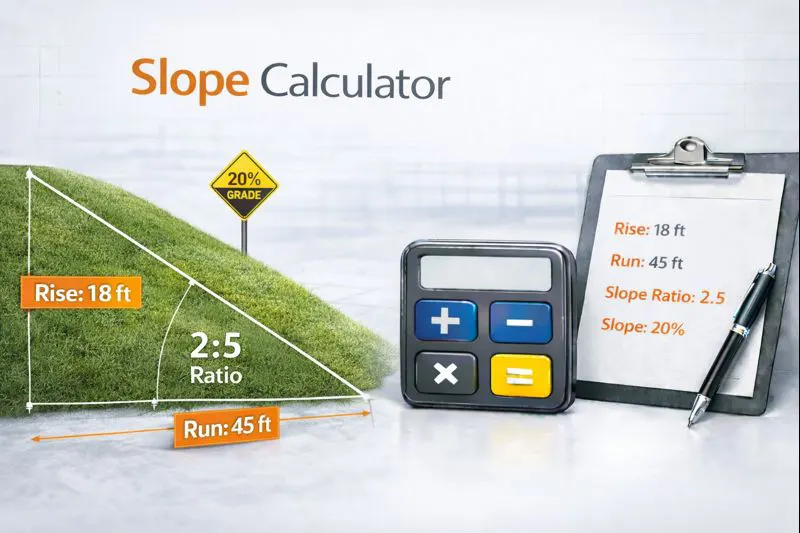
What Does the Slope Calculator Do?
A slope calculator determines how steep a line is between two points. You provide two sets of coordinates — (x₁, y₁) and (x₂, y₂) — and the tool computes the slope in every format used across mathematics, engineering, and construction. No manual formula work, no rounding errors.
Here's why thousands of users rely on this tool:
- Multiple output formats — get slope as a fraction, decimal, percentage, angle in degrees, and rise-over-run ratio all at once
- Distance calculation included — automatically computes the straight-line distance between your two points
- — see your slope plotted on an interactive coordinate plane for instant understanding
- Handles all cases — positive slopes, negative slopes, zero (horizontal), and undefined (vertical) lines
The calculations follow standard analytical geometry formulas taught in schools worldwide and applied in professional engineering. For more useful mathematical tools, explore our free online calculation tools.
ADVANCED SLOPE CALCULATOR - WordPress Elementor HTML Widget Paste this entire code into an Elementor HTML widget Mode Tabs MODE 1: Two Points MODE 2: Rise & Run MODE 3: Angle or Percentage Big slope display Cards Step breakdown
The Core Formula
Slope measures the rate of change between two points on a line. The fundamental formula is:
Slope (m) = (y₂ − y₁) / (x₂ − x₁)
This is often described as "rise over run" — the vertical change divided by the horizontal change. Here's how the calculator processes your inputs step by step:
Step 1: Calculate the rise. Subtract the first y-coordinate from the second: rise = y₂ − y₁. If you enter points (2, 3) and (8, 9), the rise is 9 − 3 = 6.
Step 2: Calculate the run. Subtract the first x-coordinate from the second: run = x₂ − x₁. Using the same points, the run is 8 − 2 = 6.
Step 3: Compute the slope. Divide rise by run: m = 6 / 6 = 1. This means the line rises 1 unit for every 1 unit it moves horizontally.
Step 4: Convert to other formats.
- Percentage slope: m × 100 = 100%
- Angle of inclination: arctan(m) = arctan(1) = 45°
- Distance between points: √(rise² + run²) = √(36 + 36) = 8.485 units
Step 5: Determine the slope equation. Using point-slope form (y − y₁ = m(x − x₁)), the calculator derives the full equation of the line: y = x + 1.
Special Cases
When the run equals zero (both x-coordinates are the same), the line is perfectly vertical and the slope is undefined. When the rise equals zero, the line is horizontal and the slope is . The calculator detects and labels these cases automatically.
Important Note
Slope direction matters. A positive slope means the line goes upward from left to right. A negative slope means it goes downward. In construction and civil engineering — including road design projects across the UAE — slope percentage is often expressed as an absolute value with the direction noted separately.
Example 1: Road Gradient Design in Abu Dhabi
A civil engineer is designing a ramp access road connecting two levels on Saadiyat Island. The road starts at elevation point (0, 0) and must reach point (50, 4) (50 meters horizontal, 4 meters elevation gain).
Rise: 4 − 0 = 4
Run: 50 − 0 = 50
Slope (m): 4 / 50 = 0.08
Percentage: 0.08 × 100 = 8%
Angle: arctan(0.08) = 4.57°
Distance: √(4² + 50²) = √(2516) = 50.16 meters
An 8% gradient is within the maximum slope typically permitted for vehicle ramps by UAE municipal road design standards. The actual road surface length (50.16m) is slightly longer than the horizontal distance due to the incline.
Example 2: Student Homework — Negative Slope
Noor, a Grade 10 student at a school in Sharjah, needs to find the slope of a line passing through points (−3, 7)(5, 1).
Rise: 1 − 7 = −6
Run: 5 − (−3) = 8
Slope (m): −6 / 8 = −0.75 or −3/4
Percentage: −75%
Angle: arctan(−0.75) = −36.87° (the line descends from left to right)
Distance: √(36 + 64) = √100 = 10 units
The negative slope tells Noor the line goes downward as you move from left to right. The line equation is y − 7 = −¾(x + 3), which simplifies to y = −0.75x + 4.75.
Example 3: Drainage Fall for a Flat Roof — Minimal Slope
A contractor in Al Ain is verifying the drainage fall on a flat commercial roof. Water must flow from point (0, 0.30) to the drain at (12, 0.18) — a very slight decline over 12 meters.
Rise: 0.18 − 0.30 = −0.12 m
Run: 12 − 0 = 12 m
Slope (m): −0.12 / 12 = −0.01
Percentage: −1% (1 cm drop per meter)
Angle: arctan(0.01) = −0.57°
A 1% fall is the minimum recommended for flat roof drainage. If the slope were any less, standing water could accumulate — a common defect flagged during building inspections in the UAE. Most building codes recommend 1–2% minimum fall to the nearest drain point.
Understanding Slope Formats
Different fields use different slope expressions. Here's a quick conversion reference:
| Format | Expression | Example (1 in 10 slope) | Common Usage |
|---|---|---|---|
| Decimal | m = rise ÷ run | 0.10 | Mathematics, physics |
| Fraction | rise : run | 1/10 | Geometry, textbooks |
| m × 100 | 10% | Roads, construction, drainage | |
| arctan(m) | 5.71° | Engineering, surveying | |
| Ratio | 1 : (run/rise) | 1 : 10 | Civil engineering, site plans |
UAE Construction Context
Slope calculations are essential in UAE construction projects. Road gradients, parking ramp angles, and stormwater drainage falls must meet municipal design guidelines. For example, Dubai MunicipalityAbu Dhabi Municipality publish design manuals that specify maximum permissible road slopes, pedestrian ramp gradients (typically 1:12 or ~8.3%), and minimum drainage fall requirements for building permits.
Common Mistakes to Avoid
- Swapping rise and run — always compute y-change first, then divide by x-change, not the other way around
- Inconsistent point order — if you use y₂ − y₁ in the numerator, you must use x₂ − x₁ in the denominator (same order)
- Confusing slope with angle — a 100% slope is not 90°; it's actually 45°. Percentage and degrees are not interchangeable
- Ignoring sign — the positive or negative sign tells you the direction of the line; dropping it loses critical information