 OnlineCalculator
Why Use a Pipe Weight Calculator?
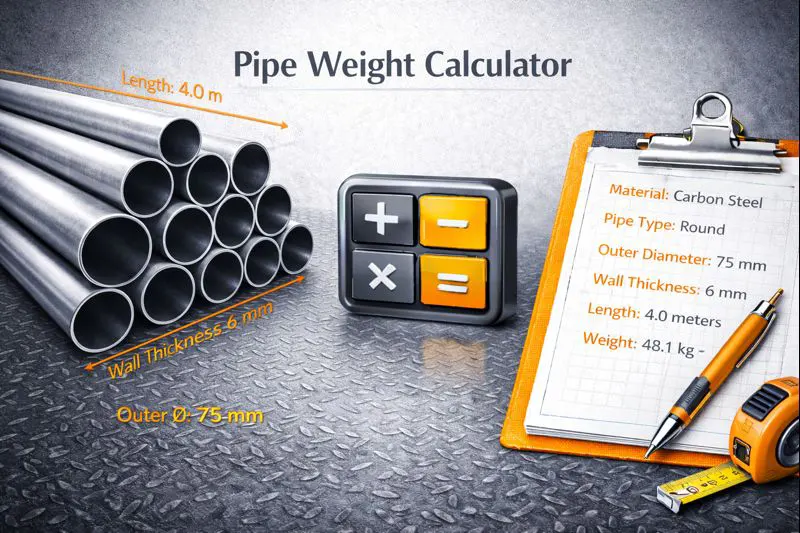
Knowing the exact weight of pipes before purchase or installation prevents costly mistakes and ensures structural safety. This calculator uses industry-standard formulas to compute pipe weight based on outer diameter, wall thickness, length, and material density.
Key benefits of using this tool:
- Instant calculations – Get pipe weight in kilograms or pounds within seconds
- Multiple material support – Steel, stainless steel, copper, aluminum, PVC, and custom densities
- Unit flexibility – Input dimensions in millimeters, inches, or centimeters
- Cost estimation – Calculate total weight for accurate pricing from UAE suppliers
Engineers, contractors, procurement managers, and DIY enthusiasts across the UAE rely on accurate pipe weight data for logistics planning, structural calculations, and material cost estimation. This calculator eliminates manual errors and saves hours of computation time.
Pipe Type Tabs Round Pipe Form mm
mm
m
▼ Square Pipe Form (hidden initially) mm
mm
m Rectangular Pipe Form (hidden initially) mm
mm
mm
m Results Section kg kg mm
How the Pipe Weight Calculator Works
The calculator determines pipe weight using a straightforward formula based on the pipe's physical dimensions and material density. Here's the calculation method broken down step by step.
The Pipe Weight Formula
The standard formula for calculating hollow pipe weight is:
Weight = π × (OD² - ID²) / 4 × Length × Density
Where:
- OD = Outer Diameter of the pipe
- ID = Inner Diameter (calculated as OD - 2 × Wall Thickness)
- π (Pi) = 3.14159
- = Material density (kg/m³)
Step-by-Step Calculation Process
Step 1: Enter the pipe's outer diameter. This measurement represents the total width of the pipe from one external edge to the other.
Step 2: Input the wall thickness. For seamless pipes, wall thickness is uniform. For welded pipes, measure at a point away from the weld seam.
Step 3: Specify the pipe length. Enter the total length of pipe you need to weigh.
Step 4: Select the material. Choose from preset options (carbon steel, stainless steel 304/316, copper, aluminum, PVC) or enter a custom density value.
Step 5: Click Calculate. The tool instantly displays the weight in your preferred unit.
Material Density Values Used
| Density (kg/m³) |
|---|
Example 1: Carbon Steel Pipe for Construction Project
A contractor in DIFC needs to order structural steel pipes for a commercial building's fire suppression system.
Given specifications:
- Outer Diameter: 114.3 mm (4-inch nominal)
- Wall Thickness: 6.02 mm (Schedule 40)
- Length: 6 meters per pipe
- Material: Carbon Steel (7,850 kg/m³)
Calculation:
Inner Diameter = 114.3 - (2 × 6.02) = 102.26 mm
Cross-sectional Area = π × (114.3² - 102.26²) / 4 = 2,043.8 mm²
Volume = 2,043.8 × 6,000 = 12,262,800 mm³ = 0.01226 m³
Weight = 0.01226 × 7,850 = 96.26 kg per pipe
For an order of 50 pipes, total weight = 4,813 kg, essential information for crane capacity and transport planning.
Example 2: Stainless Steel Pipe for Food Processing Facility
A food processing plant in Dubai Industrial City requires sanitary stainless steel piping for their new production line.
Given specifications:
- Outer Diameter: 50.8 mm (2-inch)
- Wall Thickness: 1.65 mm
- Length: 100 meters total run
- Material: Stainless Steel 316 (8,027 kg/m³)
Calculation:
Inner Diameter = 50.8 - (2 × 1.65) = 47.5 mm
Cross-sectional Area = π × (50.8² - 47.5²) / 4 = 255.4 mm²
Volume per meter = 255.4 × 1,000 = 255,400 mm³ = 0.0002554 m³
Weight per meter = 0.0002554 × 8,027 = 2.05 kg/m
Total weight = 2.05 × 100 = 205 kg
This weight data helps calculate shipping costs from European suppliers and verify delivery weights upon arrival.
Example 3: Large Diameter Aluminum Pipe for HVAC Ducting
An HVAC contractor in Abu Dhabi is installing aluminum ducting for a mall ventilation system.
Given specifications:
- Outer Diameter: 300 mm
- Wall Thickness: 3 mm
- Length: 12 meters
- Material: Aluminum (2,700 kg/m³)
Calculation:
Inner Diameter = 300 - (2 × 3) = 294 mm
Cross-sectional Area = π × (300² - 294²) / 4 = 2,799.9 mm²
Volume = 2,799.9 × 12,000 = 33,598,800 mm³ = 0.03360 m³
Weight = 0.03360 × 2,700 = 90.7 kg per section
The relatively light weight of aluminum compared to steel (same dimensions in steel would weigh 263.7 kg) makes it ideal for overhead installations where weight restrictions apply.
Manufacturing Tolerances
Actual pipe weights may vary from calculated values by ±5% to ±10% due to manufacturing tolerances. Seamless pipes typically have tighter tolerances than welded pipes. When ordering large quantities, request mill test certificates that include actual measured weights.
UAE Standards and Specifications
The Emirates Authority for Standardization and Metrology (ESMA) oversees standards for pipes used in the UAE. Common standards referenced include:
- ASTM A53/A106 – Carbon steel seamless and welded pipes
- ASTM A312 – Stainless steel pipes
- ASME B36.10/B36.19 – Pipe dimension standards
Common Mistakes to Avoid
Confusing nominal size with actual dimensions: A "2-inch pipe" doesn't have a 2-inch outer diameter. Nominal Pipe Size (NPS) is a naming convention, not an actual measurement. Always use actual measured dimensions.
Ignoring fittings and flanges: Total system weight includes not just straight pipe but also elbows, tees, reducers, flanges, and valves. These can add 15-25% to base pipe weight.
Using wrong density for alloys: Stainless steel 304 and 316 have different densities. Duplex stainless steels are heavier still. Verify the exact alloy specification before calculating.
Expert Tips
For quick estimates, memorize that 1-inch Schedule 40 carbon steel pipe weighs approximately 2.5 kg per meter. Scale proportionally for rough calculations when exact figures aren't immediately needed.
Start Calculating Your Pipe Weights Now
Enter your pipe specifications in the calculator above to get instant, accurate weight results. For commercial pipe sourcing in the UAE, leading suppliers in Jebel Ali Free Zone and Dubai Industrial City can provide certified weight data and mill test reports.
Bookmark this page for quick access during your next project, and explore our other calculation tools for more engineering solutions.