 OnlineCalculator
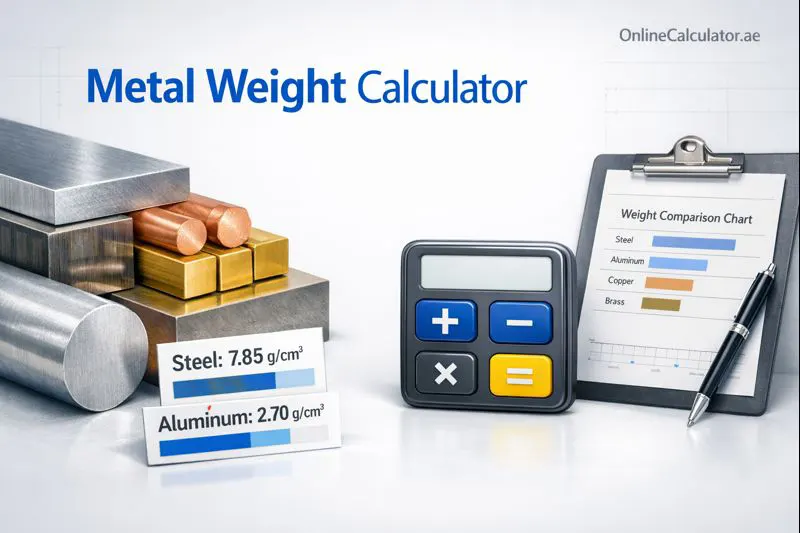
Why Use This Metal Weight Calculator?
Ordering too much material wastes money. Ordering too little stalls your project. A reliable removes the guesswork by converting your dimensions, shape, and alloy selection into an accurate weight estimate you can hand straight to your supplier or freight forwarder.
Here's what makes this tool stand out:
- 20+ metals and alloys — from mild steel and stainless 304/316 to exotic metals like Inconel and Monel.
- 10+ cross-section shapes — round bar, square bar, flat bar, hexagonal bar, round tube, square tube, rectangular tube, sheet/plate, angle, and channel.
- Multiple unit systems — switch freely between millimeters/kilograms and inches/pounds.
- Quantity multiplier — calculate the total for an entire batch in one step.
The formulas behind this calculator follow internationally recognized engineering references, giving engineers, fabricators, procurement teams, and DIY builders a trustworthy starting point for cost estimates and logistics planning. Explore more handy tools on Online Calculator UAE.
ADVANCED METAL WEIGHT CALCULATOR For WordPress Elementor HTML Widget Paste this entire code block into an Elementor "HTML" widget. MATERIAL + SHAPE Custom density field (hidden by default) Dynamic fields injected here LENGTH + QUANTITY — Total Weight (1 pcs) — — —
The Core Formula
Every metal weight calculation follows the same principle:
Weight = Volume × Density
The calculator first determines the cross-sectional area based on the shape you select, multiplies it by the you enter, and then multiplies the resulting volume by the of the chosen metal or alloy.
Step-by-Step Breakdown
Step 1 — Choose your metal. Each metal has a unique density measured in g/cm³ (or lb/in³). For example, mild steel is approximately , aluminum 6061 is about , and copper sits around .
Step 2 — Select the shape. The shape determines which geometric formula is used for the cross-sectional area. A round bar uses π × (d/2)², a square bar uses side², and a tube subtracts the inner area from the outer area.
Step 3 — Enter dimensions. Provide the outer diameter (or width and height), wall thickness for hollow sections, and total length. The calculator converts everything into consistent units before computing.
Step 4 — Set quantity. If you need 50 identical pieces, just enter 50 and the tool gives you the individual piece weight plus the total batch weight.
Important Notes
Theoretical weight can differ from actual weight by ±2–5 % depending on manufacturing tolerances, alloy variation, and surface finish. Always confirm critical weights with your supplier's mill certificates. For structural projects governed by Abu Dhabi's building codes or Dubai Municipality standards, use certified test data for final engineering calculations.
Example 1 — Mild Steel Round Bar for a Workshop in Al Quoz
A fabrication shop in Al Quoz, Dubai needs 25 pieces of mild steel round bar, each 50 mm diameter × 6,000 mm long.
Cross-sectional area: π × (25)² = 1,963.50 mm²
Volume per piece: 1,963.50 × 6,000 = 11,781,000 mm³ = 11,781 cm³
Weight per piece: 11,781 × 7.85 g/cm³ = 92.48 kg
Total batch weight: 92.48 × 25 = 2,312.0 kg ≈ 2.31 tonnes
Knowing the total weight helps the shop arrange the right flatbed truck and negotiate freight from Jebel Ali steel suppliers.
Example 2 — Aluminum 6061 Sheet for Yacht Cladding on Yas Island
A marine outfitter near Yas Marina orders 10 sheets of aluminum 6061, each 2,000 mm × 1,000 mm × 3 mm thick.
Volume per sheet: 2,000 × 1,000 × 3 = 6,000,000 mm³ = 6,000 cm³
Weight per sheet: 6,000 × 2.71 g/cm³ = 16.26 kg
Total weight: 16.26 × 10 = 162.6 kg
Lightweight aluminum sheets keep the overall vessel weight low, improving fuel efficiency — a critical factor for Yas Marina charter operators.
Example 3 — Stainless Steel 316 Pipe for a DIFC Building Cooling System
A MEP contractor working on a DIFC tower needs 40 pieces of SS 316 pipe: OD 114.3 mm, wall thickness 6.02 mm, length 6,000 mm.
Inner diameter: 114.3 − (2 × 6.02) = 102.26 mm
Cross-sectional area: π × [(57.15)² − (51.13)²] = 2,044.9 mm²
Volume per piece: 2,044.9 × 6,000 = 12,269,400 mm³ = 12,269.4 cm³
Weight per piece: 12,269.4 × 8.0 g/cm³ = 98.16 kg
Total batch weight: 98.16 × 40 = 3,926.2 kg ≈ 3.93 tonnes
SS 316 is chosen here because its molybdenum content resists chloride corrosion — essential for chilled-water systems in humid Gulf climates.
Density Varies by Alloy Grade
"Stainless steel" is not a single material. SS 304 has a density of roughly 8.0 g/cm³, while SS 430 (ferritic) is closer to . Always match the alloy grade on your purchase order to the density value used in calculations.
Mill Tolerances Affect Weight
Hot-rolled sections can be +3 % to −5 % off nominal dimensions. Cold-drawn products tend to be tighter at ±0.5 %. If weight accuracy matters for freight budgeting or crane planning, request mill test certificates (MTC) from your supplier.
Common Mistakes to Avoid
- Mixing units — entering millimeters for diameter but inches for length will produce nonsensical results.
- Forgetting wall thickness — a solid bar and a hollow tube with the same outer diameter have drastically different weights.
- Using generic density — "steel" can range from 7.75 to 8.05 g/cm³ depending on the grade. Select the specific alloy.
- Ignoring cut kerf and wastage — real projects always lose material to cutting and machining. Budget an extra 5–10 % on top of theoretical weight.
Pro Tip
When requesting quotations from UAE steel traders, share both the unit weight (kg/piece) and total weight (kg or tonnes). Suppliers in Jebel Ali Free Zone and Sharjah Industrial Area typically price per tonne, so providing tonnage speeds up the quote process.
Start Calculating Now
Scroll up and plug in your dimensions to get an instant weight estimate. Bookmark this page for quick access during procurement meetings or site visits. If you need additional engineering tools, explore our full library of free calculators designed for professionals and everyday users alike. For official UAE construction material standards, refer to the Emirates Authority for Standardization and Metrology (ESMA).
Related Tools You Might Find Useful
- Steel Bar Weight Calculator — focused rebar and reinforcement bar estimation.
- Pipe Weight Calculator — specialized for pipes with schedule thickness tables.
- Unit Converter — convert mm to inches, kg to lbs, and more.
- Construction Cost Estimator — budget materials, labor, and logistics.
- Scrap Metal Value Calculator — estimate scrap worth at current market rates.
- Looking for a break? Check out our fun entertainment calculators too.