 OnlineCalculator
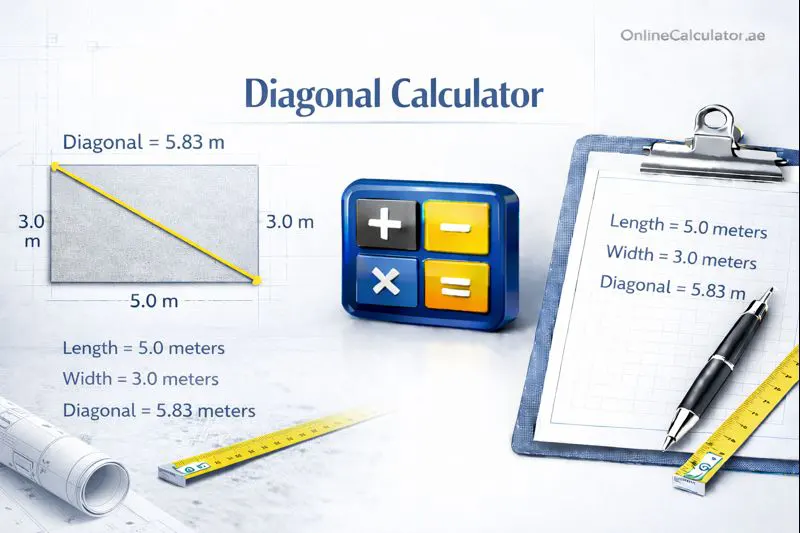
What Is a Diagonal Calculator?
A diagonal is a straight line connecting two non-adjacent corners of a shape. Finding this measurement manually requires formulas and careful calculation—but our Online Calculator UAE tool handles everything automatically.
Simply enter your dimensions, and the calculator applies the correct formula based on your shape type. The result appears instantly, complete with the formula used so you can verify the math yourself.
Key benefits of using this diagonal calculator:
- Multiple shape support – Works for rectangles, squares, cubes, and regular polygons
- Instant results – No manual calculations or formula memorization needed
- Step-by-step breakdown – See exactly how your result was calculated
- Unit flexibility – Works with any measurement unit (cm, inches, meters, feet)
This tool uses the Pythagorean theorem and standard geometric formulas trusted by engineers, architects, and mathematicians worldwide.
ADVANCED DIAGONAL CALCULATOR Compatible with WordPress Elementor HTML Widget Simply copy and paste this entire code into an Elementor HTML widget Shape Selector ▭ □ ⬜ ⬡ Input Container Rectangle Inputs cm
cm Square Inputs cm Cube Inputs cm Polygon Inputs cm Unit Selector Calculate Button Results Container Steps will be inserted here Additional results will be inserted here SVG diagram will be inserted here
How the Diagonal Calculator Works
The mathematics behind diagonal calculations depends on the shape you're measuring. Here's how each formula works:
Rectangle Diagonal Formula
For rectangles, the diagonal creates two right triangles. Using the Pythagorean theorem, the diagonal (d) equals:
d = √(length² + width²)
The calculator squares both dimensions, adds them together, and takes the square root of the sum. This method works regardless of which dimension is longer.
Square Diagonal Formula
Squares are special rectangles where all sides are equal. The simplified formula becomes:
d = side × √2
Since √2 ≈ 1.414, you can multiply any side length by 1.414 to find the diagonal quickly.
Cube Space Diagonal Formula
A cube has two types of diagonals: face diagonals (across one surface) and space diagonals (through the entire cube). The space diagonal formula is:
d = side × √3
Since √3 ≈ 1.732, multiplying the edge length by 1.732 gives you the longest diagonal through a cube.
Regular Polygon Diagonal
For regular polygons (shapes with equal sides and angles), the diagonal formula uses trigonometry:
d = side × (sin(π × k/n) / sin(π/n))
Where n = number of sides and k = which diagonal you want (k=1 for adjacent vertices, k=2 for the next, etc.).
Important notes:
- Always use the same unit for all measurements
- Results are mathematically precise to several decimal places
- For irregular shapes, you may need to divide them into regular components
Practical Examples Using the Diagonal Calculator
These real-world scenarios demonstrate how diagonal calculations apply to everyday situations.
Example 1: Finding TV Screen Size
Scenario: Ahmed in Dubai Marina wants to verify his TV's advertised screen size. The visible screen measures 111.8 cm wide and 62.9 cm tall.
Calculation:
- Formula: d = √(length² + width²)
- d = √(111.8² + 62.9²)
- d = √(12,499.24 + 3,956.41)
- d = √16,455.65
- d = 128.3 cm (approximately 50.5 inches)
Ahmed confirms his TV is indeed a 50-inch model, as screen sizes are measured diagonally.
Example 2: Construction Squareness Check
Scenario: A contractor in Abu Dhabi is building a room foundation measuring 4 meters by 3 meters. To verify the corners are perfectly square, they need to check if both diagonals are equal.
Calculation:
- Formula: d = √(length² + width²)
- d = √(4² + 3²)
- d = √(16 + 9)
- d = √25
- d = 5 meters exactly
Both diagonals should measure exactly 5 meters. If they differ, the corners aren't square and need adjustment. This classic 3-4-5 triangle is commonly used in construction.
Example 3: Shipping Box Space Diagonal
Scenario: A logistics company in Jebel Ali Free Zone needs to fit a long rod inside a cubic shipping container. The container measures 1.5 meters on each edge. What's the longest item that can fit diagonally?
Calculation:
- Formula: d = side × √3
- d = 1.5 × √3
- d = 1.5 × 1.732
- d = 2.598 meters (approximately 2.6 meters)
The longest rod that can fit diagonally through the cube is about 2.6 meters—significantly longer than the 1.5-meter edge length.
When Diagonal Calculations Matter
Diagonal measurements are critical in several professional and personal contexts:
- Screen sizes: TVs, monitors, and phones are measured diagonally
- Construction: Checking squareness of foundations, frames, and rooms
- Interior design: Determining if furniture fits through doorways at an angle
- Photography: Calculating sensor diagonal for lens coverage
- Sports: Baseball diamond measurements, boxing ring dimensions
Common Mistakes to Avoid
Mixing units: If your length is in meters and width in centimeters, convert them to match before calculating. The diagonal will be in whatever unit you used for inputs.
Confusing face and space diagonals: A cube has shorter diagonals across each face (using √2) and longer diagonals through the entire cube (using √3). Make sure you're calculating the right one.
Assuming rectangles are squares: The square formula (side × √2) only works when all sides are equal. For different length and width, always use the full Pythagorean formula.
Professional Tips
Builders and engineers often use the 3-4-5 rule to check squareness without calculators. Any triangle with sides in a 3:4:5 ratio (or multiples like 6:8:10) forms a perfect right angle.
For quick mental estimates of rectangle diagonals, the result is always between the longer side and the sum of both sides. This helps catch calculation errors.