 OnlineCalculator
How Does the Concrete Mix Calculator Work?
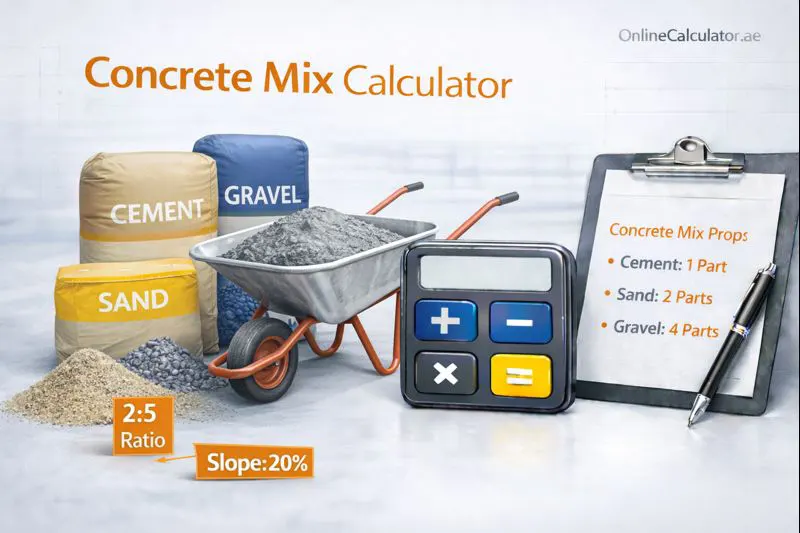
A concrete mix calculator takes your project dimensions and desired mix ratio, then computes the precise volume and weight of each ingredient you need. Instead of relying on rough estimates or "rule of thumb" methods that lead to over-ordering or weak mixes, this tool applies standard volumetric and weight-based formulas used across the construction industry.
Here's what makes this tool valuable:
- Accurate material estimates — know exactly how many bags of cement and cubic meters of aggregate to order
- Multiple mix ratios supported — from M5 lean mix to M25 structural concrete, plus custom ratios
- Waste factor included — accounts for the 5–10% material loss typical on job sites
- Cost estimation — get approximate material costs in AED so you can budget before purchasing
The calculations follow standards recognized by the American Society for Testing and Materials (ASTM) and are consistent with practices used across UAE construction projects regulated by local municipalities. For more handy project tools, explore our computation tools hub.
ADVANCED CONCRETE MIX CALCULATOR - WordPress Elementor HTML Widget Paste this entire code into an Elementor HTML widget Mode Tabs Dimension inputs Volume input (hidden by default) Mix selection Custom ratio fields Ratio display Waste & cost 💡 For UAE summer pours (June–Sept), use a 0.45 W/C ratio with chilled water and plan for early morning or evening placement to prevent rapid moisture loss. Visual proportion bar Detailed breakdown
The Core Formula
Concrete is a mixture of , fine aggregate (sand), coarse aggregate (gravel), and . The mix ratio defines the proportion of each ingredient by volume. For example, a 1:2:4 mix means 1 part cement, 2 parts sand, and 4 parts gravel.
The calculator uses this process:
Step 1: Calculate wet volume. Multiply length × width × depth of the area you're filling. For example, a slab that is 5m × 4m × 0.15m = 3.0 m³ wet volume.
Step 2: Convert to dry volume. Concrete shrinks when mixed with water. Dry ingredients occupy roughly 1.54× the wet volume (accounting for air voids and compaction). So 3.0 m³ × 1.54 = 4.62 m³ dry volume.
Step 3: Split by ratio. Using the total parts in the ratio (e.g., 1+2+4 = 7 parts), divide the dry volume to get each ingredient's share. Cement = 4.62 / 7 = 0.66 m³. Sand = 0.66 × 2 = 1.32 m³. Gravel = 0.66 × 4 = 2.64 m³.
Step 4: Convert to practical units. Cement volume is converted to bags (each 50 kg bag ≈ 0.035 m³). Sand and gravel are expressed in cubic meters or tonnes. Water is calculated using a (typically 0.45–0.60 by weight).
Step 5: Add waste factor. A percentage (usually 5–10%) is added to each quantity to cover spillage, over-excavation, and uneven surfaces.
Important Notes
The actual strength of concrete depends on aggregate quality, water purity, curing conditions, and compaction. For structural work in the UAE — especially projects requiring approvals from local building authorities — always verify your mix design with a certified engineer or ready-mix supplier.
Example 1: Residential Driveway in Arabian Ranches
Ahmed is pouring a driveway at his villa. The slab measures 6m × 3m × 0.15m and requires an M20 mix (1:1.5:3).
Wet volume: 6 × 3 × 0.15 = 2.7 m³
Dry volume: 2.7 × 1.54 = 4.158 m³
Total ratio parts: 1 + 1.5 + 3 = 5.5
Cement: 4.158 / 5.5 = 0.756 m³ → 0.756 / 0.035 = 21.6 bags (~22 bags of 50 kg)
Sand: 0.756 × 1.5 = 1.134 m³
Gravel: 0.756 × 3 = 2.268 m³
Water: 22 × 50 × 0.50 = 550 litres
With 5% waste: 23 bags cement, 1.19 m³ sand, 2.38 m³ gravel
Ahmed's estimated material cost at local UAE supplier rates: approximately AED 1,200–1,500.
Example 2: Boundary Wall Footing in Al Ain
Fatima is building a compound wall. The strip footing is 20m × 0.4m × 0.3m using an M15 mix (1:2:4).
Wet volume: 20 × 0.4 × 0.3 = 2.4 m³
Dry volume: 2.4 × 1.54 = 3.696 m³
Total parts: 1 + 2 + 4 = 7
Cement: 3.696 / 7 = 0.528 m³ → 0.528 / 0.035 = 15.1 bags (~16 bags)
Sand: 0.528 × 2 = 1.056 m³
Gravel: 0.528 × 4 = 2.112 m³
Water: 16 × 50 × 0.55 = 440 litres
With 10% waste (trench work typically has more spillage): 18 bags cement, 1.16 m³ sand, 2.32 m³ gravel. Estimated cost: AED 950–1,200.
Example 3: Small Column Repair (Low Volume)
Raj needs to repair a damaged column base at a shop in Sharjah. The volume is just 0.5m × 0.3m × 0.3m using a strong M25 mix (1:1:2).
Wet volume: 0.5 × 0.3 × 0.3 = 0.045 m³
Dry volume: 0.045 × 1.54 = 0.069 m³
Total parts: 1 + 1 + 2 = 4
Cement: 0.069 / 4 = 0.017 m³ → ~0.5 bags
Sand: 0.017 m³
Gravel: 0.035 m³
Water: 25 × 0.45 = ~11 litres
For very small volumes like this, buying pre-mixed bags is often more practical and cost-effective — typically around AED 15–25 per 40 kg bag from hardware stores across the UAE.
Mix Grade Selection
Choosing the wrong mix grade is one of the most common mistakes. Here's a quick reference:
| Mix Grade | Ratio (C:S:G) | Strength (MPa) | Typical Use |
|---|---|---|---|
| M5 | 1 : 5 : 10 | 5 | Levelling, lean base |
| 1 : 3 : 6 | 10 | Non-structural flooring | |
| 15 | |||
| 1 : 1.5 : 3 | 20 | Slabs, driveways, beams | |
| 1 : 1 : 2 | 25 | Structural columns, RCC work |
UAE-Specific Considerations
The UAE's hot climate directly impacts concrete work. During summer months (June–September), temperatures above 45°C cause rapid moisture loss. Use chilled water or ice in the mix, pour during early morning or evening, and apply curing compound immediately after finishing. The Dubai Municipality guidelines recommend special hot-weather concreting procedures when ambient temperatures exceed 35°C.
Common Mistakes to Avoid
- Adding too much water for workability — this weakens the concrete dramatically
- Using uncleaned or silt-heavy sand — always source washed aggregate
- Ignoring the waste factor — especially in trench or formwork pours
- Skipping curing — concrete needs 7–28 days of moisture retention for full strength
Start Calculating Your Concrete Mix Now
Use the concrete mix calculator above to get accurate quantities for your next project — whether it's a small home repair or a large commercial pour. The tool is free, requires no sign-up, and gives you results instantly.
For more construction and project planning tools, visit our free calculators collection. For UAE building regulations and permits, refer to your local municipality authority's official website.