 OnlineCalculator
What Is a Transit Calculator?
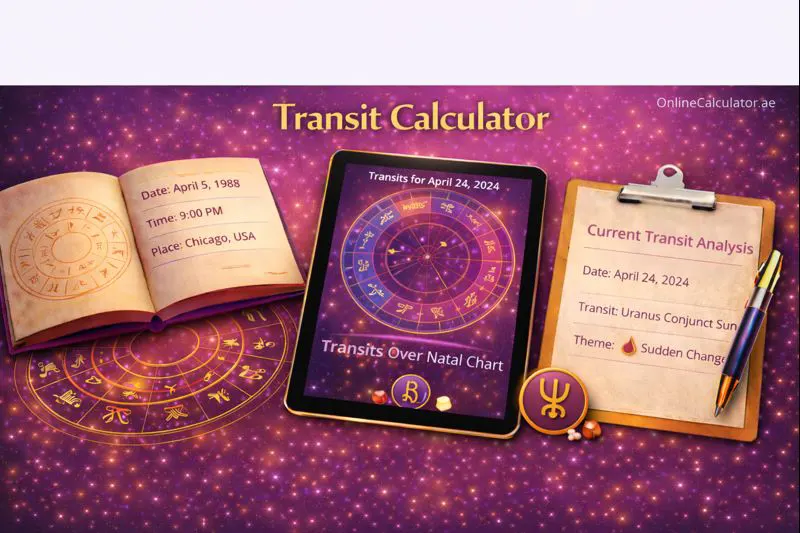
A transit calculator compares the current positions of planets in the sky with the planetary placements in your natal chart. This comparison reveals how present cosmic energies interact with your personal astrological blueprint, highlighting periods of opportunity, challenge, and transformation.
Transit astrology has guided decisions for thousands of years. When Saturn crosses your natal Moon, you might face emotional tests. When Jupiter aligns with your Venus, love and abundance could flourish. Our calculator makes these complex calculations accessible to everyone.
Key benefits of using this transit calculator:
- Instant results – Get your complete transit chart within seconds
- Personalized interpretations – Readings based on your exact birth time and location
- All major aspects covered – Conjunctions, oppositions, trines, squares, and sextiles
- Both inner and outer planets – From quick Moon transits to transformative Pluto movements
This transit calculator uses precise astronomical data combined with traditional astrological interpretation methods. For deeper cosmic insights, explore our Online Calculator UAE collection featuring various Love & Entertainment tools.
ADVANCED TRANSIT CALCULATOR WIDGET For WordPress Elementor HTML Widget Copy and paste this entire code into Elementor's HTML widget
Loading State
Results Section Chart Visual SVG wheel will be inserted here Natal Positions Natal planets will be inserted here Current Transits Transit planets will be inserted here Active Aspects Aspects will be inserted here Summary Summary will be inserted here
How the Transit Calculator Works
The transit calculator performs complex astronomical calculations to determine exact planetary positions for both your birth moment and the current date. Here's the step-by-step process:
Step 1: Calculate Your Natal Chart
Using your birth date, exact time, and location, the calculator determines where each planet was positioned at your birth. This creates your personal astrological fingerprint – your natal chart with its unique planetary placements across the twelve houses and zodiac signs.
Step 2: Determine Current Planetary Positions
The calculator uses ephemeris data (astronomical tables tracking planetary movements) to pinpoint exactly where each planet sits in the sky at your selected transit date. These real-time positions form the transit chart.
Step 3: Compare and Calculate Aspects
The tool overlays the transit chart onto your natal chart, identifying where transiting planets form significant angular relationships (aspects) with your natal planets. The main aspects calculated include:
- Conjunction (0°) – Planets occupy the same degree, merging energies intensely
- Opposition (180°) – Planets face each other, creating tension requiring balance
- Trine (120°) – Harmonious flow of energy and natural talents
- Square (90°) – Dynamic tension prompting action and growth
- Sextile (60°) – Gentle opportunities requiring conscious effort
Step 4: Generate Interpretations
Based on which transiting planet aspects which natal planet, the calculator provides personalized readings. A transiting Jupiter conjunct natal Venus produces different effects than transiting Saturn square natal Mars.
Important note: Transit accuracy depends entirely on your birth time precision. Even a few minutes difference can shift house cusps and change interpretations. If you're uncertain about your exact birth time, consider using a natal chart generator first to verify your placements.
Example 1: Career Opportunity Transit
Scenario: Fatima, a marketing manager in Dubai Marina, was born on March 15, 1990, at 2:30 PM in Abu Dhabi. She wants to know about her career transits for January 2025.
Birth data entered:
- Date: March 15, 1990
- Time: 14:30
- Location: Abu Dhabi, UAE
- Transit date: January 15, 2025
Key transit identified: Jupiter (currently in Gemini) forms a trine aspect to her natal Midheaven (career point) at 15° Libra.
Result interpretation: This Jupiter-Midheaven trine indicates a favorable 4-month window for career expansion, public recognition, or professional opportunities. The trine aspect suggests these opportunities flow naturally rather than requiring intense effort. Fatima might receive a promotion offer or attractive job proposal during this period.
Example 2: Relationship Transit
Scenario: Ahmed, a software developer working in DIFC, was born July 22, 1988, at 8:45 AM in Sharjah. He's curious about his relationship outlook for February 2025.
Birth data entered:
- Date: July 22, 1988
- Time: 08:45
- Location: Sharjah, UAE
- Transit date: February 14, 2025
Key transit identified: Transiting Venus conjunct his natal Venus at 28° Gemini, while simultaneously forming a sextile to his natal Mars.
Result interpretation: This Venus-Venus conjunction amplifies romantic energy, attractiveness, and social charm. Combined with the Venus-Mars sextile, Ahmed experiences heightened romantic magnetism. This 2-week transit window favors meeting potential partners, deepening existing relationships, or enjoying social gatherings. For more relationship insights, Ahmed could check his relationship compatibility.
Example 3: Challenging Growth Transit
Scenario: Priya, an entrepreneur launching a business on Yas Island, was born November 3, 1985, at 11:20 PM in Mumbai, India. She relocated to UAE in 2020 and checks her March 2025 transits.
Birth data entered:
- Date: November 3, 1985
- Time: 23:20
- Location: Mumbai, India
- Transit date: March 1, 2025
Key transit identified: Transiting Saturn in Pisces squares her natal Sun at 11° Scorpio.
Result interpretation: Saturn-Sun squares represent demanding periods requiring discipline and restructuring. For Priya, this suggests her business launch may face delays, require additional permits, or need structural adjustments. However, Saturn transits reward persistence – obstacles overcome during this transit often lead to lasting success. This challenging aspect lasts approximately 3 months, after which foundations become significantly stronger.
Transit Duration and Intensity
Different planets create transits of varying lengths. The Moon moves through your chart in approximately 2.5 days, while Pluto can take 2-3 years to complete a single aspect. Generally:
- Moon transits: Hours to 2 days – affect moods and daily rhythms
- Mercury/Venus transits: 1-3 weeks – influence communication and relationships
- Mars transits: 6-8 weeks – impact energy and motivation
- Jupiter transits: About 1 year – bring expansion and opportunities
- Saturn transits: 2-3 years – demand responsibility and maturation
- Uranus/Neptune/Pluto transits: Multiple years – trigger deep transformation
Common Mistakes to Avoid
Using approximate birth times: A birth time error of 15 minutes can shift your Ascendant by 3-4 degrees, significantly altering house-based transit interpretations.
Ignoring aspect orbs: Transits are strongest when exact (within 1°) and weaken as the orb increases. Our calculator uses standard orbs but tighter orbs produce more precise timing.
Focusing only on challenging aspects: Squares and oppositions get attention, but trines and sextiles bring equally important opportunities. Review all aspects for complete understanding.
Expert Tips
Track transits to your natal Moon for emotional patterns. Your lunar sign interpretation reveals how you process these emotional transits.
Pay special attention when outer planets (Jupiter through Pluto) aspect your natal Sun, Moon, or Ascendant – these mark significant life chapters.
Start Your Transit Reading Now
Enter your birth details above to discover which planetary energies are active in your life right now. Whether you're navigating career decisions, relationship questions, or personal growth, understanding your current transits provides valuable cosmic context.
For comprehensive astrological guidance, combine transit insights with your Vedic birth chart analysis or explore how your life path number interacts with current planetary cycles.
Remember: Astrology reveals potentials and timing – your choices shape outcomes. Use transit insights as one tool among many for informed decision-making.